Handmade washbasins are pieces thrown on the wheel and decorated by hand, usually in glazed ceramic, fired clay or stone, and no two units are ever identical. To choose well, look at three things before the pattern: the actual dimensions of the piece, the height at which the rim will end up and the maintenance the material calls for.
The style — floral, geometric or a single colour — is decided afterwards, and always in relation to what is already in the bathroom: the floor, the wall tiling and the light coming in. This guide follows that order: dimensions, height, material, style and care of hand-painted washbasins.

What is a handmade washbasin and how does it differ from a factory-made one?
A handmade washbasin is made one piece at a time — wheel, drying, kiln and brush — whereas a factory-made one is mass-produced from a mould and glazed automatically. What you notice once it is installed is the variation: two washbasins of the same model share a pattern, but not the exact brushwork or shade.
That is not a defect; it is the product. If you are going to fit two matching pieces on a double vanity unit, order them together and from the same batch. As the pieces are wheel-thrown, their diameter can also vary by a few millimetres, the same irregularity that is accepted in zellige or cement tiles.
How a hand-painted washbasin is made, step by step
- The clay is shaped by hand on a potter’s wheel until the final form and depth are reached.
- It is left to air-dry so that the water used to work the clay evaporates without it cracking.
- It is fired for the first time to harden the ceramic.
- It is glazed in the base colour, which is usually white.
- It is fired again to fix the glaze and seal the surface.
- The decoration is painted by hand, with all the detail of each model’s pattern.
These six stages cannot be rushed: that is what sets it apart from a basin picked out of a mass-production catalogue, and it is also why a handmade order takes time. Ask the workshop for the lead time before you fix the installation date.
What size is a handmade washbasin and at what height is it fitted?
The hand-painted washbasins in our catalogue measure 42.5 cm in diameter and 14 cm in height, with a base of about 17 cm. With a piece of this size, for the top rim to fall within the ergonomic range of 85–90 cm, the vanity unit or countertop needs to sit between 71 and 76 cm from the floor.
| Item | Measurement | Why it matters |
|---|---|---|
| Diameter of the piece | 42.5 cm | Sets the minimum countertop width; leave about 10 cm clear on each side |
| Height of the piece | 14 cm | It is added to the height of the vanity unit, not subtracted |
| Diameter of the base | approx. 17 cm | This is the surface it rests on: it must sit steady and centred over the waste outlet |
| Top rim of the washbasin | 85–90 cm from the floor | A comfortable range for most adults |
| Resulting height of the vanity unit or countertop | 71–76 cm | The reference 85–90 cm minus the 14 cm of the piece |
| Spout outlet above the rim | 3–5 cm | Prevents splashing and leaves room for your hands |
| Wall-mounted tap | 25–30 cm above the countertop | An alternative when a tall spout is visually obtrusive |

The most common mistake is to fit the vanity unit at the usual height — 85 or 90 cm — and set a 14 cm washbasin on top: the rim ends up at 99 or 104 cm and you have to lift your elbows to wash your hands. If children use the bathroom, lower the whole arrangement so that the rim sits at 80–83 cm; if the users are tall, raise it to 92–94 cm.
Before you place the order, check these four points:
- The clear space on the countertop, with the piece centred and room for the taps.
- The type of tap: a tall-spout mixer on the countertop or a tap built into the wall.
- The position of the existing waste outlet in relation to the centre of the base.
- Whether the piece has an overflow and a tap hole, or comes without them. Check with the workshop before you buy the taps.
Which material should you choose for a handmade washbasin?
For everyday use in a main bathroom, glazed ceramic is the easiest option to live with: the glaze vitrifies in the kiln, seals the visible surface and can be cleaned with neutral soap. Unglazed clay, natural stone and concrete are porous and need a water-repellent or sealer that has to be renewed every so often.
| Material | How it behaves | Measured water absorption | Maintenance required |
|---|---|---|---|
| Hand-painted glazed ceramic | The glaze seals the pores on the visible face | No specific test on the piece | Neutral soap and drying; no acids or abrasives |
| Unglazed fired clay (terracotta) | Porous by nature, warm to the touch | 16.9 % (test report no. 7539, UNE-EN ISO 10545-3) | Water-repellent essential, renewed periodically |
| Zellige, for the wall tiling around the washbasin | Hand-glazed ceramic with irregular shading | 15.7 % (test report no. 9103, UNE-EN ISO 10545-3) | Water-repellent and a grout suited to the colour |
| Natural stone (marble, granite) | Solid, heavy piece; check the load the vanity unit can bear | Not tested in our laboratory | Periodic sealing; marble is marked by acids (lemon, limescale, descalers) |
| Concrete or microcement | Matt, contemporary look | Not tested in our laboratory | Sealer; may develop hairline cracks over time |
| Factory-made porcelain | Mass-moulded, no variation between pieces | Below 0.5 % | Practically none |
The absorption figures come from the test reports on our terracotta or fired clay and zellige pieces, tested in 15×5 and 10×10 cm formats by a laboratory listed in the Register of Testing Laboratories of the Junta de Andalucía (the Andalusian regional government). They are not tests of the washbasin, but they show how each family of materials behaves: you can consult the full test reports, with their report numbers and standards.
How do you choose a design to suit your bathroom’s style?
The washbasin’s pattern is chosen to suit the floor and wall finishes you already have, not the other way round. If the floor or the wall has a strong pattern, the washbasin should take a step back; if the bathroom is neutral, the washbasin can be the piece that takes the lead.
Rustic or country-house bathroom
Earth tones work on their own. A fired clay floor, whitewashed walls and a washbasin with floral decoration in mustards and greens make a coherent scheme effortlessly. This is the territory of models such as Arahal or Brenes, with plant motifs and warm colours. Taps in brass or aged bronze finish the look nicely; shiny chrome looks out of place.
Contemporary bathroom with zellige
Zellige tiles bring texture and variation in tone without a pattern, so they can take a decorated washbasin without overloading the bathroom. A panel of zellige in bottle green, deep blue or off-white behind the washbasin catches the light differently at every hour of the day and creates the focal point; the washbasin can then be plain or have simple brushwork.
Classic Andalusian bathroom with cement tiles
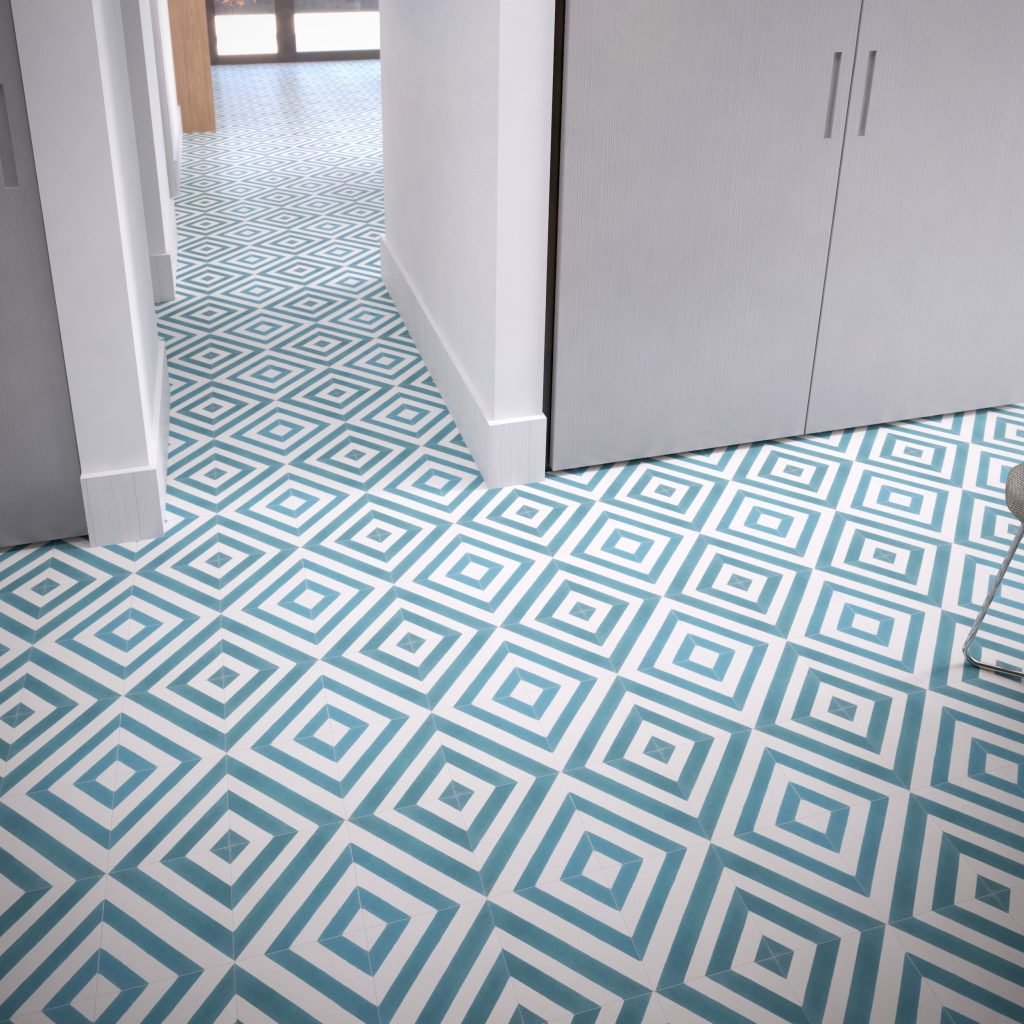
Here, geometry rules. A cement tile floor in black and white or in blues calls for a washbasin with a geometric motif and a limited palette, such as the Carmona model, in which blue predominates. If you are still deciding on the floor, our guide on how to decorate a bathroom with cement tiles will help you settle on the pattern before choosing the washbasin.
Cloakrooms and small bathrooms
A 42.5 cm round piece fits on narrow countertops, and this is where a handmade basin looks its best: it is seen in full, close up and without competing with a shower or a large piece of furniture. If the countertop is not deep enough, a wall-mounted tap frees up the centimetres the piece needs.

How do you combine the washbasin with the floor and wall tiling?
The rule that works best in bathrooms with handmade materials is to have just one statement piece: a single patterned element, with everything else playing a supporting role in plain colours or texture. From there, three combinations come up again and again in the projects we see.
Painted washbasin against a dark background
Against dark wall tiling — green, blue or black zellige — the painted piece acts as a spot of colour and gains definition. It works very well alongside organic materials: unvarnished wood, wickerwork, plants. It is the most theatrical combination and the one that copes best with a bathroom without natural light, as long as the lighting falls on the washbasin and not behind it.
Painted washbasin against a light background
With white or cream walls, the washbasin adds freshness without cluttering the room. The trick is to pick out one of the colours in the pattern and repeat it in a detail: the towels, the mirror, a border or the skirting itself. Two echoes are enough; by the third repetition, the bathroom starts to look like a sample book.
Washbasin in the same colour as the rest of the bathroom
The most understated option: the washbasin shares its colour range with the wall tiling and stands out through relief and brushwork, not contrast. It is the natural route when you are already combining two handmade materials; in our article on how to combine cement tiles and zellige in one project, we explain how to share out the roles so that neither treads on the other’s toes.

Which hand-painted washbasin models are in the catalogue?
Our washbasins belong to the Sevilla Collection and are named after towns in the province of Seville: Aguadulce, Arahal, Aznalcóllar, Cantillana, Carmona, Castilleja, Cazalla, Algaba, Casariche or Tocina. The collection’s reference size is 42.5 × 14 cm, so the pattern can be changed without rebuilding the vanity unit; check the measurement on the product page of the model you choose.


The catalogue changes over time, so the reliable reference is always the product page: the catalogue of hand-painted washbasins and handmade tiles shows the pieces available, with their code and photograph. If you are looking for a motif that does not appear there, ask before ruling it out.
How do you care for a hand-painted washbasin?
Clean it with neutral liquid soap and a sponge or microfibre cloth, then dry it with a soft cloth. What to avoid is very specific: acids, harsh descalers, chemical drain unblockers and abrasive scourers, which attack the glaze and dull the pattern.
Drying it every day is what pays off most: in hard-water areas, it is the limescale left in the bottom of the bowl that stains over time, not use. The full routine, with the recommended products and frequency, is set out in our guide to caring for and maintaining painted washbasins.
Common mistakes when choosing a handmade washbasin
- Choosing the pattern before measuring the space on the countertop.
- Adding the 14 cm of the piece to a vanity unit that is already at 85 or 90 cm.
- Putting a pattern on the floor, the wall and the washbasin all at once.
- Expecting two identical units of a hand-painted product.
- Buying the taps without knowing whether the piece has a tap hole and an overflow.
Frequently asked questions about handmade washbasins
What size is a handmade, hand-painted washbasin?
Those in our Sevilla Collection measure 42.5 cm in diameter and 14 cm in height, with a base about 17 cm in diameter. It is a size designed for countertop installation. As they are thrown by hand, there may be small variations of a few millimetres between units, so it is worth allowing some margin when you measure the space.
At what height should the vanity unit be fitted if the washbasin sits on the countertop?
As a reference, the top rim should be between 85 and 90 cm from the floor; subtract the height of the piece from that. With a 14 cm washbasin, the vanity unit or countertop sits between 71 and 76 cm. For tall users, raise the rim to 92–94 cm; if children use it, lower it to 80–83 cm.
Can a handmade washbasin stand up to daily use in a main bathroom?
Yes, if it is made of glazed ceramic and cleaned with gentle products. The vitrified glaze does not absorb water on the visible face and withstands everyday use. What does damage it are sharp knocks from hard objects and acidic or abrasive products, including many household descalers and drain unblockers.
Why are no two handmade washbasins the same?
Because each piece is thrown, glazed and painted by hand, one at a time. The brush does not repeat the stroke with millimetre precision, and the kiln does not give exactly the same shade in two firings either. That variation is the product’s signature: if you need two matching pieces, order them from the same batch.
Are there handmade washbasins in concrete or stone?
Yes, you can find them on the market, as well as others in marble, granite or microcement. We work with hand-painted glazed ceramic. The practical difference lies in maintenance: concrete, microcement and stone are porous and need their sealer renewing, whereas ceramic glaze needs nothing more than neutral soap.
Can a handmade basin be fitted in a very small cloakroom?
Yes, and it is often where it works best: in a guest cloakroom, the piece is seen in full and from close up. Check the depth of the countertop, because a 42.5 cm diameter needs about 50 cm to sit comfortably, and avoid having a pattern on the floor and the wall as well. In a small space, one statement piece is enough.
Once you are clear on the measurements, the next step is to see the pieces in person and compare the pattern with your floor and wall tiling. Through the contact page, you can arrange a visit to the showroom, by appointment at our workshop in Seville, or ask us about models, lead times and availability.