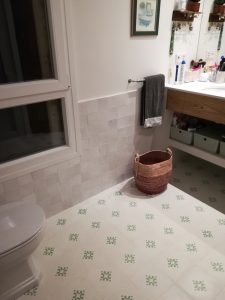
Zellige is a glazed clay tile, fired and hand-cut in Morocco, with irregular edges and an uneven sheen. Zellige tile ideas for the home don’t have to mean renovating the whole house: it is enough to concentrate the zellige on a single surface — a kitchen splashback, a shower, the wall behind the washbasin, a fireplace recess or a cabinet front — and let the light do the rest.
Here are the ideas that work best room by room, which zellige tile format suits each one, how much it weighs per square metre and what the laboratory tests say.
What is zellige, and why does it make such a difference to a room?
It is a glazed ceramic tile made one piece at a time: clay shaped by hand, dried, fired, glazed, fired again and cut by hand into its final shape. In Arabic, zellige means “small polished stone”, and that sequence of manual steps explains what you see on the wall.
A mass-produced tile gives a flat, uniform reflection. Zellige does not: each piece has its own curvature, a spot where the glaze pools more thickly and its own shade, so the same wall looks different in the morning and in the afternoon light. That movement is the real reason people choose it; for the full story, see our article on the artisan process of making zellige.

Its technical nature determines where it can go. Zellige is ceramic: it is tested to the UNE-EN ISO 10545 series (the Spanish edition of EN ISO 10545) and classified under UNE-EN 14411. Cement tiles and terrazzo, on the other hand, are not fired but left to set, and they are tested as concrete tiles (UNE-EN 1339). Comparing their data sheets without bearing this in mind leads to the wrong conclusions.
What the laboratory tests say
Our glazed zellige was tested on 100 × 100 × 12 mm pieces (test report no. 9103, sample taken on 28/05/2024, Elabora laboratory, registration no. AND-L-155). Two results matter most: an average water absorption of 15.7 % (UNE-EN ISO 10545-3) and visible abrasion defects at 750 revolutions, which means class 3 (UNE-EN ISO 10545-7).
| Material | Water absorption (E) | Method | What it means at home |
|---|---|---|---|
| Glazed zellige 10 × 10 cm | 15.7 % | UNE-EN ISO 10545-3 | Porous: yes on walls; on floors only in small, dry areas |
| Terracotta 15 × 5 cm | 16.9 % | UNE-EN ISO 10545-3 | Always needs a water repellent |
| Hydraulic terrazzo 20 × 20 cm | 5.9 – 6.2 % | UNE-EN 13748-1 | Suitable for flooring |
| Porcelain tile (market benchmark) | Less than 0.5 % | UNE-EN ISO 10545-3 | The opposite extreme: no porosity and no craftsmanship |
In plain terms: zellige is a material for walls and for surfaces that are not walked on every day. The full test reports are on our laboratory tests page.
Where does zellige look best indoors?
On any vertical surface you want to turn into the focal point of the room. These are the five areas where it performs best.
The kitchen splashback
The strip between the worktop and the wall units is the prime spot: a continuous surface at eye level that catches raking light for most of the day. With wooden units and a pale stone worktop, a splashback in off-white or smoky grey lifts the whole kitchen without shouting; if you want it to take centre stage, a forest green or a petrol blue steals the show. And it copes with a real working kitchen: water and grease come off with neutral soap.
The shower, the washbasin and half-height tiling
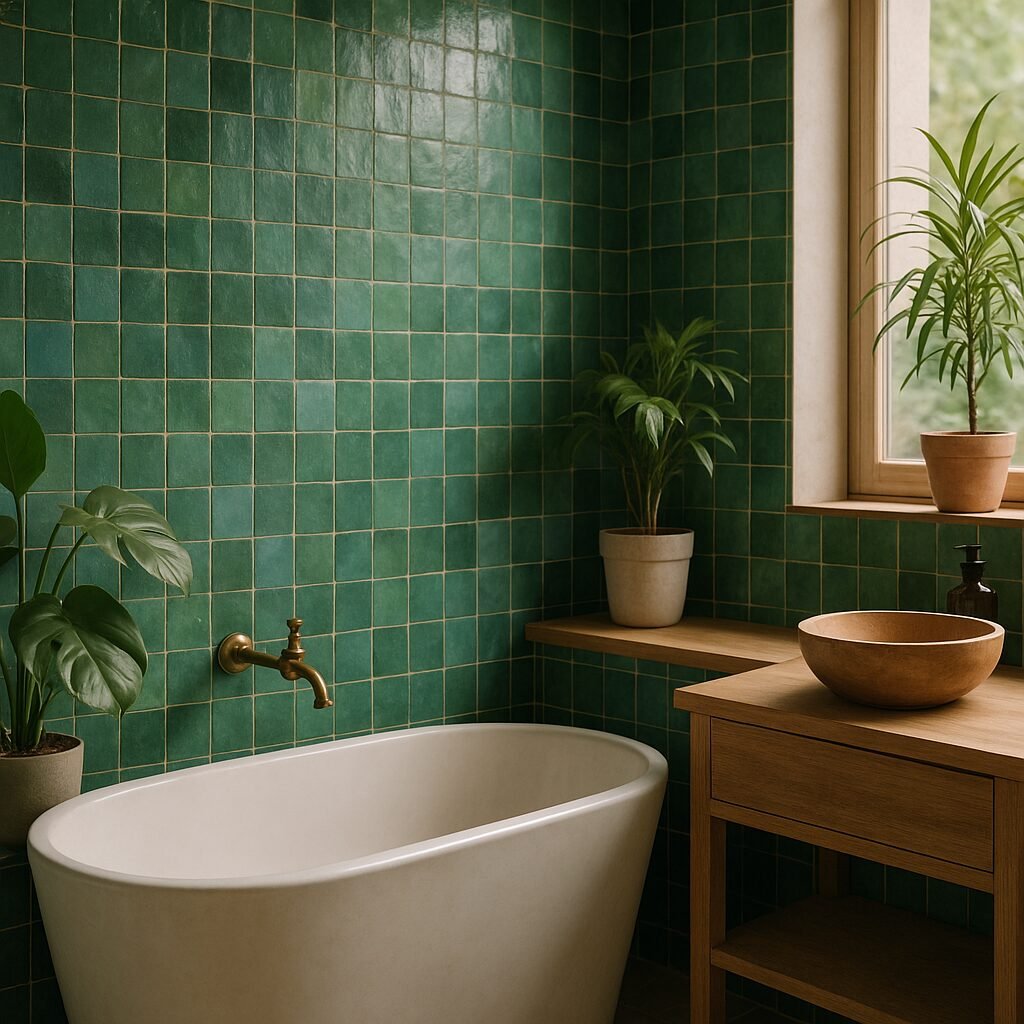
In the bathroom there are three safe options: tiling the whole shower, putting zellige only on the wall behind the washbasin, or taking it up to half height like a tall dado. The third uses the least material and does the most to transform an old bathroom. That irregular sheen against black or gold taps is the contrast that works best.
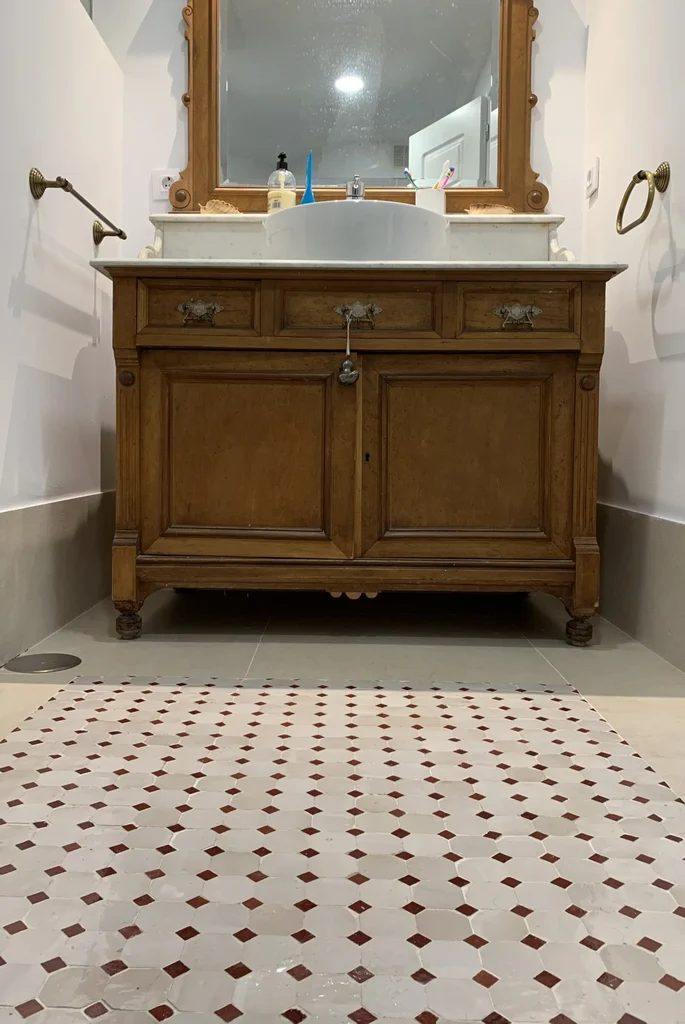
The fireplace, the stove and living-room niches
A fireplace recess or the wall behind a stove is a small, highly visible surface that nobody walks on: the perfect setting. Zellige is fired ceramic and handles heat well, but the adhesive and grout must be rated for high temperatures, and you need to respect the clearances set by the appliance manufacturer, as we explain in our article on zellige for fireplaces and stoves. The same logic applies to a niche or the back of built-in shelving.
Entrance hall, corridor and stair risers
In the entrance hall it works as a dado or as a panel behind the hall console. On a staircase, the riser — the vertical face of each step — is the ideal place: you see it head-on as you go up, nobody steps on it, and it can take a single flat colour or a gradation of tones from one step to the next.
The bedroom headboard
A panel as wide as the bed and 90 to 120 cm high replaces the headboard and adds texture without overloading the room. With 5 × 5 cm pieces in light tones, the sheen changes with the bedside lamp.
Which zellige format should you choose for each idea?
Format matters more than colour: the smaller the piece, the more joints there are and the more texture the whole surface has; the larger it is, the cleaner it looks. These are the formats most often used indoors, with the weight per square metre calculated from the actual weight of each piece.
| Format | Ref. | Size | Weight/pc | Pcs/m² | Approx. weight/m² | Best suited to |
|---|---|---|---|---|---|---|
| Mjeddij | ZS01 | 15 × 15 × 1.6 cm | 0.3 kg | 45 | 13.5 kg | Large wall areas and splashbacks |
| Mjeddij | ZS02 | 10 × 10 × 1 cm | 0.16 kg | 100 | 16 kg | Bathrooms, kitchens, fireplaces |
| Mjeddij | ZS03 | 5 × 5 × 1 cm | 0.05 kg | 400 | 20 kg | Niches, headboards, curves |
| Bejemat | ZS11 | 30 × 10 × 1.8 cm | 1 kg | 34 | 34 kg | Tall walls and dados |
| Bejemat | ZS12 | 20 × 10 × 1.8 cm | 0.6 kg | 50 | 30 kg | Kitchen splashbacks and half-height tiling |
| Bejemat | ZS15 | 15 × 5 × 1.5 cm | 0.18 kg | 134 | 24 kg | Small bathrooms and herringbone |
| Chakar | ZS31 | 12 × 11 × 1 cm | 0.13 kg | 135 | 18 kg | Geometric accent walls |
| Darj | ZS51 | 10 × 10 × 1 cm | 0.08 kg | 200 | 16 kg | Borders and compositions |
| Kora 6 | ZS61 | 14 × 12.2 × 1 cm | 0.3 kg | 78 | 23.4 kg | Decorative panels |
The pieces-per-square-metre figures are approximate: each piece is irregular and the joint width shifts the result. The full list is on our zellige formats page; a common elongated format for bathrooms is the 15 × 5 cm Bejemat.

Can zellige be used on furniture and other surfaces?
Yes. Two or three square metres are enough to transform a whole piece of furniture. The key is to choose surfaces that will not take cuts or direct knocks.
- Side table tops, occasional tables and consoles: overhead light multiplies the reflections in the glaze.
- Ledges, shelves and the backs of bookcases: they are seen head-on and use little material.
- Vanity unit fronts and bath panels: they round off the scheme if the wall is already in zellige.
- Headboards and built-in masonry benches: large vertical surfaces where the small format comes into its own.
- Columns and curved surfaces: with small pieces, flexible adhesive and precise cuts; it is slow work and calls for a tiler experienced with handmade tiles.
Before cladding a piece of furniture, check two things. Weight: zellige adds between 13 and 34 kg per square metre, plus the adhesive, and the structure has to carry it. And use: on a kitchen worktop the joints suffer far more than on a coffee table, so for everyday food preparation stone or wood is the better choice, with the zellige on the vertical splashback.
How do you combine zellige with wood, marble and cement tiles?
Zellige brings gloss and irregularity, so whatever sits next to it should bring the opposite: something matt and continuous. With marble or pale stone it works if the veining is subtle, because two stars side by side cancel each other out.
With wood: gloss against matt
It is the safest combination. The palettes match on their own: the earth tones, botanical greens, deep blues and warm whites of zellige go naturally with the honey, amber and chocolate tones of oak or walnut. An off-white splashback above wooden units is more interesting than the same kitchen in plain white, simply because of the way the light moves.
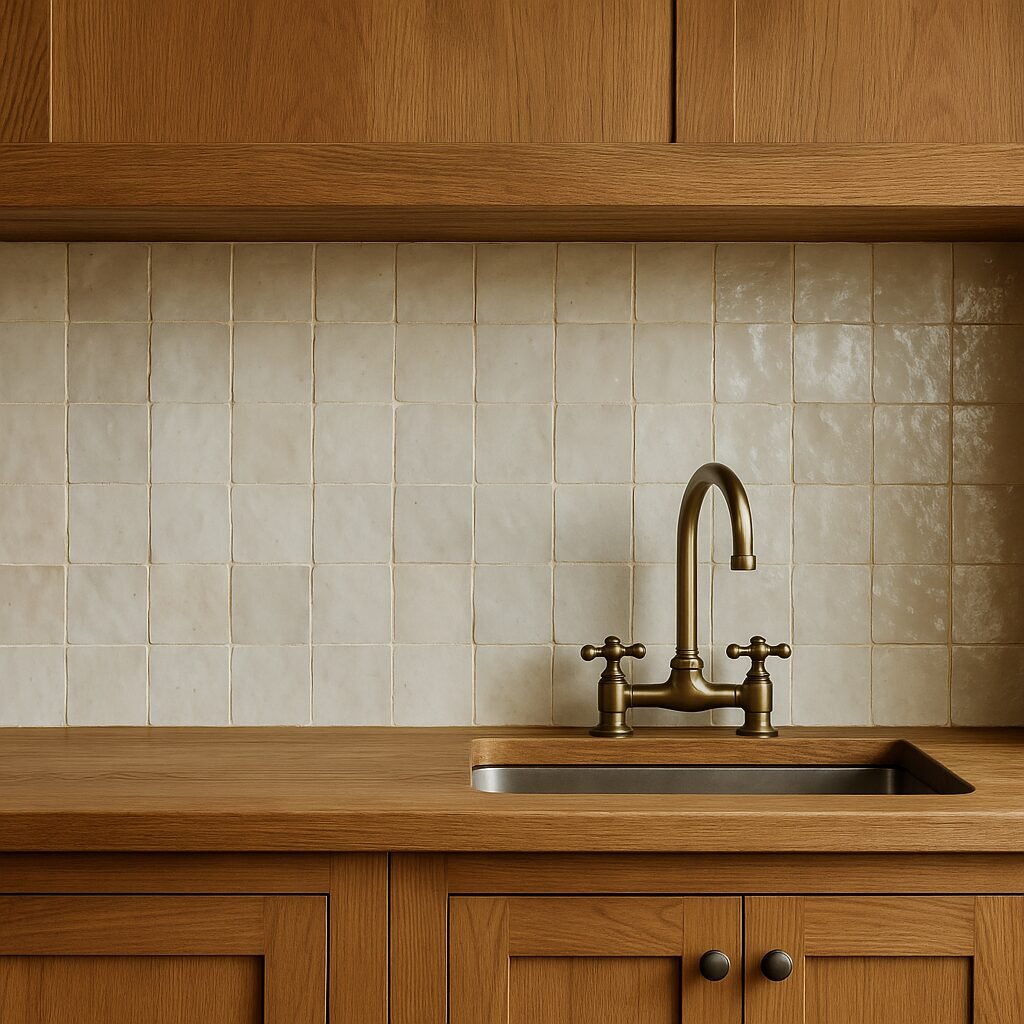
With cement tiles
It works by sharing out the roles: the cement tile floor provides the pattern and the zellige wall the gloss, or the other way round, with a plain floor and a patterned wall. If the floor is patterned, the zellige goes in a single flat colour. We go into this in our guide to combining cement tiles and zellige in one project.
Does zellige work in small flats or rooms with little light?
It works especially well, and for a physical reason: the glossy glaze reflects light and spreads it around instead of absorbing it. A windowless bathroom of three square metres or a narrow kitchen feels more spacious; a matt tile in the same place deadens the room.
With little natural light, pale tones — warm white, sand, beige, sage green, sky blue — are the safe bet. Dark colours are not off-limits: a cloakroom in cobalt blue with neutral sanitaryware gains depth, but it tolerates no rivals, so the rest of the room has to stay quiet.
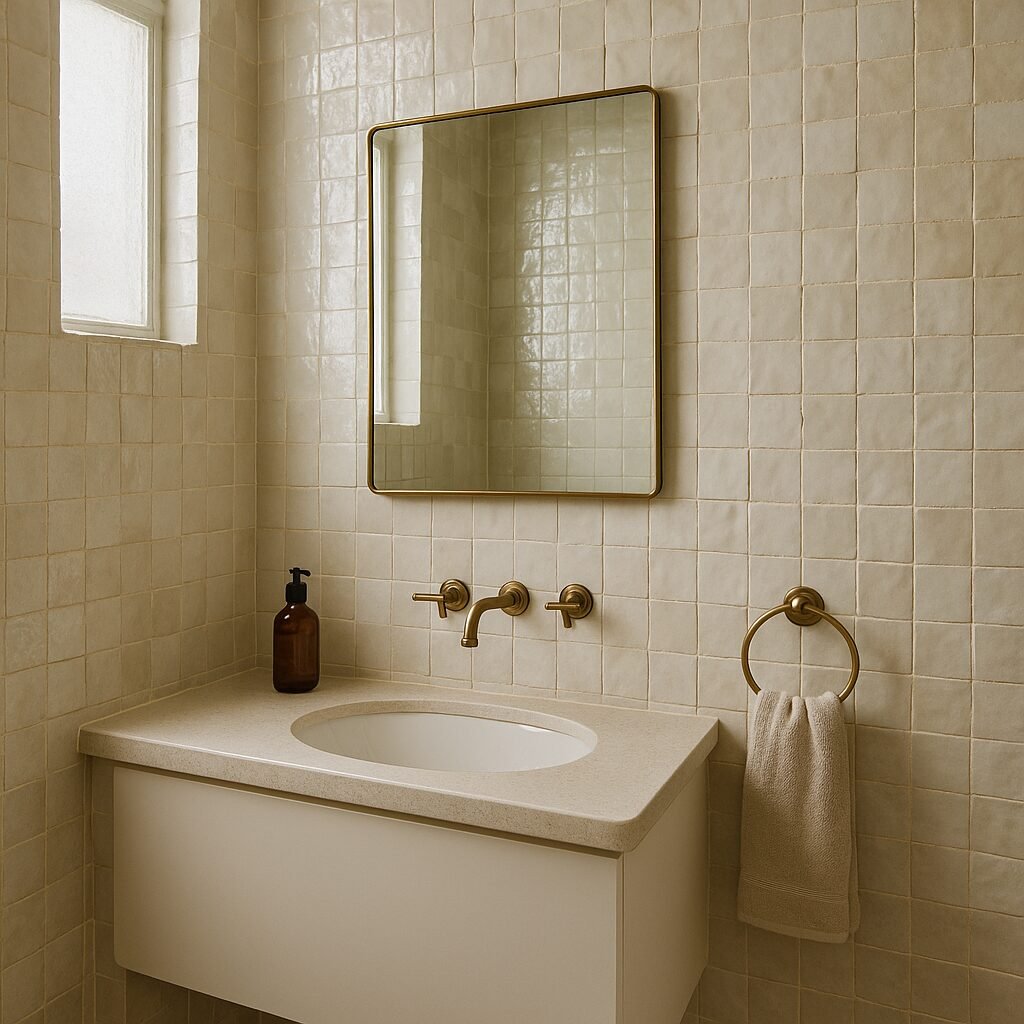
Three key decisions: a small piece and a narrow range of tones, a continuous surface (better one whole wall than three separate patches) and a joint the same colour as the tile or a shade lighter, so that the grid does not break up the view.
Earth tones and biophilic design
Much of zellige’s current appeal comes from the trend for bringing nature indoors: earthy colours, leafy greens and deep blues alongside wood, natural fibres and plants. Zellige fits the trend like a glove, because these are the traditional colours of Moroccan glazes; you can see them in the zellige colour chart.
How do you plan a zellige project, step by step?
Zellige is not bought like a mass-produced tile. These steps help you avoid the most common disappointments.
- Measure the actual area section by section and note where it meets joinery, sockets and taps.
- Choose the format before the colour: first decide how much texture you want.
- Work out the number of pieces using the pieces per square metre in the table, and add finishing and edge pieces.
- Order more material than the measurements call for: there are cuts and rejects, and it is wise to keep spares from the same batch for repairs. Confirm the quantity with the workshop.
- Ask for a physical sample and look at it at home at different times of day: a screen cannot reproduce the glaze.
- Mix pieces from several boxes before fixing, so that the variation in tone is spread out and does not form patches.
- Do a dry layout, especially for herringbone, gradients or geometric compositions.
- Choose the grout and joint colour without rushing: nothing changes the final result more.
Mistakes we see again and again
- Expecting identical pieces: zellige varies in colour, shape and size, and that is the reason to buy it.
- Leaving joints too wide: zellige calls for fine joints and is laid almost butt-jointed.
- Using a dark grout on a glaze with crazing without first testing it on a loose piece.
- Cleaning with abrasives or strong acids, which attack the joints and dull the glaze.
- Laying it on a floor with constant foot traffic, such as a corridor or the entrance.
Grout deserves a chapter of its own, because with zellige it doesn’t just fill the joint: it draws. We cover it in our guide to grout for zellige.
Frequently asked questions about zellige indoors
Can zellige be laid on floors at home?
Only in small, dry areas without constant foot traffic. Its abrasion class 3 (UNE-EN ISO 10545-7) corresponds to rooms in normal use, not to kitchens, entrances or corridors. Our test reports include no slip-resistance test on zellige: the pendulum requires an area of 124 × 76 mm, and small pieces have to be tested on a sample that has already been laid. For floors, choose cement tiles or terrazzo.
How much extra zellige should you order?
Always more than the measurements suggest. Because each piece is cut by hand, some are lost to breakage and cutting, and herringbone patterns or finishing pieces use extra. It is wise to keep a few pieces from the same batch in case something needs repairing years later. Check the quantity with the workshop.
Does zellige stain on a kitchen splashback?
The visible face is glazed and does not absorb grease or water; the weak point is the joint. Neutral soap and a cloth are all it needs. Avoid abrasives, wire scourers and strong acids, which dull the glaze and erode the grout, and wipe off oil splashes promptly.
Which zellige colour makes a small space look bigger?
Light, warm tones: off-white, sand, beige, sage green or sky blue. They reflect more light and blur the boundaries of the room. A dark colour works in a cloakroom or a niche, but it adds depth, not space. With little natural light, go for pale colours and a continuous surface.
Can zellige withstand the heat of a hob or a fireplace?
Yes. It is kiln-fired ceramic and copes well with the heat on a kitchen splashback or around a fireplace. What matters is the system: adhesive and grout suitable for high temperatures, and respecting the safety clearances specified by the appliance manufacturer.
Why are no two pieces of zellige the same?
Because each piece is moulded, glazed and cut by hand, and the glaze reacts differently depending on where it sits in the kiln. Within the same product reference there is variation in tone, gloss and size, with irregular edges. That is why the boxes are mixed before laying: the variation, spread across the surface, is what creates the effect.
If you have already settled on one of these zellige tile ideas, the next step is to see the material in person: choose a range and ask for a sample so you can look at it in the light of your own home. You can start with our catalogue of zellige in stock and check availability with the workshop.