Moroccan tile is the generic name for the glazed ceramic that is cut by hand in Morocco, and zellige is its best-known variety. Traditional Moroccan tiles are told apart by format, and each one has its own Arabic name: bejmat the rectangle, mjeddij the square, kora the hexagon or the octagon. That name decides the sizes and how many pieces fit into a square metre.
This guide is the map of those formats: what each one is called, how big it is and how many pieces you need. If what you are after is the material itself, its glazes and its finishes, that is in our zellige tiles section; if you are looking for ideas room by room, in the zellige photo gallery.
What exactly is a Moroccan tile?
It is an umbrella term, not a specific product. Different things are sold under that label: glazed zellige, unglazed bejmat clay, hand-painted tiles and industrial stoneware that imitates all of them.
- Zellige (from the Arabic zellij, the same root that gave Spanish its word for tile, azulejo): fired clay, glazed piece by piece and cut by hand. It is the material.
- Bejmat: in the Spanish market, the elongated rectangular format, the one that traditionally paved the houses and courtyards of Fez. It is the shape, not the material.
- Mjeddij: the square format, from 3 × 3 to 15 × 15 cm. This is the zellige most people recognise on kitchen splashbacks and bathroom walls.
There is a frequent confusion: some suppliers call the unglazed clay rectangle “bejmat” and reserve “zellige” for the same rectangle glazed. The nomenclature is not standardised, so the useful question is not what it is called but whether the piece is glazed or bare: the treatment and the maintenance depend on that.
Which traditional zellige formats exist, and how many pieces go into a square metre?
Nine families, twenty-five references and a range that runs from 34 to 1,111 pieces per square metre. That figure — pieces per square metre — is what shapes a Moroccan tile budget most, because it sets both the material you buy and the hours it takes to lay it. In our catalogue, bejmat is spelled “bejemat”.
| Family | Shape and thickness | References and sizes (cm) | Pieces / m² | Typical use |
|---|---|---|---|---|
| Mjeddij | Square, 1–1.6 cm | ZS01 15×15; ZS02 10×10; ZS03 5×5; ZS04 3×3 | 45; 100; 400; 1,111 | Bathrooms and kitchen splashbacks |
| Bejemat | Elongated rectangle, 1–1.8 cm | ZS11 30×10; ZS12 20×10; ZS13 15×7.5; ZS14 20×5; ZS15 15×5; ZS16 10×5 | 34; 50; 89; 100; 134; 200 | Indoor floors and wall tiling |
| Nzik | Diamond, 1 cm | ZS21 14.5×8.5 | 168 | Zigzag patterns |
| Chakar | Cut-out, interlocking, 1 cm | ZS31 12×11; ZS32 10×9; ZS33 5×5 | 135; 200; 800 | Continuous pattern |
| Fekroun | Lobed, interlocking, 1 cm | ZS41 11.7×10; ZS42 5.7×4.7 | 155; 747 | Continuous pattern |
| Darj | Cut-out, interlocking, 1 cm | ZS51 10×10; ZS52 5×5 | 200; 800 | Mosaics and plates |
| Ders | Cut-out, interlocking, 1 cm | ZS71 10×10; ZS72 5×5 | 228; 910 | Mosaics and plates |
| Kora 6 | Hexagonal, 1 cm | ZS61 14×12.2; ZS62 11×9.6; ZS63 5×4.5 | 78; 120; 593 | Floors and honeycomb layouts |
| Kora 8 | Octagonal, 1.5 cm | ZS81 10×10; ZS82 5×5 | 100; 400 | Geometric panels |
Thickness counts too: it runs from 1 cm in the small pieces to 1.8 cm in the large bejmat, and it conditions the junctions with joinery and the finished floor level. The weights and the downloadable list are on our zellige formats page.
How to work out the pieces you need
- Measure the net surface you are going to cover, deducting openings.
- Multiply it by the pieces per square metre of the chosen format: 4 m² of 15 × 5 cm bejmat come to 536 pieces; those same 4 m² in 15 × 15 mjeddij are covered with 180.
- Add the margin for cuts and breakages that whoever lays it advises you — with hand-cut ceramics around 10 % is set aside — and order it all at once and in the same colour: an artisan glaze does not repeat the exact shade from one firing to the next.
What is bejmat and how does it differ from square zellige?
Bejmat is the elongated rectangular format of Moroccan tile, with proportions from 2:1 to 4:1 and thicker than the rest. It was born as a floor tile, and that explains its 1.8 cm thickness in the large references against the bare centimetre of the small pieces.
It is made in six sizes, from the ZS16 at 10 × 5 cm and the ZS15 at 15 × 5 cm to the ZS11 at 30 × 10 cm, the largest single piece in the range. The jump changes how the wall reads: 34 pieces per square metre give long lines; 200 turn the wall into a weave.
Common bejmat bonds
- Half bond, with the joint offset by half a piece: the classic, and the one that generates the fewest cuts.
- Vertical, standing on the short side: it stretches the height of a small bathroom.
- Herringbone: the most striking and the one that produces the most waste, because the perimeter has to be cut on the diagonal.
- Stack bond, with the joints aligned: it reinforces the horizontal in long kitchen splashbacks.

What shapes are there beyond the square and the rectangle?
Six more families, all with the same logic: pieces that interlock with each other without cutting on site. The kora 6 hexagon, the kora 8 octagon and the nzik diamond are recognisable geometries; chakar, fekroun — tortoise, in Moroccan Arabic — darj and ders are cut-out outlines that only draw a pattern once the panel is assembled.
The pieces per square metre give that geometry away: a 10 × 10 cm darj does not cover 100 cm². It takes 200 pieces per square metre, so each one occupies half of its bounding square; ders, with the same nominal size, needs 228, and at 5 × 5 cm it reaches 910.
The smaller the piece, the more joint there is per square metre and the more the grout colour weighs: from 5 × 5 cm down, the joint stops being a construction detail and becomes half the pattern.


What is the difference between a single piece, a plate and a border?
They are three ways of buying the same material, and they decide who makes the pattern: with the single piece it is the tiler, on the wall; with the plate and the border it comes resolved from the workshop. Hence the answer for anyone searching for a “large zellige plate”: what is sold as a panel is not a bigger piece but a composed mosaic.
| Way of buying | What it is | How it reaches the site | Where it fits |
|---|---|---|---|
| Single piece (ref. ZS) | Individual tile in one colour, with its format and its thickness | Loose, by the square metre or by units | Bathroom wall tiling, kitchen splashbacks and indoor floors |
| Mosaic plate (ref. ZP) | Geometric composition assembled from pieces cut by hand one by one | In ready-composed panels, with the pattern already resolved | Niches, patterned dados and washbasin surrounds |
| Border (ref. ZCF) | Finishing strip with a motif that repeats along its length | In assembled strips, ready to lay in a line | Dado top rails and door or mirror frames |
| Carved zellige | 10 × 10 cm piece with the pattern carved into the glaze itself | Piece by piece, like loose zellige | Continuous patterned panels, without cutting the material |
The zellige plates bring together the classic mosaics — khatim kmar, muthaman, mdoudad, ankboutiya — and are the practical way to take Moroccan geometry to a specific surface. The panel sizes vary from one model to another: it is worth confirming them before planning the setting out.

Arab borders do another job: they do not cover a surface, they finish it. They crown a dado, mark a line in a courtyard or frame a mirror, and they pay off best when the rest of the wall is plain. The motifs are in zellige borders.

What is carved zellige and why is it not the same as mosaic?
Carved zellige is a 10 × 10 cm square piece on which the pattern is carved by hand, removing glaze until the terracotta shows through; the contrast between glaze and clay is the whole effect. In mosaic, by contrast, the pattern comes from cutting and assembling different pieces.
The practical difference is on site: carved tiles are laid like any 10 × 10 wall tiling, piece by piece and with a continuous joint, whereas mosaic requires the composition of the panel to be respected. The models are named after villages in Córdoba — Adamuz, Lucena, Montoro, Zuheros — and are in the carved zellige range.
How do you tell handmade zellige from an industrial imitation?
By the catalogue of formats before the photograph. The stoneware that imitates zellige is made in calibrated pieces, almost always square or rectangular. Three quick checks:
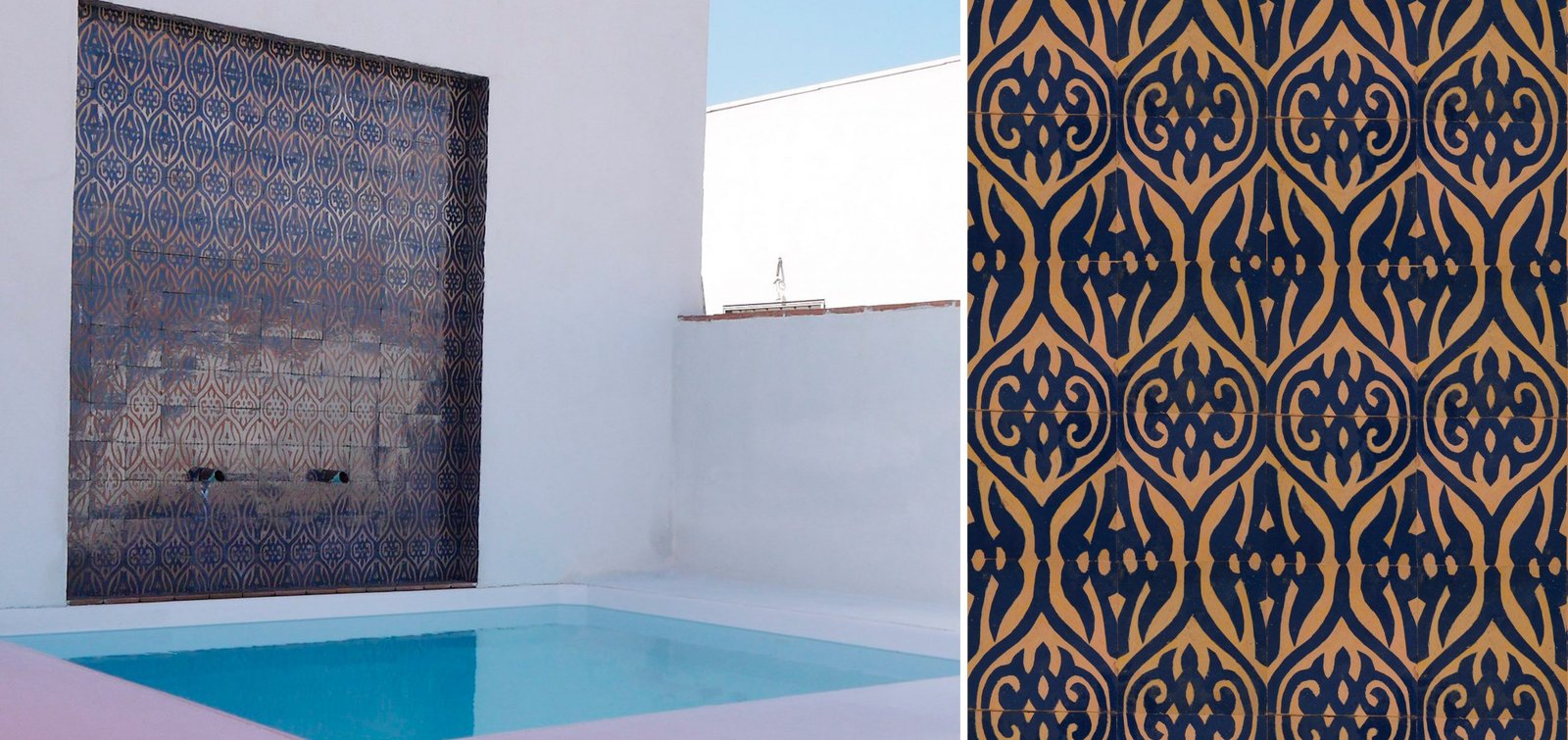
- The geometry. Chakar, fekroun, darj, ders, nzik or kora do not exist in stoneware: they call for each piece to be cut one by one.
- Calibre and edge. The industrial tile is graded by calibre and shade because it comes out of a mould; in the handmade one the sizes are nominal and the edge stays irregular, slightly bevelled by the hand cut.
- Water absorption. Glazed 10 × 10 cm zellige gave an average coefficient of 15.7 % under UNE-EN ISO 10545-3, the Spanish version of the European standard EN ISO 10545-3 (test report no. 9103); porcelain stoneware sits below 0.5 %. If the data sheet declares low absorption, it is not handmade clay.
The full reports, with their number, date and method applied, are published on the Spanish-language laboratory testing page of this site. That 15.7 % also explains why zellige calls for a water repellent and why it is worth thinking twice before laying it outdoors in areas with frost.
What does the price of Moroccan tiles depend on?
On how much handwork each square metre carries, not on the square metre in the abstract. Two references in the same colour and the same material can be far apart because one carries 34 pieces per metre and the other 1,111. The factors that move the figure:
- Pieces per square metre. Every piece is glazed and cut by hand: more pieces, more work in the workshop and on site.
- Degree of elaboration. A plain piece, a mosaic plate and a border do not share a process: the plate requires every tessera to be cut and adjusted.
- Laying. A herringbone bond or a 5 × 5 cm format takes far more tiler hours than bejmat in a half bond.
- Weight and transport. A square metre of 15 × 15 cm mjeddij weighs about 13.5 kg; one of 5 × 5 cm kora 8, about 40.
Prices, lead times and minimum orders depend on the format, the colour and the quantity, and not all glazes cost the same nor are they all always available: the sensible thing is to ask the workshop with the format chosen and the metres already measured.
Frequently asked questions about Moroccan tiles
Is Moroccan tile the same as zellige?
Not exactly. “Moroccan tile” is a commercial term that covers several products: glazed zellige, unglazed bejmat clay, hand-painted tiles and industrial imitations. Zellige is one of them: fired clay, glazed and cut by hand. All zellige is Moroccan tile, but not all Moroccan tile is zellige.
What is the difference between bejmat and zellige?
In the most widespread Spanish usage, bejmat is the name of a format — the elongated rectangle, from 10 × 5 to 30 × 10 cm — and zellige the name of the material. Some suppliers use “bejmat” for the unglazed clay piece. There is no standardised nomenclature: the practical thing is to ask whether the piece is glazed and in what sizes.
Which is the largest zellige format?
The largest single piece in the catalogue is the ZS11 bejmat at 30 × 10 × 1.8 cm, with 34 units per square metre; among the squares, the ZS01 mjeddij at 15 × 15 cm, with 45. If the aim is to cover a large panel with a continuous pattern, the answer is not a bigger piece but a mosaic plate composed in the workshop.
How many zellige pieces go into a square metre?
It depends on the format and the range is enormous: 34 pieces in the 30 × 10 cm bejmat, 100 in the 10 × 10 mjeddij, 400 in the 5 × 5 square and 1,111 in the 3 × 3 cm one. This is the figure to take to the budget, because it determines the material and the laying hours.
Can Moroccan tile be laid on the floor?
Yes indoors, and with judgement. Bejmat was born precisely as a floor tile and its 1.8 cm thickness backs that up, but the abrasion test places glazed zellige in class 3, with visible defects at 750 revolutions (UNE-EN ISO 10545-7, the Spanish version of EN ISO 10545-7): it works for domestic use, not for high-traffic premises. Outdoors, frost and slip resistance have to be assessed first.
What are Arab borders and how are they laid?
They are decorative finishing strips made up of hand-cut pieces that repeat a motif along the strip. They are used to crown a dado, frame a mirror or a door and separate two different surfaces. They arrive assembled from the workshop, so on site they are set following the marked line, without composing the pattern piece by piece.
The next step is to cross format with colour: choose the geometry in the table above and check which glazes it comes in on the zellige colour chart. If you would rather see it and touch it, our Seville showroom has the pieces to hand by appointment.