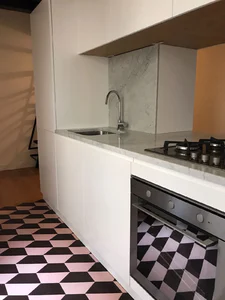
Hexagonal cement tiles are six-sided pieces that tile the plane leaving no gaps and no filler pieces. Our cement tile catalogue has three formats: H21 at 30 × 20 cm (21 pcs/m²), H22 at 23 × 20 cm (29 pcs/m²) and H23 at 11.5 × 10 cm (116 pcs/m²). The format decides the layout, the perimeter cuts and the weight of the floor.
The hexagon is not a new shape: the hexagonal paving tile Gaudí designed in the early twentieth century is still the pavement of Passeig de Gràcia today. What has changed is where a hexagonal cement tile floor is used, and with it come new questions: how many pieces fit, how much gets cut and how the junction with another floor is resolved.
What hexagonal tile formats are there and how much does each weigh?
Three, and they are not interchangeable. The H22 and the H23 are regular hexagons: all six sides are the same length. The H21, at 30 × 20 cm, is an elongated hexagon, with a dominant axis that makes the layout point one way.
| Ref. | Shape | Size | Weight per piece | Units per m² | Weight per m² (calculated) |
|---|---|---|---|---|---|
| H21 | Elongated hexagon | 30 × 20 × 1.7 cm | 1.62 kg | 21 pcs | 34.0 kg |
| H22 | Regular hexagon | 23 × 20 × 1.5 cm | 1.16 kg | 29 pcs | 33.6 kg |
| H23 | Regular hexagon | 11.5 × 10 × 1.5 cm | 0.35 kg | 116 pcs | 40.6 kg |
Sizes, weights and units come from the cement tile format table; the weight per m² is the unit weight times the number of pieces, with no adhesive or grout. Three consequences follow from it:
- The H21 is 2 mm thicker (17 against 15 mm). If you mix it with another format on the same plane, that difference is taken up in the adhesive bed, and it is settled when the floor is set out, not with the trowel in your hand.
- The H23 weighs more per square metre than the large formats: 40.6 kg against 33–34 kg. Bear it in mind if it is going on a wall.
- The H23 is exactly half the H22 lengthwise (11.5 against 23 cm across the long diagonal). They share geometry and orientation, so the two patterns sit well together on the same floor, but the boundary between them does not resolve itself: you have to cut pieces or finish it with a straight band.

The patterned hexagonal models in the catalogue come in the H22 format, 23 × 20 cm, the most common one. If your project calls for the H21 or the H23, check with the workshop which models and colours exist in those formats before you close the design.
How do you set out a hexagonal tile floor?
From the centre and with both axes marked, never from a corner. On a hexagonal floor there is no straight line made up of joints alone: the pattern advances in zigzag, so all four walls of a rectangular room will need cutting. How the tiles fall is decided before the first one is bedded.
- Decide the orientation. Point up, with the long diagonal running the way you walk, or flat side up, turned 90°. In a corridor, the long diagonal in the direction of travel stretches it; turning it widens the corridor, and with the H21 the effect is stronger.
- Mark the axes and set the master row. The first full row goes on the long axis of the room, not against the wall.
- Check the cut at both ends. If one side is left with a strip narrower than a third of a tile, shift half a module and share the difference. It is cheaper to correct with chalk than with an angle grinder.
- Lay complete rows, not areas. The hexagon does not forgive drift: a one-millimetre error per piece builds up in three directions and three metres on the row no longer closes.
- Leave the perimeter until last. The cut pieces go on the least visible sides: under furniture, behind the door or against the far wall.
One detail takes people by surprise on site: in a hexagonal pattern three pieces meet at every vertex, at 120°, not four at 90°. Cross spacers are no use; you need T- or Y-spacers, wedges or levelling clips. The rest of the procedure — substrate, adhesive, curing and grouting — is no different from any other cement tile floor.
How much wastage should you allow on a hexagonal floor?
Around 10 %, against the 5–7 % usually allowed for square formats. And that percentage does not depend on the square metres but on the perimeter: on a hexagonal floor you cut per linear metre of wall, not per square metre of floor.
A 4 × 5 m living room has 20 m² and 18 m of perimeter: 0.9 metres of cutting per square metre laid. A 2 × 2 m bathroom has 4 m² and 8 m of perimeter: 2 metres of cutting per square metre, more than twice as much. The smaller and more broken up the room, the higher the proportional wastage. A bathroom with a shower tray, a wall-hung unit and a door reveal can climb to 15 %.
The hexagon has one advantage: cut along its axis, point to point, it gives two identical halves that can both be used on the same wall, in alternate rows. Against the perpendicular walls the cut is an asymmetric triangle and the offcut ends up in the skip.
- Order all the material at once and from the same batch: the pigment of one run and the next is not identical, and a later patch shows.
- Keep four or five whole tiles: replacing a broken one in a hexagonal pattern shows more than on a square floor.
- If the model has a directional pattern, count the wastage separately: some offcuts will be useless because the pattern falls the wrong way round.
What patterns can you make with hexagonal tiles?
More than you would think: the hexagon offers three directions of symmetry instead of the two of the square. The layouts that hold up best on a real job:
- Single-colour honeycomb. One colour, and let the joint draw the pattern. The safest option on large surfaces.
- Six-tile flower. Six pieces of one colour around a seventh in another. A large module that reads from a distance.
- Gradient. Two or three shades from the same family in decreasing density, so the colour dissolves towards one end. It works well in long corridors: the shades are in the cement tile colour chart.
- Rug. A rectangle of hexagons set into another floor, in front of the island or under the table.
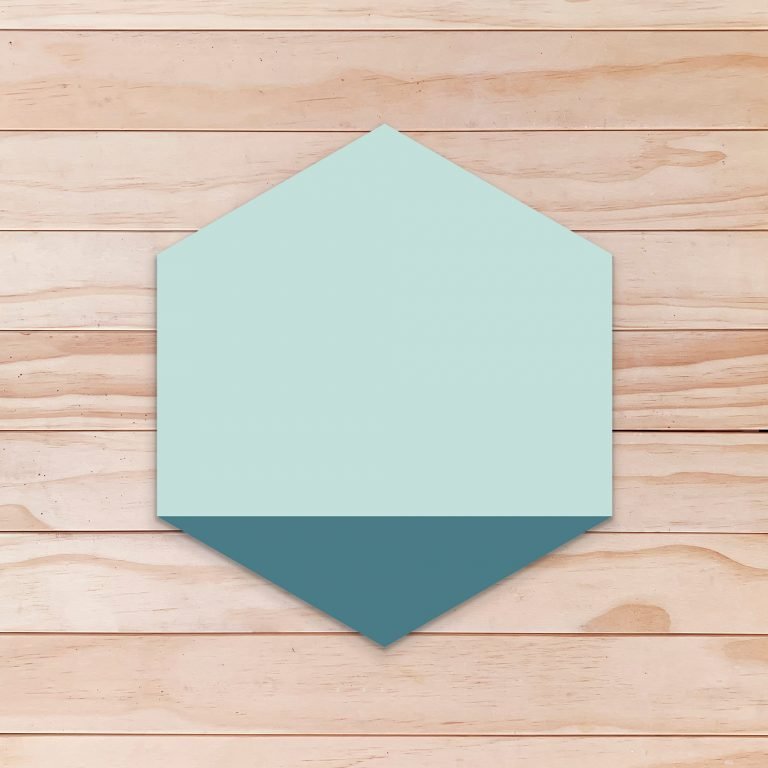
- Two-colour tile, turned. Models such as the Mod. 600 carry two colours on the same tile and the pattern on the floor depends only on how you turn each piece: diamonds, bands or triangles with a single material.

Orientation is a design variable in its own right. With a model like the Mod. 612, whose pattern converges on a vertex, six pieces pointing at the same spot close a full radial figure; left all in the same position, the floor reads as a run of chevrons. Before deciding, lay out a square metre dry and photograph it from above: the overhead view shows what you cannot see standing up. There are more compositions in the guide to cement tile patterns.
How do you resolve the transition to another floor?
With a straight joint that does not depend on the pattern, because the edge of a hexagonal floor is always a zigzag. Four ways out, from the simplest to the most laborious:
- Straight cut and trim profile. The pattern is cut in a line and the junction is covered with a brass, steel or aluminium profile. Quick, clean, and the one that best absorbs differences in thickness.
- Border band. A strip of rectangular pieces or a border frames the hexagons and gives them a straight edge. The classic solution in period homes.
- Progressive dissolve. The hexagons space out towards the other material, which fills the gaps. The most striking junction and the one that eats the most hours: it calls for a tile-by-tile setting-out drawing.
- Direct junction with a wide joint. Leave the zigzag on show and fill the sawtooth with grout. It works with continuous materials such as microcement or polished concrete; not with a timber floor.
The most frequent problem at these junctions is not the pattern, it is the thickness: a 15 or 17 mm cement tile next to a 9 mm porcelain tile means building up underneath, and that is measured before the old floor comes up.
Where do hexagonal tiles fit well, and where not?
They fit where the floor is the protagonist and the plan is clean; they get complicated where there are plenty of corners, steps and junctions.
Where it works
- Entrance halls and corridors. Small, much-seen surfaces with a simple plan. The H21 in the direction of travel stretches a short corridor.
- Kitchens. As a rug in front of the island or across the whole floor; if it goes up a vertical face, count the 33–41 kg/m² from the table.
- Bathrooms. An H22 has the same length of joint per square metre as a 20 × 20 cm square, around 10 linear metres; the H23 doubles that figure. More joint means more grip underfoot when wet, but also more surface to clean and seal.
- Courtyards and covered terraces. On the same conditions as any cement tile outdoors, explained in the guide to cement tiles in courtyards and terraces.
Where I would think twice
- Stairs. A step calls for a straight piece on the tread and another on the riser. With hexagons the edge is left serrated and has to be finished with a stair-nosing profile.
- Very small, very broken-up rooms. A 2 m² cloakroom with three door reveals can end up with more cut pieces than whole ones, and the pattern disappears.
- Floors with many access hatches, gullies and inspection chambers. Every circular or square element inside the pattern is a bespoke cut.

Slip resistance deserves an honest qualification. The PTV of 59.5 in the wet pendulum test — class 3, the top of the pendulum scale and the class the Spanish Technical Building Code (CTE) requires outdoors, in swimming pools and in showers — belongs to the 20 × 20 cm hydraulic terrazzo of test report no. 4718, not to the cement tile and not to a hexagonal format. The cement tile has its own report, no. 9102, on a 200 × 200 × 15 mm piece and under UNE-EN 1339, the Spanish version of EN 1339. On top of that, the pendulum needs a sliding area of 124 × 76 mm that does not fit on an H23: on small pieces the test has to be run on an already laid sample. The full laboratory test reports are published on our Spanish site and, if you need an Rd figure for the hexagonal format in your project, ask the workshop for it.
Frequently asked questions about hexagonal tiles
What size is a hexagonal tile?
Our cement tile catalogue has three: H21 at 30 × 20 cm and 1.7 cm thick, H22 at 23 × 20 cm and 1.5 cm, and H23 at 11.5 × 10 cm and 1.5 cm. The first figure is the long diagonal, point to point, and the second the width between parallel sides. In ceramic they vary a great deal from one manufacturer to another: always compare diagonal with diagonal.
How many hexagonal tiles are there in a square metre?
Twenty-one in the H21 format, twenty-nine in the H22 and one hundred and sixteen in the H23. Those are the units before wastage: to that figure you add around 10 % for the perimeter cuts, and up to 15 % in small rooms or rooms with many corners. Always order the whole amount from a single batch.
Can hexagonal tiles be laid on a small bathroom floor?
Yes, and the small format works better than the large one: the H23 at 11.5 × 10 cm spreads more joints, adapts better to the falls of a formed shower tray and gives more grip on a wet floor. In exchange, in a 4 m² bathroom the proportion of cut pieces is high: allow generous wastage and decide in advance where the offcuts go.
Are hexagonal tiles any good outdoors?
The shape changes nothing: what decides whether a tile stands up outdoors is its water absorption, its slip resistance and whether the area freezes. Cement tiles work in courtyards and covered terraces with the right treatment and in climates without hard frosts. Check the test reports for the material, not for the format, and do it before you choose.
What joint width does a hexagonal floor take?
Between 1.5 and 3 mm is usual with cement tiles, the same as in square formats. What changes is the spacer: with three pieces meeting at each vertex at 120°, cross spacers do not fit and you need T- or Y-spacers, wedges or levelling clips. Butt-jointing is not advisable: the tile needs room to move.
Can hexagons be combined with square tiles?
Yes, but the junction between the two patterns is never a clean line on its own. Resolve it with a trim profile, with a band or border around the edge, or with a progressive dissolve of one pattern into the other. And check the thicknesses of both formats beforehand: two millimetres of difference are corrected in the adhesive bed, but they have to be allowed for.
The next step is to ask for a physical sample: the colour of a cement tile is decided with the piece in your hand and in the light of the room, never on a screen. Start with the hexagonal cement tile catalogue and tell us which model and which colours you would like to see.