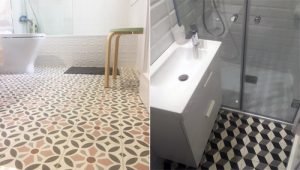
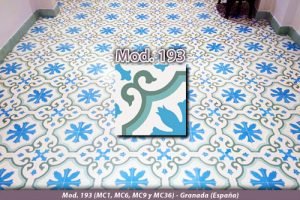
To work out how many tiles per square metre you need, multiply the area to be covered by the pieces per square metre of the chosen format and add the wastage: 5–10% for a straight lay and up to 15–20% for a diagonal, a herringbone or mosaics with a continuous pattern. Round the result up and order it all from a single batch.
With handmade tiles that formula falls short: a hexagon does not fill the rectangle that contains it, and a patterned tile cut in half is rarely of any use twice.
How many tiles per square metre does each format take?
Between 16 and 205, depending on the format: 16 in the 25 × 25 cm square, 25 in the 20 × 20 cm one and 205 in the 7 × 7 cm olambrilla insert. This is the full table of the formats we make, with the weight per piece and per square metre.
| Shape | Ref. | Dimensions | Pieces / m² | Weight / piece | Weight / m² |
|---|---|---|---|---|---|
| Square | H02 | 25 × 25 × 1.8 cm | 16 | 2.30 kg | 36.8 kg |
| Square | H03 | 20 × 20 × 1.5 cm | 25 | 1.30 kg | 32.5 kg |
| Square | H04 | 15 × 15 × 1.5 cm | 45 | 0.79 kg | 35.6 kg |
| Square | H05 | 14 × 14 × 1.5 cm | 52 | 0.69 kg | 35.9 kg |
| Square | H06 | 10 × 10 × 1.5 cm | 100 | 0.35 kg | 35.0 kg |
| Rectangular | H11 | 30 × 15 × 1.6 cm | 23 | 1.45 kg | 33.4 kg |
| Rectangular | H12 | 25 × 10 × 1.6 cm | 40 | 0.86 kg | 34.4 kg |
| Rectangular | H13 | 20 × 10 × 1.5 cm | 50 | 0.62 kg | 31.0 kg |
| Hexagonal | H21 | 30 × 20 × 1.7 cm | 21 | 1.62 kg | 34.0 kg |
| Hexagonal | H22 | 23 × 20 × 1.5 cm | 29 | 1.16 kg | 33.6 kg |
| Hexagonal | H23 | 11.5 × 10 × 1.5 cm | 116 | 0.35 kg | 40.6 kg |
| Octagonal | H31 | 20 × 20 × 1.5 cm | 25 | 1.14 kg | 28.5 kg |
| Laghaz | H41 | 20 × 17 × 1.5 cm | 50 | 0.62 kg | 31.0 kg |
| Labrys | H51 | 30 × 20 × 1.5 cm | 25 | 1.35 kg | 33.8 kg |
| Chakar | H61 | 20 × 17 × 1.5 cm | 50 | 0.58 kg | 29.0 kg |
| Diamante | H71 | 28 × 16.5 × 1.6 cm | 44 | 0.72 kg | 31.7 kg |
| Olambrilla | H07 | 7 × 7 × 1.5 cm | 205 | 0.25 kg | 51.3 kg |
The dimensions and the units per square metre are those of our cement tile format table; the weight per m² is the product of the two columns. The olambrilla rarely covers a whole floor —it is used as an insert or a trim—: its 205 units are a theoretical reference.

How do you measure the square metres of an irregular room?
By breaking the plan down into rectangles, measuring each one at its widest point and adding them up. Old houses do not have parallel walls: measuring length and width once is the quickest way to come up short.
- Measure on the floor, not on the drawing: the drawing does not pick up levelling screeds or the corners that appear once the old floor is taken up.
- Split the plan into rectangles: living room, fireplace recess, mouth of the corridor, wardrobe setback.
- Measure each run at three points and keep the largest figure: in an 8 m corridor there are 3 or 4 cm of difference between the two ends.
- Add the door openings: the floor runs under the door as far as the centre line of the frame.
- Only deduct what is large. A fixed island or a fitted wardrobe comes off; a 30 × 30 cm pillar does not, because the cuts around it eat up that square metre.
- Note the perimeter separately, because that is what you need for the border and the skirting. Steps, dados and worktops are measured separately: they usually take a different format.
How much wastage should you add for each layout?
Between 5% and 20%. What decides the percentage is not the material but the pattern and the geometry of the room.
| Type of laying | Wastage | Reason |
|---|---|---|
| Straight lay, square tile, regular room | 5% | Cuts on two sides only and the offcut is reused |
| Straight lay with corridors, pillars or recesses | 8–10% | Every change of direction forces a cut that cannot be reused |
| Rectangular in brick bond or third bond | 8–10% | The offset leaves half tiles at the end of every course |
| Diagonal at 45° | 12–15% | The whole perimeter is cut into triangles, and a triangle is of no further use |
| Herringbone with rectangular tiles | 15% | Mitred starts and finishes on all four sides |
| Hexagonal, octagonal and carved shapes | 12–15% | The finish against the wall means cutting every piece to size |
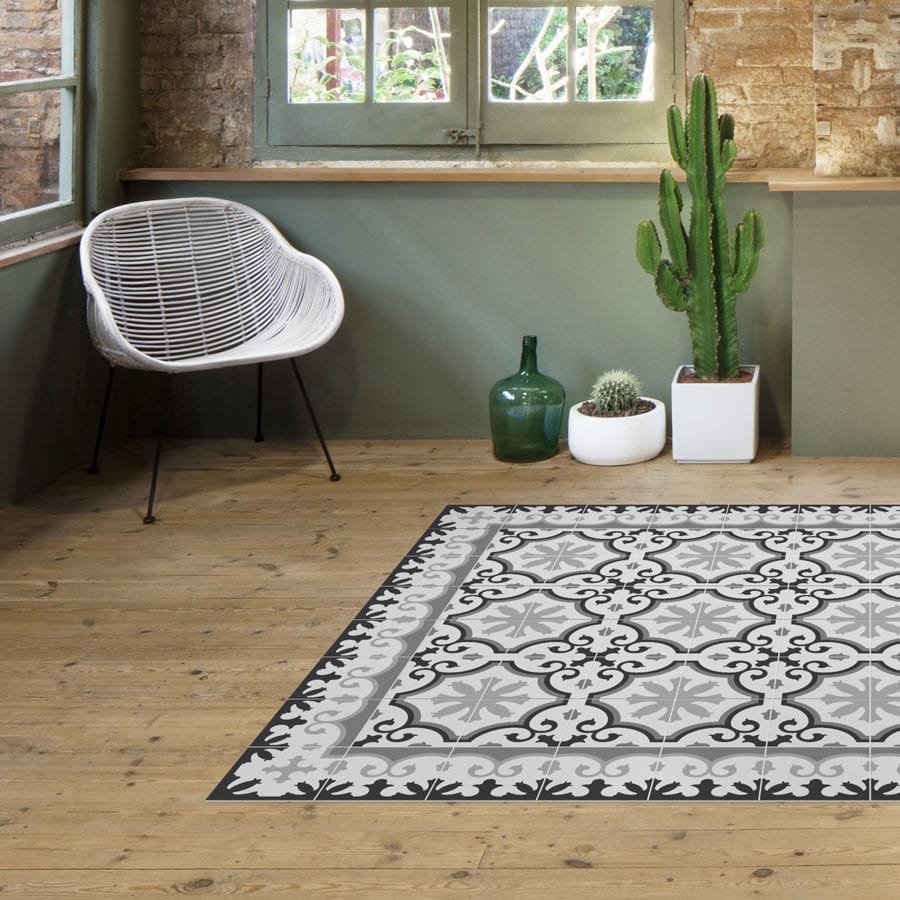
| Rug with a perimeter border | 10% plus whole corners | The border is set out to the module; corners cannot be cut |
| Complex mosaic, medallion or continuous pattern | 15–20% | One badly cut tile breaks the pattern |
There is one reason no generic calculation takes in: the offcut from a cut is almost never usable. On a plain floor you lay the two halves at opposite ends; on a mosaic the pattern has an orientation and only fits in the symmetrical position. That is why a floor laid to a cement tile pattern wastes more than single-colour porcelain.
Add another couple of points if the building is out of square or the format is larger than 25 × 25 cm. And respect the minimum: 5% of a 3 m² cloakroom is 0.15 m², which does not even cover one breakage. Always order one extra square metre. Laying itself is a separate subject, covered in our step-by-step installation guide; this article stops at the order.
Why does dividing one square metre by the size of the tile give the wrong answer?
Because the rectangle that contains the tile is not the area it occupies. Shapes that interlock fit in greater numbers than length × width suggests: the gap runs from a quarter to half the units.
- Hexagonal H22 (23 × 20 cm): the rectangle would give 21 pieces per m²; the real figure is 29.
- Laghaz H41 (20 × 17 cm): 29 against 50.
- Diamante H71 (28 × 16.5 cm): 21 against 44.
Anyone working out a hexagonal floor with the rectangle formula comes up short by one tile in four; with the Diamante H71, by more than half. The same goes for the Chakar model: its H61 yields 50 units per m², not the 29 of its overall size.
How are the border, the skirting and the olambrillas calculated?
In linear metres, not square metres: divide the length of the perimeter by the width of the piece and then add the corners, which go in whole.
| Piece | Ref. | Dimensions | Units / linear metre | Weight / piece |
|---|---|---|---|---|
| Smooth skirting | HR01 | 20 × 10 × 1.5 cm | 5 | 0.66 kg |
| Pigeon-collar skirting | HR11 | 20 × 10 × 1.5 cm | 5 | 0.64 kg |
| Relief skirting | HR21 | 20 × 10 × 1.5 cm | 5 | 0.62 kg |
| Smooth skirting | HR02 | 20 × 20 × 1.5 cm | 3 | 1.40 kg |
For the cement tile skirting: measure the perimeter, deduct the door openings and the fronts of any units that reach the floor, divide by the width of the piece, round up and add 10%. Each external corner uses two pieces.
For the border: if it is the same format as the field, every linear metre is five pieces in 20 × 20 cm or four in 25 × 25 cm, plus one corner per angle —four in a rectangular rug—. Check with the workshop whether that cement tile border model has a corner piece of its own. Olambrillas, used as inserts between H31 octagons, work out at one per octagon: of the order of 25 per square metre.

A worked example: a living room with a cement tile rug
A living room of 4.20 × 3.60 m —15.12 m²— with a central rug of 2.40 × 3.00 m, a 20 cm perimeter border and a plain field all round, everything in H03 at 20 × 20 cm, plus HR01 skirting.
- Inner field of the rug. Taking the border off all four sides leaves 2.00 × 2.60 m = 5.20 m². At 25 pieces/m²: 130 pieces.
- Perimeter border. The complete rug is 7.20 m² (180 pieces) and the inner field 130: the band comes to 50 pieces, four of them corners.
- Plain field. 15.12 − 7.20 = 7.92 m² × 25 = 198 pieces.
- Wastage. Plain field at 5% → 208 pieces; rug field at 10% → 143; border at 10% → 55, corners included.
- Skirting. Perimeter 2 × (4.20 + 3.60) = 15.60 m, less 0.90 m for the door opening = 14.70 m. At 5 units per linear metre, 74 pieces; with 10%, 82 pieces.
- Weight of the order. 406 floor pieces × 1.30 kg + 82 skirting pieces × 0.66 kg = 582 kg.
The 15.12 m² you started with have turned into 16.24 m² of material, and the order is not “16 m² of model X”: it is three separate references. For more compositions, see our cement floor photo gallery.
How many boxes should you order, and why from a single batch?
Divide the total pieces of each reference by the units in the box for that format and always round up. The units per box change with the format and the model: confirm them with the workshop before closing the order.
Why the material has to come from a single batch
Cement tiles are pressed in a mould and cured, not fired: the pigment is dosed by mixes, so two production runs separated in time can give the same colour on the chart with a difference in shade that shows once they are laid side by side. Ordering the whole quantity at once, wastage included, is how you secure an even shade; with zellige the effect is greater, because glaze and kiln vary from firing to firing.
Replacements and the weight of the order
Set at least one square metre of each model aside, unopened and in a dry place, in case of a breakage or an inspection hatch that has to be lifted. Work out the weight before organising the unloading: 40 m² of H02 comes to around 1,500 kg.
How does the calculation change with zellige and terracotta?
The method is the same; the figures and the wastage change. Zellige is cut by hand: the units per square metre depend on the carved shape, not on the overall size, and the reasonable minimum allowance is 15%, because some pieces are discarded while laying.
| Shape | Ref. | Dimensions | Pieces / m² |
|---|---|---|---|
| Mjeddij | ZS01 | 15 × 15 × 1.6 cm | 45 |
| Mjeddij | ZS02 | 10 × 10 × 1 cm | 100 |
| Mjeddij | ZS03 | 5 × 5 × 1 cm | 400 |
| Mjeddij | ZS04 | 3 × 3 × 1 cm | 1,111 |
| Bejemat | ZS12 | 20 × 10 × 1.8 cm | 50 |
| Bejemat | ZS15 | 15 × 5 × 1.5 cm | 134 |
| Nzik | ZS21 | 14.5 × 8.5 × 1 cm | 168 |
| Chakar | ZS31 | 12 × 11 × 1 cm | 135 |
| Fekroun | ZS41 | 11.7 × 10 × 1 cm | 155 |
| Darj | ZS51 | 10 × 10 × 1 cm | 200 |
| Ders | ZS71 | 10 × 10 × 1 cm | 228 |
| Kora 6 | ZS61 | 14 × 12.2 × 1 cm | 78 |
Compare the three 10 × 10 cm pieces: the Mjeddij gives 100 units per square metre, the Darj 200 and the Ders 228. Identical overall size and twice the consumption, because the carved edge interlocks with the one next to it: look at the zellige formats table and do not estimate by eye. When laying, open several boxes at once and mix the pieces.
With terracotta the calculation is straightforward, but its 16.9% water absorption —test report no. 7539 from our laboratory testing— makes sealing essential: ask for the coverage per litre of the treatment as well.
Frequently asked questions about calculating material
How many 20 × 20 cm cement tiles are there in a square metre?
Twenty-five. That is the H03 format, 20 × 20 × 1.5 cm and 1.30 kg per piece: 32.5 kg per square metre. A 12 m² living room comes to 300 pieces plus wastage, so 315 for a straight lay at 5% and 345 on the 45° diagonal.
What percentage of wastage should you order?
5% for a straight lay with square tiles in a regular room; 8–10% with corridors, pillars or recesses; 12–15% for a diagonal, a herringbone or hexagonal formats; and up to 20% for complex mosaics. On small areas the percentage falls short: always add one extra square metre.
How much does a square metre of cement tile weigh?
Between 28.5 kg for the octagonal H31 and 40.6 kg for the small H23 hexagon, with most floor formats between 31 and 36 kg. The 7 × 7 cm olambrilla rises to 51.3 kg, but it rarely covers a whole floor. Work out the weight before booking transport: 40 m² is over a tonne.
How many zellige pieces are there in a square metre?
From 45 for the 15 × 15 cm Mjeddij up to 1,111 for the 3 × 3 cm one. With carved shapes the overall size is misleading: two 10 × 10 cm pieces can give 100 or 228 units per m² depending on their profile. Check the format table and add 15% for wastage.
Can I order more material later if I come up short?
Yes, with one caveat: cement tiles are made in mixes and zellige in kiln firings, so a later order may show a slight difference in shade. That is why it is best to order everything from a single batch, wastage included, and keep one unopened square metre in reserve.
How is the price per square metre calculated?
The price depends on the model, the number of colours in each tile, the format and the quantity: it cannot be read off a table of pieces per square metre. What you can prepare beforehand is the area with wastage, the linear metres of border and skirting and the breakdown by reference.
With the metres measured, the wastage decided and the layout broken down by reference, you can ask for a quotation without surprises. Take a look at the cement tiles in stock and send us the dimensions: we will send back the piece count by family and the weight of the order.