Outdoor cement tiles can work, but only under certain conditions: they are pressed concrete tiles, porous and unfired, and they need a substrate laid to a fall, installation with no voids, 2–3 mm joints and a water-repellent. They work on covered patios, porches, balconies and terraces in mild climates; with frequent frosts, around swimming pools or with strong colours in full sun, hydraulic terrazzo is the better choice.
Can cement tiles be used outdoors?
Yes, as long as you accept the nature of the material and lay it accordingly. A cement tile is not ceramic: a face layer of white cement, marble powder and mineral pigments is cold-pressed onto a body of cement and sand, and the tile is not fired—it sets. For the purposes of the standards it is a concrete paving tile (UNE-EN 1339, the Spanish version of EN 1339), just like terrazzo.
This gives it two limitations: it is porous, and water held in the pores leaves stains, brings out salts and, if it freezes, breaks the tile from the inside; and its colour layer is only a few millimetres thick, so sun and rain tone it down over the years.
We have been cautious about this use for years: back in 2017, writing about the project for the square on Calle Sierpe in Crevillent (Alicante)—cement tiles on the access steps and on the street, with a concrete kerb—we were already warning that some shades lighten in the sun.

- Where they work: inner courtyards, porches, covered galleries, balconies, kitchens under a pergola and terraces in mild climates with no standing water.
- With reservations: full sun with strong colours, areas that get the odd frost each year and busy outdoor stairs.
- Where they don’t: pool surrounds, outdoor showers, climates with frequent freeze–thaw cycles and public paving where slip resistance class 3 is required; that is where hydraulic terrazzo fits in.
Where do they work best: patio, terrace, porch or balcony?
The better protected the floor is from standing water and the midday sun, the better it ages. Here is how that plays out in each space.
Inner courtyards
The Andalusian patio is the natural habitat of cement tile flooring: partial shade, ventilation and heavy use, with no frost. A tile rug works very well here—a patterned panel framed by plain tiles or terracotta—and it also pushes the cuts out to the perimeter. With pots that are watered every day, use saucers and plan for drainage.
Terraces and roof terraces
Here, what lies underneath is what counts: waterproofing in good condition and a fall towards the drains. The Spanish Building Code (CTE), in its Basic Document DB-HS 1, sets a minimum fall of 1% for flat roofs with pedestrian access, and in practice 1–2% is used. Without a fall, water sits in the joints and in the pores.
Porches and outdoor kitchens
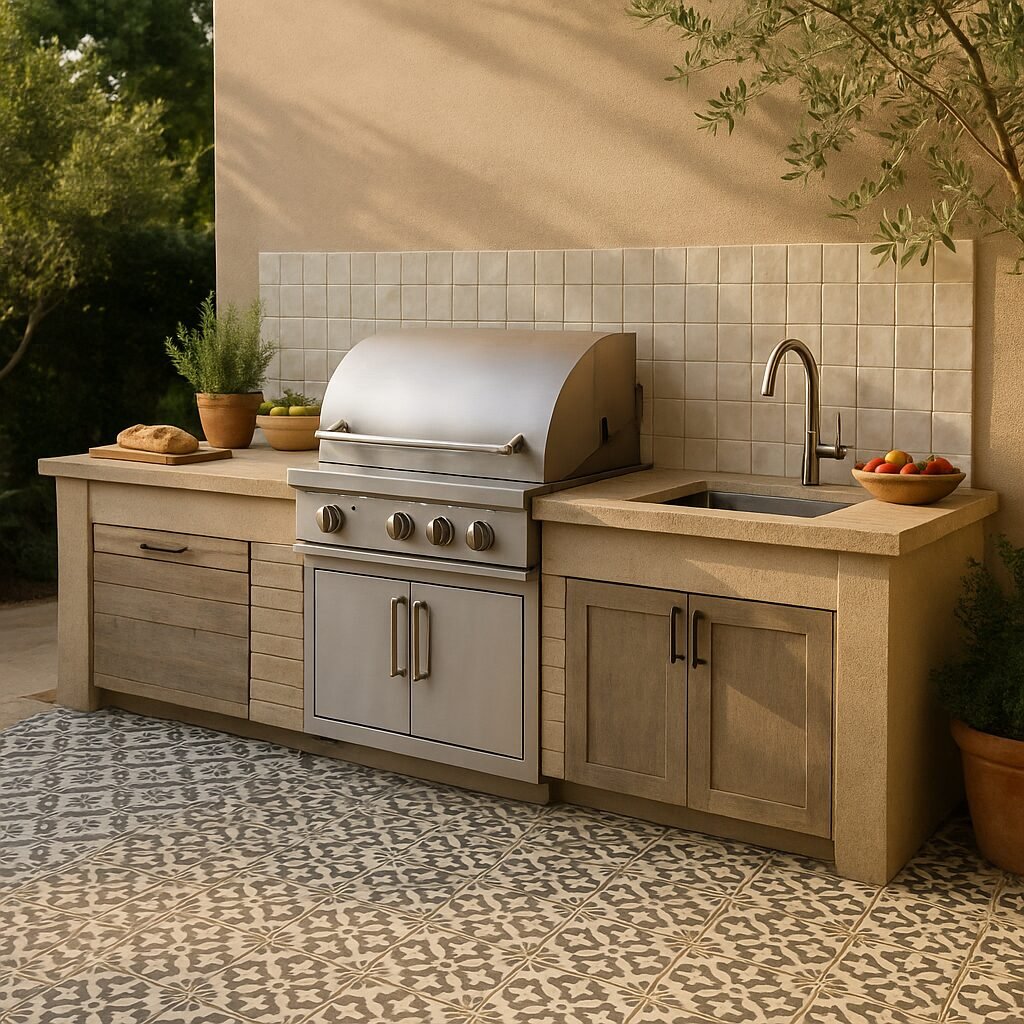
Probably the best scenario: light, yes; direct rain and midday sun, no. The extra challenge is barbecue grease, so the water-repellent should also be oil-repellent. It goes very well with a tiled splashback in outdoor zellige and earthy palettes.
Balconies and covered galleries
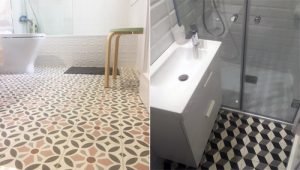
Small surfaces, nearly always sheltered by the balcony above and with little foot traffic: ideal candidates. On the balcony in the photos, model 109 was laid on the floor and on the parapet. Pay attention to the fall towards the drip edge and to the finish along the edge, which is where water gets in.

Do cement tiles fade in the sun or crack in frost?
These are the two real risks of exposure to the elements, and both are managed the same way: less water in the pores and sensible colours.
Frost: the enemy is trapped water
As our laboratory tests show, absorption is what counts: water lodged in the pores expands as it freezes and breaks the tile from the inside. Our 20×20 cm hydraulic terrazzo has an average water absorption coefficient of 5.9–6.2% (UNE-EN 13748-1), whereas porcelain stoneware stays below 0.5%. With occasional frosts, cement tiles need a fall, drainage and a water-repellent; with frequent freeze–thaw cycles, it is better not to leave them exposed.
Sun: stable pigments, a surface that ages
The pigments are mineral oxides and do not disappear like paint, but the cement surface wears and lightens over the years, and saturated shades show it sooner than greys, sands and earth tones. In full sun, choose neutral colours and leave a sample in place for a few weeks before ordering.

Are cement tiles slippery when wet? Slip resistance classes and the CTE
With a natural matt finish they grip well when dry; when wet, it depends on the finish, and a waxed or polished tile is slippery: outdoors, no waxes or floor polishes. The benchmark is the Spanish Building Code’s Basic Document DB-SUA 1, which classifies floors by their slip resistance, Rd, measured with the friction pendulum test (Spanish standard UNE 41901:2017 EX):
| Rd value (PTV) | Class | Where it is required |
|---|---|---|
| Rd ≤ 15 | Class 0 | Not valid anywhere: the CTE requires at least class 1 |
| 15 < Rd ≤ 35 | Class 1 | Dry indoor areas with a slope of less than 6% |
| 35 < Rd ≤ 45 | Class 2 | Dry indoor areas with a slope of 6% or more and stairs; wet indoor areas (entrances, bathrooms, kitchens) with a slope of less than 6% |
| Rd > 45 | Class 3 | Wet indoor areas with a slope of 6% or more and stairs; outdoor areas, swimming pools and showers |
Class 3 is required in buildings for public use (public residential, commercial, educational, healthcare, administrative and public assembly uses); in a private home it is not compulsory, but it is the sensible benchmark for any floor that gets wet, and for outdoor steps and entrances too.
Our 20×20 cm hydraulic terrazzo achieved a wet PTV of 59.5 at 20 °C (individual values from 55 to 60): class 3, the top of the scale, according to test report no. 4718 from Elabora, a laboratory listed in the register of the Junta de Andalucía (the Andalusian regional government) under number AND-L-155. For cement tiles we publish test report no. 9102 (UNE-EN 1339); if you need to demonstrate a specific class, ask us about the finish and the testing.
Which cement tile format and thickness should you choose for outdoor use?
For outdoor floors, choose the thickest and heaviest formats in the range (1.6–1.8 cm), which spread loads better and suffer less at the edges, and keep the 10×10 and the tile inserts for rugs and finishing details. The full range is on our cement tile formats page.
| Format | Ref. | Size | Weight per piece | Pieces per m² | Outdoor use |
|---|---|---|---|---|---|
| Square | H02 | 25 × 25 × 1.8 cm | 2.30 kg | 16 | Large terraces and patios |
| Square | H03 | 20 × 20 × 1.5 cm | 1.30 kg | 25 | Rugs with a border |
| Rectangular | H11 | 30 × 15 × 1.6 cm | 1.45 kg | 23 | Herringbone and chequerboard |
| Rectangular | H12 | 25 × 10 × 1.6 cm | 0.86 kg | 40 | Narrow herringbone and borders |
| Hexagonal | H21 | 30 × 20 × 1.7 cm | 1.62 kg | 21 | Patios that break the grid |
| Hexagonal | H22 | 23 × 20 × 1.5 cm | 1.16 kg | 29 | Balconies and covered galleries |
| Chakar | H61 | 20 × 17 × 1.5 cm | 0.58 kg | 50 | Central rugs |
Work out how many tiles you need from the pieces per m² column and add 5–10% wastage for cuts (more for herringbone or diagonal layouts). Order everything at once: the shade varies between batches, and a few spare tiles from the same batch are the only way to repair a breakage without it showing.
Colours and patterns that age well outdoors
In our 49-colour chart (MC1–MC49), greys, sands, earth tones, muted greens and black and white stand up better outdoors than saturated shades. Simple geometric patterns hide wear better than florals, and a single colour laid in herringbone is the safest option in full sun. The Chakar cement tile (20 × 17 cm, 50 pieces per m²) works well as a central rug; in our article on the most popular cement tile patterns we compare herringbone, chequerboard and rugs.
How do you lay cement tiles on a terrace or patio?
They are fixed with exterior-grade tile adhesive on a stable screed laid to a fall, with no voids under the tile, a slightly wider joint than indoors and a water-repellent to finish. This is the order:
- Substrate and setting-out. A cured, firm, clean screed with no hollow spots (tap it: if it sounds hollow, repair it), with the waterproofing and the fall already built into the layers below. Dry-lay a few rows to centre the pattern and push the cuts out to the perimeter.
- Adhesive. An exterior-grade tile adhesive, class C2 (improved adhesion) and S1 (deformable), applied by back-buttering—notched trowel on the screed and a thin coat on the back of the tile—so that no air pockets are left. Do not soak the tiles in water.
- Laying. Bed each tile with a rubber mallet—never a metal one, and never directly on the face. Leave 2–3 mm joints (1–2 mm indoors) and remove adhesive residue while it is still fresh: once dry, it will not come off.
- Movement joints. Respect the expansion joints in the screed, leave a perimeter joint against walls and divide large or very sunny areas into bays; these joints are sealed with a flexible sealant, not with grout.
- Water-repellent and grouting. Apply a first coat of water-repellent so that the grout does not get into the pores, then grout with an exterior-grade cementitious grout that is flexible and has reduced water absorption (class CG2 W), in a shade close to the background colour of the tile; remove the haze while it is still fresh. We go into the details in our guide on how to lay cement tiles.
- Drying and protection. Let the tiles and grout dry out completely—days or weeks, depending on the weather—and apply a breathable water- and oil-repellent impregnator. Avoid waxes and varnishes that form a film: they turn white and peel in the sun.
What maintenance do outdoor cement tiles need?
Not much, but it has to be regular: sweeping, water with neutral soap, no acid products and renewing the water-repellent when water stops beading on the surface.
- Cleaning: a soft-bristled broom or a dust mop for leaves and dust; wash with lukewarm water and pH-neutral soap.
- Off limits: bleach on coloured tiles, hydrochloric acid, limescale removers, harsh degreasers, metal scourers and pressure washers, which open up the pores and strip out the grout.
- Fresh stains: blot with kitchen paper and wash with neutral soap; for grease, use a cleaner made specifically for cement.
- Efflorescence: the whitish marks of the first few months are salts from the cement that water carries to the surface as it evaporates; brush them off dry and wash with water, and they die out over time.
- Water-repellent: every season, sprinkle a few drops of water on the floor; if they soak in instead of beading, it is time to renew it, following the manufacturer’s instructions.
- Pots and furniture: saucers or feet under plant pots, felt pads on metal legs and no dragging.
- Repairs: cut out the grout around the broken tile, lift it with a chisel working from the centre, clean the bed and fix the new tile with the same tile adhesive.
The full routine, with products and common mistakes, is in our guide to cement tile floor maintenance and care.
Cement tiles, terrazzo, terracotta or zellige: which works best outdoors?
If the decision is a technical one, hydraulic terrazzo is the safest outdoor paving our workshop makes; cement tiles win on pattern and colour in sheltered spaces; terracotta is the traditional choice for the patio; and zellige is a wall material, not one for outdoor floors:
| Material | What it is and standard | Water absorption | Slip resistance | Where it fits outdoors |
|---|---|---|---|---|
| Cement tile | Pressed concrete, UNE-EN 1339 (report 9102) | Porous; needs a water-repellent | Natural matt; no published figure | Covered patios, porches and balconies |
| Hydraulic terrazzo 20×20 cm | Concrete, UNE-EN 1339 and UNE-EN 13748-1/2 (report 4718) | 5.9–6.2% | Wet PTV 59.5: class 3 | Terraces, stairs, swimming pools and frost-prone climates |
| Terracotta 15×5 cm | Ceramic, UNE-EN ISO 10545 (report 7539) | 16.9% | Naturally rough; no published figure | Traditional patios, with a water-repellent |
| Glazed zellige 10×10 cm | Glazed ceramic, UNE-EN ISO 10545 (report 9103) | 15.7% | Glossy glaze: slippery when wet | Walls, fountains and benches |
| Cement-tile-effect porcelain stoneware | Low-porosity ceramic | Below 0.5% | Depends on the manufacturer’s finish | Hard frosts or swimming pools |
The rule of thumb: handmade patterns where water doesn’t linger, terrazzo where the floor gets wet every day or freezes. The two sit well together in the same patio, with cement tiles as a central rug and terrazzo on the walkways; you will find formats and colours in our terrazzo catalogue.
Frequently asked questions about outdoor cement tiles
Do cement tiles fade in the sun?
The pigments are mineral and do not disappear, but the cement surface wears and lightens after years of sun and rain, especially in saturated shades. Under a porch the change is minimal; in full sun, expect a patina. Choose greys, sands or earth tones and test a sample in place.
Can cement tiles withstand frost?
They can withstand occasional frosts if they are properly laid: no voids underneath, a fall that drains the water away and the water-repellent kept up to date, because the damage is done by water freezing inside the pores. Where freeze–thaw cycles are frequent, we do not recommend them in exposed areas: use hydraulic terrazzo or a covered area.
What adhesive should you use for cement tiles on a terrace?
An exterior-grade tile adhesive, class C2 (improved adhesion) and S1 (deformable), applied by back-buttering on a clean, firm screed laid to a fall. Ready-mixed paste adhesives for indoor use are not suitable, the tiles are not soaked before laying, and the joint is kept at 2–3 mm.
Can cement tiles be laid in herringbone on a patio or terrace?
Yes, and it is one of the best options outdoors: with plain rectangular tiles (30 × 15, 25 × 10 or 20 × 10 cm) in a single colour there is no pattern to match and no shade differences to notice, and the floor ages evenly. Expect more cuts at the perimeter, with 10–15% wastage.
Are cement tiles suitable for a pool surround or an outdoor shower?
We don’t recommend them: they are porous, chlorinated water and sun take a toll on the surface, and the CTE requires slip resistance class 3 for swimming pools and showers in buildings for public use. Our 20×20 cm hydraulic terrazzo does reach that class (wet PTV 59.5, test report no. 4718), and that is what we suggest instead.
The next step is to ask for a sample and leave it in place for a few weeks: it is the most reliable test of how it will behave outdoors. You can see the models in the cement tile catalogue and, if you have questions about formats, finishes or tests, write to us or visit our Seville showroom by appointment.