In Andalusia, tiles are not just a surface covering: they are a language. They speak of cool patios, whispering fountains and streets where colour rules. When you look at a floor of azulejos in Seville or a tiled dado in Córdoba, you see more than design: you see centuries of craft, trade routes and cultural exchange. And yes, that charm is still alive today in floors, kitchens and bathrooms that combine tradition and contemporary design.
Andalusian tiles: living history from al-Andalus to the modern day
The legacy of al-Andalus left a unique visual heritage: endless geometric designs, interlacing strapwork, ataurique (stylised foliage ornament) and a sheer devotion to pattern. In the workshops of Triana, in Seville, pottery became a major art form. From there it made its way into palaces, cloisters and the patios of ordinary homes. The Plaza de España, the Royal Alcázar of Seville and the Alhambra are the finest showcase of that world of tesserae, glazes and relief work.
In time came another revolution: the cement tile. With a cement base and mineral pigments, it brought mosaic to a large scale. The result? Hard-wearing, colourful floors with a handcrafted signature that is making a strong comeback today in restoration projects and new homes.
From the patios of Seville to contemporary homes
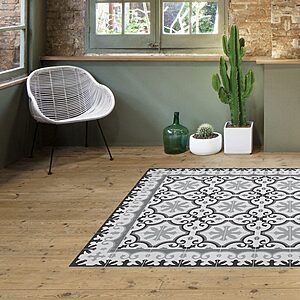
If you have ever strolled through an Andalusian patio, you know the floor matters as much as the flowerpots. In today’s homes, that spirit carries over into kitchens, bathrooms and entrances that seek coolness, texture and personality. Cement tiles work like a mineral “rug”: they frame spaces, play with the light and add character without overdoing it.
Can you picture a ceramic dado with a Moorish border and a chequerboard cement tile floor in copper green and cobalt blue? That combination, so Sevillian and so current, creates interiors that never go out of fashion.
Craft and technique: how a cement tile is made
The magic happens in the mould. First, the artisans place a metal divider that outlines the motif. Then they pour in mineral pigments (iron, cobalt or chromium oxides) mixed with white cement and marble powder. Layers of mortar are added and, finally, the tile is pressed. No firing, no kilns: the tile sets and is then cured under water for weeks. That is why we talk about cement tile floors with a silky texture and deep colours.
This almost hypnotic process explains their durability in high-traffic areas and the patina they acquire over time. It is not a “perfect” factory finish; it is a living material, with variations that add depth and authenticity.
Natural materials and sustainability
Cement, marble powder, mineral pigments, sand and water. The recipe is short and honest. Without firing, energy consumption is lower than for ceramic coverings. In addition, many tiles are made to order, making the most of resources and avoiding surplus. For projects pursuing sustainable design, cement tile is a natural ally.
Geometry, strapwork and colour: the Andalusian visual language
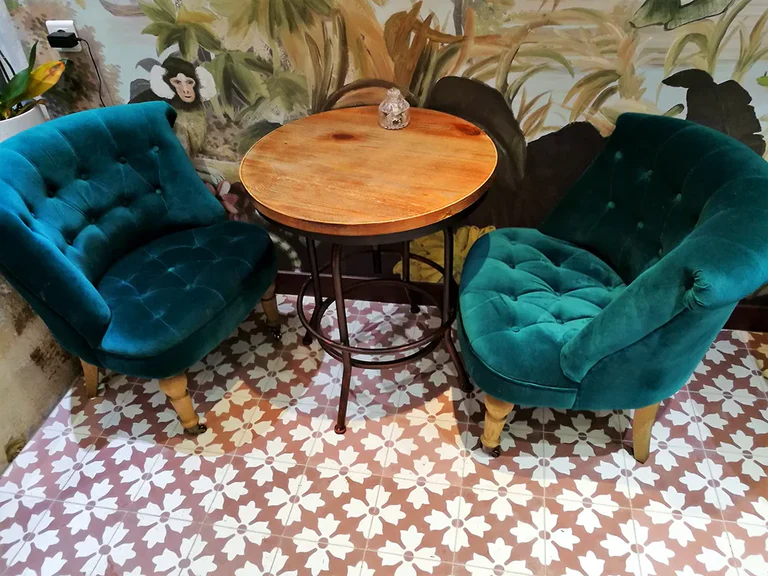
When we think of Andalusia, we think of rhythm. Diamonds, eight-pointed stars, Greek key frets and stylised flowers form patterns that recall the music of a guitar. The influence of Nasrid alicatado (cut glazed-tile mosaic) sits alongside Sevillian glazed earthenware and the nineteenth-century motifs that made cement tile floors popular.
The classic palette combines off-white, black, copper green and cobalt blue. Contemporary versions bring in sand, terracotta, sage or graphite. There is no need to cover the whole house: a tiled panel in the kitchen, a cement tile rug in the entrance hall or a shower wall with a border is enough to create a focal point and set the style.
Heritage, restoration and current projects
Andalusia is a living laboratory of refurbishment. Cortijos (country estates), patio houses, boutique hotels and cultural venues are recovering their original floors or reinterpreting historic patterns. The key is to respect scale and design: borders to frame, central fields with room to breathe and edges that work with dados and skirting.
In new builds, cement tile brings a sense of rootedness. It is not just a trend; it is a way of connecting the project to its setting. That visual continuity between interior and patio—so Mediterranean—gains even more with mineral mosaics and glazed ceramics.
Practical tips for design and installation
Less is more. Choose one lead pattern and let the other materials play a supporting role. Natural colours on the walls, warm wood or stone will bring balance. For installation, the surface must be perfectly level; use a grout that matches the tone and seal with products suited to oil and wine stains. With simple maintenance, the floor improves with age.
Zellige and Sevillian tiles: kinship and differences
Zellige, with its watery sheen and organic edges, is the Maghrebi “cousin” of our azulejos. It is made by hand, glazed and fired in traditional kilns, which gives it that irregular sparkle so loved in kitchens and bathrooms. Cement tile, by contrast, is not fired and offers a matt feel, greater thickness and a pattern in a colour layer several millimetres thick that stands up to daily use on high-traffic floors.
Combine the two? Absolutely. Walls in softly gleaming glazed tile and floors in matt cement tile create a contrast of textures and a light that feels very Andalusian. Think of the galleries of the Plaza de España or the patios of Granada: light, water, ceramics and rhythm.
Andalusia, colour and craft: the Demosaica view
At Demosaica we celebrate that heritage. We make cement tiles in our own workshop in Seville, with artisans who have mastered the mould, the pigment and the curing time. If historic patterns appeal to you or you want a bespoke design for your project in Seville, Córdoba, Málaga or Cádiz, we will help you choose the pattern, scale and palette.
Ready to walk on history every day? Discover our cement tiles and bring the spirit of Andalusian patios into your home. From a small entrance rug to a complete kitchen, cement tile turns every step into a fragment of Andalusia.