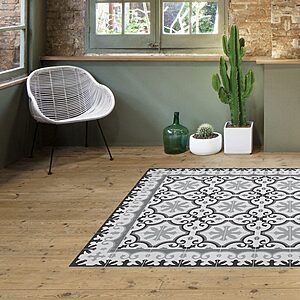
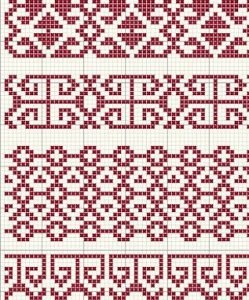
Patchwork tiles combine pieces in several designs, colours or textures on the same surface, instead of repeating a single tile. The name comes from patchwork quilting, in which scraps of fabric are sewn together. With cement tiles, patchwork is created with real tiles of each design, all in the same format and the same thickness, laid at random, grouped in bands or confined to a rug.

What are patchwork tiles, and how do they differ from patchwork-effect porcelain?
In a genuine patchwork, every piece is a different tile: you choose the designs, decide how many of each go in, and the surface never repeats itself in the same way. In patchwork-effect porcelain, the variety is printed at the factory on a limited number of faces, so the floor ends up repeating the same cycle of patterns every few metres.
The difference is also one of material. A cement tile is not fired: it is cold-pressed and then cures, and the pattern is part of the body of the tile, not a layer printed on the surface. That is why it is tested as a concrete paving tile, to EN 1339 (UNE-EN 1339 in Spain), and not to the standards for ceramics; you can look through the laboratory test reports. Ceramic patchwork and cement tile patchwork are not made the same way, and they do not age the same way either.
How do you combine patchwork tiles without overwhelming the space?
The rule that saves the most projects is a simple one: limit the palette to two or three dominant colours plus a neutral, stick to a single format and a single thickness across the whole surface, and decide in advance what proportion of the tiles will be patterned and how many plain. A patchwork becomes tiring when six colour families are competing, not when there are lots of patterns.
Three approaches that work
- Controlled random mix. All the designs are spread evenly, but the layout is dry-laid first so that no two identical tiles end up next to each other or form unintended diagonals.
- Bands. Tiles of the same design are grouped into strips, and the strips alternate. It is the most orderly option, and the one that works best in hallways, on stairs and in half-height wall tiling.
- Rug. The patchwork is confined to a rectangle with a plain frame or a border, and the rest of the floor is laid in a single design or in another material. It is the most versatile approach in living rooms and open-plan kitchens; you will find more ideas in our article on cement tile rugs.

Solid-colour patchwork, the understated option
You do not have to mix patterns. Combining only plain tiles within a single colour range gives a much calmer result that still reads as patchwork. One of the suggestions we have put together in the workshop plays with white, off-white, cream, yellow and red: colours MC1, MC3, MC15, MC18 and MC23 from our cement tile colour chart.

The chart goes up to MC49, so the same exercise can be repeated in greens, blues or greys. With plain colours, the natural variation in shade from one tile to the next is more noticeable, and it works in your favour.
Which formats can I mix, and how many tiles do I need of each design?
Only tiles of the same format and the same thickness should be mixed. Combining a 20 × 20 tile 1.5 cm thick with a 25 × 25 tile 1.8 cm thick means building up the adhesive under some tiles and not under others, and the floor ends up with lippage you can feel underfoot. If you want to mix sizes, keep them in separate areas or put a band of another material in between.
These are the formats most often used for patchwork; the full list of cement tile formats also includes skirting tiles and special pieces.
| Format | Ref. | Size | Thickness | Weight per piece | Pieces per m² |
|---|---|---|---|---|---|
| Square | H02 | 25 × 25 cm | 1.8 cm | 2.30 kg | 16 |
| Square | H03 | 20 × 20 cm | 1.5 cm | 1.30 kg | 25 |
| Square | H04 | 15 × 15 cm | 1.5 cm | 0.79 kg | 45 |
| Square | H06 | 10 × 10 cm | 1.5 cm | 0.35 kg | 100 |
| Rectangular | H11 | 30 × 15 cm | 1.6 cm | 1.45 kg | 23 |
| Rectangular | H13 | 20 × 10 cm | 1.5 cm | 0.62 kg | 50 |
| Hexagonal | H21 | 30 × 20 cm | 1.7 cm | 1.62 kg | 21 |
| Hexagonal | H23 | 11.5 × 10 cm | 1.5 cm | 0.35 kg | 116 |
| Chakar | H61 | 20 × 17 cm | 1.5 cm | 0.58 kg | 50 |
| Tile insert | H07 | 7 × 7 cm | 1.5 cm | 0.25 kg | 205 |
With these figures, the split between designs is worked out in four steps:
- Measure the actual area and add the usual allowance for cuts and breakages, around 10 %.
- Multiply the resulting square metres by the pieces per m² of your format.
- Divide that total among the designs you have chosen, either equally or weighted: for example, 40 % of the main design and 30 %, 20 % and 10 % of the others.
- Round up design by design, and check the minimum production quantities per design and colour with the workshop before finalising the order.
An example: 12 m² in the 20 × 20 cm H03 format comes to 300 tiles, or 330 with the 10 % allowance; split among six designs, that is about 55 of each. With a format that is not square, such as the Chakar design (H61, 20 × 17 cm, 50 pcs/m²), the calculation is exactly the same, but cutting the pieces around the edges takes more work.
Where does a patchwork floor look good: kitchen, bathroom, living room or outdoors?
It works in any room where the rest of the scheme is calm. The more the floor or the tiled wall takes centre stage, the more neutral the furniture, worktops and walls need to be.
Kitchen
This is where it goes most often: we spend a lot of time in the kitchen, and patchwork brings light and colour without having to change the units. It can cover the whole floor or just the splashback, or form a rug under the island, always with plain units and a neutral worktop.

Bathroom
It is the other room where it fits in best, especially to break up the monotony of white wall tiles. The two safe options: the whole floor, with neutral sanitaryware and walls, or half-height patchwork on a single wall, the one with the washbasin, with the rest plain.

Living room, hallway and entrance
In areas you walk through, it works better contained than spread across the whole floor: a rug at the entrance, a rectangle under the living-room table or a band that runs along the hallway. If you prefer a continuous pattern to a mix, take a look first at the most popular cement tile patterns: some layouts create visual richness with a single design.
Outdoors, terraces and wet areas
Two figures matter here: slip resistance and water absorption. Basic Document DB-SUA 1 of the Spanish Building Code (CTE) requires class 3 in outdoor areas, showers and swimming pools, and that class is determined with the friction pendulum test in the Spanish standard UNE 41901:2017 EX. Our 20 × 20 cm hydraulic terrazzo achieved a PTV of 59.5 in the wet test, which is class 3, as recorded in test report no. 4718.
| Product tested | Average water absorption (E) | Method | Report no. |
|---|---|---|---|
| Hydraulic terrazzo 20 × 20 cm | 5.9 – 6.2 % | UNE-EN 13748-1 | 4718 |
| Glazed zellige 10 × 10 cm | 15.7 % | UNE-EN ISO 10545-3 | 9103 |
| Terracotta 15 × 5 cm | 16.9 % | UNE-EN ISO 10545-3 | 7539 |
To put these figures in context, porcelain stoneware stays below 0.5 %. Terracotta and zellige are porous by nature, which is why they are always treated with a water-repellent; terrazzo, at around 6 %, behaves differently. The cement tile results are recorded in test report no. 9102, under UNE-EN 1339. If your patchwork is going into a shower or a courtyard in an area with frost, ask for the test results for that specific product and format before you decide.
Can you create a patchwork with materials other than cement tiles?
Yes, and it is a very practical way out when you cannot decide on a single design: instead of choosing one, you use several and the mix becomes the design. The same logic works with the terrazzo tiles and the hand-painted tiles we make.


Hand-painted tiles add the brushstroke: no two tiles are alike, so the patchwork effect appears even when a design is repeated, as in this project with hand-painted tiles in a country house. Something similar happens with zellige: mixing two or three colours from the same family creates a vibrant surface without changing design, because the glaze already varies from tile to tile.
And it does not all have to go on the floor: these combinations work on walls, on the front of a bar counter or on a tabletop, which is the easiest way to try out a patchwork before extending it to a whole room.
What are the current trends in patchwork tiles?
Patchwork has gradually toned down: the multicoloured sampler of a decade ago has given way to more measured mixes, with a common thread of colour or geometry.
- Solid colours and tonal gradients. Only plain colours within a single range, in order or at random. It is the easiest version to fit into a contemporary home.
- Earthy palettes. Creams, clay tones, olive greens and warm greys are replacing the saturated blues and reds of classic patchwork.
- Contained patchwork. The tile rug is gaining ground over the fully tiled floor: it concentrates colour where you want it and leaves the rest calm.
- Black and white. The classic chequerboard, but mixing two or three geometric patterns instead of alternating two plain tiles.
- Shapes other than the square. Hexagons, Chakar- or Labrys-type formats and elongated rectangles add movement even when there are few colours.
- Mixed with wood and microcement. The patchwork is set among other materials and acts as the centrepiece of the floor.
How do you set out and lay a patchwork, step by step?
A patchwork is not laid by improvising as you go: it is decided beforehand, dry, and then carried out. These are the steps that avoid nasty surprises:
- Take delivery of all the material at once and open every box: mixing batches made at different times can introduce variations in shade.
- Dry-lay the whole surface, without adhesive, until you are happy with the arrangement. This is the time to move tiles around, not once they are stuck down.
- Take an overhead photo of the dry layout and number the tiles or the rows: that photo becomes your laying plan.
- Work outwards from the centre line of the room, so that the cuts are shared between the two ends.
- Lay with a minimal joint and check the level tile by tile: cement tiles are handmade and can vary slightly in size.
- Apply the sealer or water-repellent before grouting, so that the grout does not stain the pigment, and choose a grout colour that does not compete with the pattern.
- Clean without acids or abrasives. The full process is set out in the guide to laying cement tiles.
Common mistakes when laying a patchwork
- Mixing different formats or thicknesses and only discovering the lippage once the adhesive has set.
- Fixing tiles without a dry layout first: two identical tiles side by side or an unintended diagonal can be seen from the doorway.
- Squeezing too many designs into a small area. In a 3 m² cloakroom, four designs are already a lot.
- Grouting light tiles with dark grout without sealing them first.
- Finishing off the clean with hydrochloric acid or an aggressive rotary machine, both of which dull the colour of the cement.
Frequently asked questions about patchwork tiles
How many different designs should I mix?
As a guide, with fewer than four designs the patchwork effect barely comes across, and with more than eight the floor competes with everything else. Between five and eight designs in the same format is usually the right balance in an average-sized room.
Can I mix tiles of different sizes in the same patchwork?
Not within the same surface: each format has its own thickness and calibre, and levelling becomes complicated. What does work is changing format from one area to another, separating each size with a frame, a border or a change of material, without compromising the flatness of the floor.
Is a patchwork more expensive than a floor in a single design?
The price per square metre does not have to change because you combine designs, but the minimum production quantities per design and colour, and the number of designs in the order, do have an effect. Before finalising your list, check the minimums, lead times and possible combinations with the workshop.
Can a patchwork go in a shower or outdoors?
Yes, as long as the product has the slip resistance that DB-SUA 1 requires for those areas, class 3, and it is properly sealed. Our 20 × 20 cm hydraulic terrazzo achieved a PTV of 59.5, which puts it in class 3. In areas with frost, you also need to look at the material’s water absorption.
How do you clean a cement tile patchwork floor?
Like any cement tile floor: vacuum or sweep, then mop with water and neutral soap. Avoid acids, including hydrochloric acid, as well as bleach and abrasive products, which attack the cement and dull the colour. The water-repellent treatment is renewed periodically depending on foot traffic, and oil or wine spills are best wiped up before they dry.
Does patchwork go out of fashion?
Very saturated multicolour patchwork shows its age. Solid-colour, tonal and rug-style patchwork age much better, because they depend on colour and geometry rather than on a particular pattern. If you are worried about getting tired of it, work with light colour ranges and just a few colours.
The next step is to choose designs and a format from the cement tile catalogue and draw up your list of designs with the number of tiles for each. Tell us the area and the combination through the contact page, and we will fine-tune formats, quantities and samples before we start production.