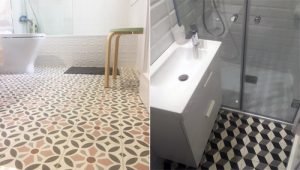
Do you want your cement tile floors to look flawless and last for decades? This guide explains how to get the most out of your cement tile grout, so that the floor is both hard-wearing and attractive. From choosing the right mix to application and maintenance techniques, it covers what you need to know to grout cement tiles and zellige floors well, with practical advice to keep them looking their best.
Choosing the right grout for your cement tiles
When it comes to bringing out the beauty of your cement tiles, the choice of grout plays a key role. For cement tiles, the workshop’s rule is simple: a fine, unpigmented cement-based grout, white or light grey, that accompanies the pattern without competing with it.
In damp rooms such as bathrooms and kitchens, consider a grout with anti-mould additives to keep the floor looking its best. In high-traffic areas, look for highly durable products so that the tiles keep their appeal over time.
Remember that grout does more than fill the gaps: it also protects your tiles from moisture and wear. An informed choice means a floor that stays in good condition for longer.
Factors to consider before buying grout
When selecting the right grout, the porosity of your cement tiles is a key factor. Their visible face is a layer of cement and pigments just a few millimetres thick that absorbs whatever is put on it, which is why in the workshop we apply a water- and oil-repellent impregnator before grouting, so that grout residue does not stick to the pigment layer. For zellige, which is often irregular, choose a flexible grout that can adapt to the variations and compensate for them.
Also consider the colour of the grout. On cement tiles, never use tinted grout: dark pigments leave irreversible stains on the face of the tile. An unpigmented white or light grey grout lets the pattern of the tile take centre stage and does not compete with its colours.
Finally, durability is essential. Look for products that provide a barrier against moisture and mould, so that your floor keeps its good looks over time.
Epoxy vs cement-based grout for cement tile floors
When choosing the right grout for your cement tiles, it helps to know the two families. Epoxy grout, known for its strength and impermeability, is difficult to clean off a porous material: its residue sticks to the pigment layer of the tile and can leave a haze that is very hard to remove. So unless you know how to clean it off porous material, it almost never adds anything on a cement tile floor. Fine, unpigmented cement-based grout, cheaper and easier to work with, is what we recommend in the workshop.
Epoxy is also more expensive, and it does not replace what really protects a cement tile floor: water-repellent treatment of the tiles and well-filled joints. With cement-based grout, maintenance comes down to cleaning with neutral soap and renewing the water-repellent when water stops beading on the surface. The choice therefore depends less on the initial cost than on the material: for cement tiles, unpigmented cement-based grout.
Grouting techniques for a perfect finish
When grouting cement tiles, consistency is key. Mix until the grout has a texture similar to peanut butter: workable enough to spread without effort, but firm enough not to slump between the tiles. Well-applied grout makes the pattern of the tiles stand out.
Use a spatula or a rubber float and work in small sections, pressing the mix only into the joints, without spreading it over the tile. Remove the excess straight away with a damp sponge, taking care not to drag out what you have just filled. This method ensures full coverage and also prevents air pockets that could weaken the grout over time.
Steps for error-free grouting
Grouting calls for a methodical approach if you want a flawless finish. The first essential step is to start with a clean, dry surface, because any residue can affect adhesion and the final appearance of the joints.
Fill the joints with the rubber float in small sections, pressing firmly to fill every gap between the tiles, but without spreading the grout over the face of the tiles. Then remove the excess, which avoids leaving holes or uneven joints.
Finally, clean the surface straight away with a damp sponge, before any residue dries on the tile: on cement tiles, grout that has dried on the face is very hard to remove. And no acids or muriatic acid to remove grout residue, because they attack the cement on the face of the tile. Remember that care at this stage is what gives a durable, attractive result.
Aftercare tips
Once the grout is in place and you have the finish you want, proper maintenance is what preserves the appearance and durability of your tiles. Here are a few essential tips.
First, clean regularly with a soft cloth and a neutral cleaner, avoiding acidic or alkaline products that can damage the grout. Also, once the construction moisture has evaporated, it is advisable to protect the whole floor, tiles and joints alike, with a water- and oil-repellent impregnator, and to renew it when water stops beading on the surface.
Lastly, deal with any spill promptly to prevent stains. Regular care will keep your floors looking immaculate for years.
Restoring zellige floors without losing their authentic beauty
Restoring zellige floors is a craft that combines technique and aesthetics. Throughout the process, the priority is to preserve the unique character of each tile. Gentle cleaning is the best approach: use water and neutral soap to avoid damaging the surface.
Zellige is prized for its rich colours. Keeping those tones vivid requires a clear sealer that protects them without altering their appearance. That way, your floor will go on expressing its tradition and design for years to come.
Identifying and repairing common grout problems
When grout deteriorates, there are two things to address: identifying the problem correctly and repairing it effectively. Failing grout shows up as discolouration, crumbling or mould. This deterioration affects not only the appearance of the zellige but also its structural integrity.
To repair it, first clean the affected area. If the grout is loose or damaged, carefully remove it and apply a fresh mix. Choose a good-quality grout that withstands moisture and foot traffic, to preserve the appearance and durability of your zellige floors.
Recommended products for zellige care
To preserve the historic character of zellige, it is important to choose cleaning and maintenance products that respect its particular qualities.
A good-quality penetrating sealer is essential to protect the tiles from stains and water damage without altering their natural finish. This type of product creates an invisible barrier that protects the surface while allowing the material to breathe.
For day-to-day cleaning, use neutral soaps, free of acids and abrasive chemicals that could wear down the vivid colours of zellige.
For restoration work, a mild polishing paste can revive tiles that have lost their shine, while each piece keeps its authentic character.
Thank you for reading. Keep exploring with Demosaica; see you in the next article.