When we talk about irregular zellige, we are talking about pure charm: surfaces that tell a story, pieces that are not “perfect” and are loved precisely because of it. If you have ever found yourself gazing at a glossy Moroccan wall covering, full of shadows and relief, you know exactly what we mean.
Irregular zellige: the beauty of imperfection
Traditional zellige is made by hand, one piece at a time, from natural clays fired in brick-built kilns. This manual process is precisely what gives it its irregularity: the imperfect edges, the slightly undulating surfaces and the shifts in tone that make it unique.
In a world full of smooth, straight, perfect surfaces, irregular zellige works as an antidote to anything “too correct”. It brings soul, texture and a slightly bohemian touch that suits rustic-chic interiors just as well as minimalist spaces that need some warmth so as not to feel cold.
What makes irregular zellige special in interior design
Beyond its Moroccan origins, what makes zellige such a sought-after material is the sum of small “flaws” that turn into great aesthetic value. Once the pieces are laid side by side, those flaws become patterns, visual vibration and a play of light.
A living surface: sheen, shadow and relief
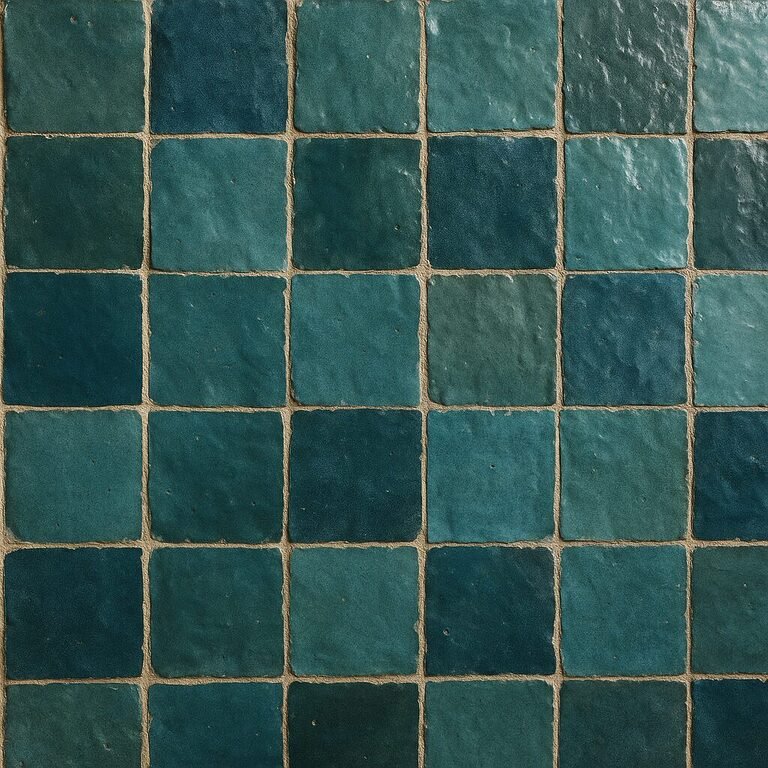
One of the first things you notice about a zellige tile wall is its surface. It is not flat: each piece reflects light differently, some shine more, others less, and some have small irregularities that cast tiny shadows. The result is an almost “moving” wall that changes throughout the day.
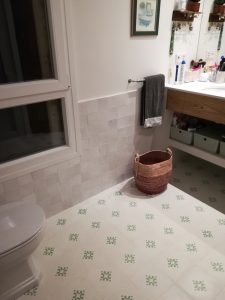
In a kitchen, a bathroom or a shower, that uneven sheen adds depth: the wall does not read as a flat, dull block but as a mosaic full of nuances. That is why it is so often used behind washbasins, on kitchen splashbacks and on shower walls: it always looks different.
Colour irregularity: tone variations that add character
Another key trait of handmade zellige is the colour variation between pieces. Even if you choose a single shade, you will find pieces that are slightly lighter or darker, with small clouds, marks or specks.
These colour variations create an almost watery, organic effect, as if you were looking at the surface of water. This richness of nuance is ideal if you want to avoid a flat finish: you can work with a single colour and still get a wall with visual movement and plenty of personality.
Uneven joints and imperfect edges
Irregular zellige can also be recognised by its edges, often slightly bevelled, a little chipped or of varying thickness. As a result, the joints are not perfectly symmetrical, and this is where it gets interesting: that “untidiness” is exactly what sets it apart from a mass-produced tile.
Rather than trying to hide these differences, good projects embrace them and accept that the lines will not be perfectly straight. The result is a much more approachable, human and warm visual language, ideal for residential spaces where the aim is to feel at home, not in a showroom.
How to make the most of zellige’s imperfection in your projects
If you like irregular zellige but are not sure how to use it with confidence, here are a few keys to getting the most out of it, in small renovations and professional projects alike.
1. Make it the star: a wall that says it all
One of the best ways to show off its imperfection is to concentrate it on a single feature wall, for example:
– The wall behind the washbasin in the bathroom,
– The kitchen splashback between the worktop and the wall units,
– An accent wall in the living room, behind the sofa or the fireplace.
By limiting zellige to a single plane, that plane becomes the visual focal point of the room. All the movement of sheen, shadows and irregular joints is concentrated there, creating a striking effect without overloading the space.
2. Pair irregular zellige with smooth materials
For the irregularity to really stand out, it works very well to pair zellige with more neutral, uniform surfaces. Think of:
– Plain worktops in natural stone or quartz,
– Microcement floors,
– Walls painted in soft matt shades.
That mix creates contrast: you let the handmade zellige provide texture and character while everything else balances the whole. It is like wearing one very special garment with an otherwise simple outfit: everything works better together.
3. Combine closely related shades to enhance depth
If you prefer bolder compositions, you can play with different shades from the same colour family, for example several blues, or greens ranging from olive to emerald. The irregularity of zellige itself will make those transitions look natural rather than rigid.
This approach gives you walls full of nuance, almost like an organic gradient, ideal for spa-style showers, Mediterranean kitchens or wellness areas in boutique hotels.
Common mistakes when working with irregular zellige (and how to avoid them)
Zellige’s imperfection is its strong point, but if it is not properly understood it can lead to disappointment. Here are some common mistakes, so that they do not catch you off guard.
Expecting a “catalogue-perfect” finish
The first one is obvious: if you expect surgically straight lines and a completely uniform colour, irregular zellige is not for you. It is not a mass-produced tile and does not try to be one; its charm lies in exactly the opposite.
Before choosing it, it is important to look at real photos, physical samples and, if possible, an area that has already been tiled. That way you get a realistic idea of the result, and you enjoy it much more afterwards, because you know that each piece will have its own character.
Choosing a grout that stands out too much
Another typical mistake is using a strongly contrasting grout without thinking it through. On a material that is irregular to begin with, a joint that is too dark or too light can visually exaggerate the differences between pieces.
If you want a softer effect, the usual choice is a grout in a shade close to that of the zellige. This helps the wall read as a whole, without the joints stealing attention from the play of sheen and tone.
Not hiring an experienced tiler
It may seem a minor detail, but it is not. Laying handmade zellige takes patience and a skilled hand: you have to select the pieces, work with the differences and distribute shades and thicknesses so that the whole looks balanced.
A good tiler understands that this is not a standard tile and works the composition as if it were a mosaic. If you are undertaking a major renovation, it is worth finding someone with specific experience in this type of wall covering.
Where irregular zellige works best
Versatility is another of the great advantages of zellige. It looks superb in residential projects, but also in commercial spaces that want to convey authenticity, craftsmanship and warmth.
Wet areas: bathrooms, showers and kitchens
Bathrooms are its natural habitat. Irregular zellige works beautifully in wet areas thanks to its glaze and its ability to reflect light; in small showers, for example, a light, glossy shade can make the space look larger.
In kitchens, its texture and sheen create very photogenic backdrops, perfect for contemporary projects with a nod to tradition or for updated rustic kitchens where the aim is materials with soul.
Commercial spaces with character
Restaurants, cafés, boutique hotels, fashion shops… all these spaces benefit from the visual strength of handmade zellige. A tiled counter, a bar or the wall behind the brand’s logo become memorable focal points.
In a world where many venues look too much alike, the texture, sheen and irregularity of zellige help build a unique, recognisable and highly sensory identity.