To clean a cement tile floor, all you need is warm water with neutral soap, a well-wrung mop and quick drying; never vinegar, muriatic acid, bleach or ammonia, because a cement tile is pigmented cement and acids burn it. Protection comes from a water- and oil-repellent, renewed when water stops beading on the surface. Look after it like this and a cement tile floor will last for decades.
At Demosaica we make cement tiles in our workshop in Seville, and the same questions keep coming up: what to mop with, how to bring an old floor back, whether it can be polished and how often to seal it. This guide follows our laying and maintenance manual (PDF) and what we see when something goes wrong.
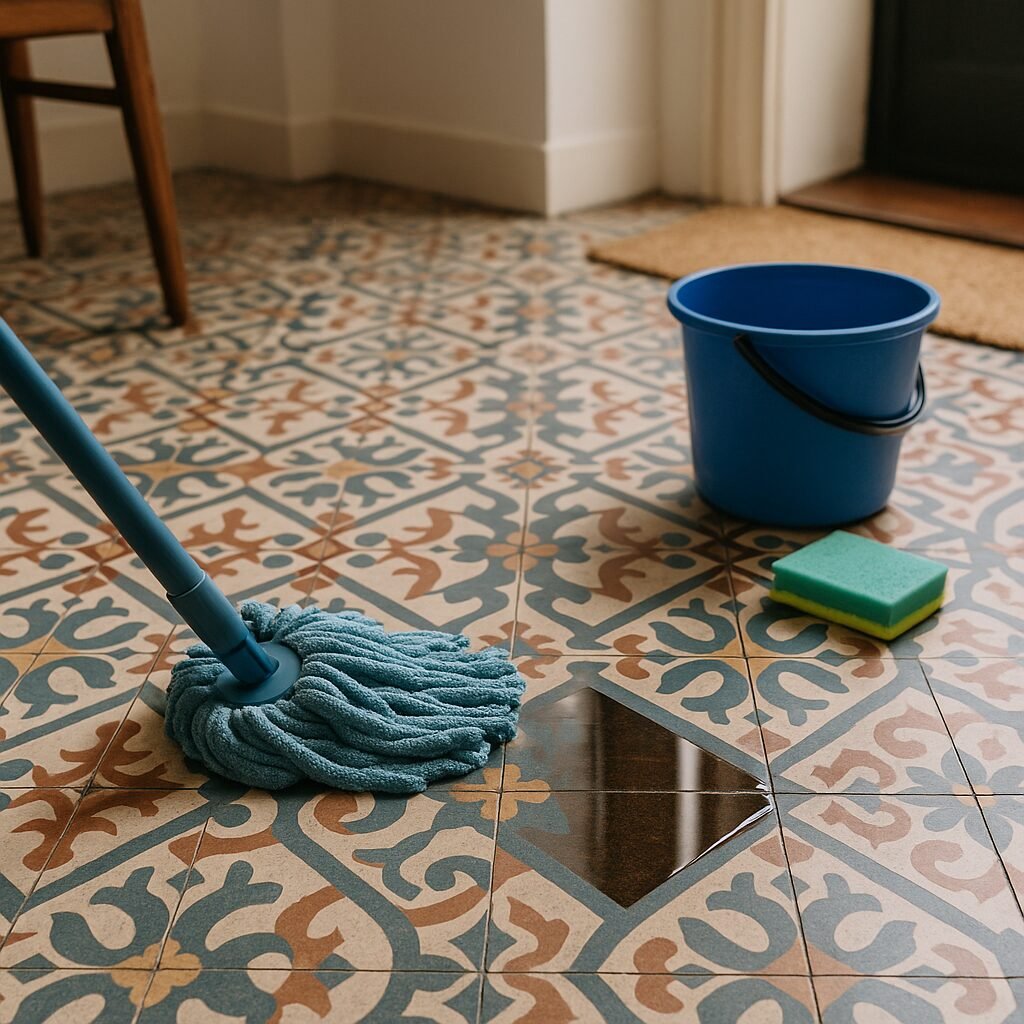
What should you use to clean a cement tile floor day to day?
A microfibre mop for dust and, when the floor needs washing, warm water with neutral soap and a thoroughly wrung-out mop. That is what our manual recommends, and it is what a properly treated cement tile will stand up to for years.
The everyday enemy is not dirt but grit: it acts like sandpaper under the soles of your shoes and dulls the satin sheen. Only wash the floor when it needs it.
- Neutral soap: liquid soft soap, Marseille soap or a cleaner such as FILACLEANER, the one named in the manual. Use only a little: too much leaves a film.
- A well-wrung mop: cement tile is porous and should never be left with puddles on it; standing water gets in through the joints and comes back as white stains.
- Drying with a dry mop in kitchens and bathrooms, to avoid water rings.
- Spills straight away: blot wine, oil or coffee with kitchen paper, without rubbing, then wipe with soapy water.
If the floor has been waxed, add the dose shown on the wax container to the water; if it only has a water-repellent, add nothing.
What products should you avoid on a cement tile floor?
Nothing acidic, nothing corrosive and nothing that scratches: vinegar, lemon, muriatic acid, descalers, bleach, ammonia, green scouring pads, metal scourers and blades. Our manual is categorical: clean with water and liquid soft soap or neutral soap, never with acid products, bleach or ammonia.
The reason is chemical. The face of a cement tile is cement, marble dust and pigments that set without firing: it is not ceramic. An acid, even a mild one like vinegar, dissolves that cement; the surface is left matt, rough and more porous, and the colour fades. It is not a stain: it is material that is no longer there.
Home remedies for cleaning cement tiles: which work and which don’t
| Remedy or product | Suitable for cement tiles? | Why |
|---|---|---|
| Warm water and neutral soap | Yes, it is the benchmark | Attacks neither the cement nor the sealer |
| Baking soda paste | Yes, occasionally | Mildly alkaline; useful on grease; rinse well |
| Vinegar or lemon | No | Acids: they dissolve the cement and dull the colour |
| Muriatic acid and descalers | Never | Like vinegar, but in minutes and with no going back |
| Bleach and ammonia | No | They leave rings, strip the sealer and dull the satin sheen |
| Steam cleaner | With reservations | Unnecessary; the heat shortens the life of the sealer |
How do you clean a very dirty or old cement tile floor?
With a diluted mild degreaser, enough time for it to work, a soft brush, plenty of rinsing and the patience to let the floor dry before you judge the result. What does not work is force: no acids and no DIY abrasive discs.
An old cement tile floor builds up dirt in its pores, oxidised waxes or oils and, sometimes, efflorescence. Test first on a hidden area. Work in this order:
- Diagnose. A few drops of water that darken the tile mean there is no protection; a yellowish film when you scrape with a fingernail means old wax or oil. Fix any loose tiles before wetting the floor.
- Vacuum thoroughly, joints included: mopping over grit means scratching.
- Degrease with a detergent for cement floors (our manual names FILAPS87, diluted as the manufacturer specifies), in small sections, leaving it to work without letting it dry and scrubbing with a soft brush or a gentle scouring pad.
- Rinse with plenty of clean water and pick it up with a wrung-out mop or a wet vacuum, until the water comes up clear.
- Strip only if wax or linseed oil remains, using a stripper for cement floors and testing it first.
- Let it dry completely, for several days if necessary: a damp floor looks darker and more even than it will once dry.
- Protect with a water- and oil-repellent and, if you want a sheen, wax on top.
- If it still looks bad (deep scratches, lippage between tiles, stains that have soaked in), it is time for professional polishing, not more product.
Smaller formats mean more joints to clean: a Chakar cement tile measuring 20 × 17 cm works out at 50 tiles per square metre, against 16 for a 25 × 25.
Restoring old cement tile floors: what can be recovered and what cannot
Anything that is dirt, wax, oil or surface wear can be recovered; colour that an acid has dissolved cannot, nor can a wear layer worn down to the grey body of the tile. Broken tiles are replaced: if the model is not in the catalogue, ask the workshop what can be reproduced from an original tile and how long it would take, as with any custom cement tile.
White stains: salts and efflorescence
The whitish haze that appears weeks after building work or after a leak is not dirt: it is salts that water carries with it as it evaporates through the cement. Brush it off dry, wash with clean water and let the floor breathe. Our manual points to the cause: a substrate that is not perfectly dry causes efflorescence stains, and the tiles must be left to breathe until all the construction moisture has escaped before the pore sealer is applied, since it closes the pores. Never use acid.
How do you remove specific stains from cement tiles?
Quickly, with the mildest product that works, and after a test. A well-sealed floor gives you time: the stain sits on top of the sealer and comes off with soap. Without protection, it soaks in within minutes.
| Stain | What to do | What to avoid |
|---|---|---|
| Grease and oil | Blot with paper; a mild diluted degreaser or baking soda paste; rinse | Strong solvents and harsh scouring pads |
| Wine, coffee, tea | Water and neutral soap as soon as possible; if it has soaked in, degreaser and then a fresh coat of water-repellent | Bleach: it leaves a ring paler than the stain |
| Cement and grout haze | Plenty of water and a soft scouring pad; diluted FILAPS87 if it persists | Muriatic acid, vinegar and tinted grouts, which stain permanently |
| Rust from furniture legs or plant pots | Acid-free rust remover, the kind formulated for marble, tested first | Phosphoric acid and acid-based rust removers |
| Mould in the joints | Diluted hydrogen peroxide or an acid-free joint cleaner, a soft brush and ventilation | Bleach and ammonia, ruled out on cement tiles |
Good grouting prevents half of these problems: 1 to 2 mm joints, untinted grout and wiping off the excess straight away with a damp cloth, as we explain in the guide to laying cement tiles.
Can a cement tile floor be polished?
Yes. A cement tile is concrete with a colour layer a few millimetres thick, and it can be machine-polished, just like terrazzo. But it is a last resort, not maintenance: every polish uses up part of that layer.
It makes sense where there is uneven wear, deep scratches or stains that no stripper will shift. On a floor that has already been polished several times it may be impossible: if the wear layer has worn too thin, the disc cuts through it and the grey body of the tile shows.
The professional process is done wet, with a rotary single-disc machine and abrasives of progressively finer grit, taking off tenths of a millimetre. Afterwards the slurry has to be vacuumed up and the floor dried and treated again, because polishing opens the pores. The natural finish is a matt satin; gloss comes from a wax or a sealer, as we explain when comparing matt and gloss finishes.
- Ask for a test in a corner before accepting the quote.
- Look for polishers with experience of cement and cement tiles, not just marble; no orbital sanders or DIY angle grinders, which leave waves and burn marks.
- Fix loose tiles and replace broken ones first; the machine will tear them out.
How often should a cement tile floor be sealed or treated with a water-repellent?
When water stops beading. Sprinkle a few drops: if they stay as beads and the tile does not darken, the treatment is still working; if they soak in within seconds, it is time to renew it. As a rough guide, every one or two years in homes and sooner in commercial premises.
A water-repellent is needed because the material absorbs water. Absorption coefficients measured in the laboratory on our tiles:
| Material | Water absorption | Test standard |
|---|---|---|
| Hydraulic terrazzo 20 × 20 cm | 5.9–6.2 % | UNE-EN 13748-1 |
| Glazed zellige 10 × 10 cm | 15.7 % | UNE-EN ISO 10545-3 |
| Terracotta 15 × 5 cm | 16.9 % | UNE-EN ISO 10545-3 |
| Porcelain stoneware (benchmark) | less than 0.5 % | — |
Cement tiles and hydraulic terrazzo are the same material, concrete that sets without firing (UNE-EN 1339, the Spanish version of EN 1339); zellige and terracotta are ceramics. The test reports are on our laboratory tests page.
What we recommend at Demosaica is a water- and oil-repellent, not a lacquer or a varnish: in our manual, FOB XTREME or MP90 ECO XTREME by FILA (one or the other, never both on the same tile). It penetrates the pores, stops water and grease getting in deep and does not change the look of the material.
- On clean, completely dry tiles; ideally, treat the tiles before laying them or, at the very least, before grouting, so that the grout does not stick to the colour layer.
- One thin, even coat applied with a brush, without overdoing it.
- Respect the manufacturer’s drying time before walking on the floor and before applying wax, if you want a sheen.
What about linseed oil?
It was the traditional treatment and many old floors still have it. It saturates the pores and darkens the colour, but it oxidises: it yellows, turns sticky, attracts dirt and is hard to remove. Today, water- and oil-repellents protect without changing the colour or breaking down.

How can you make a cement tile floor last longer in kitchens, bathrooms and high-traffic areas?
By removing grit before it scratches, protecting furniture legs and renewing the water-repellent in good time. It is not use that wears a hallway down: it is sand.
- Doormats at entrances and rugs in high-traffic areas: they trap the sand.
- Felt pads on chairs and tables; never drag furniture or appliances.
- In kitchens, a washable mat in front of the hob and the sink.
- In bathrooms, ventilate and do not leave standing water; with a water-repellent and sound joints, the floor holds up well.
And a realistic schedule:
| Frequency | What to do | With what |
|---|---|---|
| Daily or depending on use | Remove dust and grit | Microfibre mop or vacuum cleaner with a soft brush |
| Weekly | Wash the floor | Warm water and neutral soap (or FILACLEANER), a wrung-out mop, then dry |
| Every 6–12 months | Check the protection | Water-drop test; if it soaks in, renew |
| When the drop soaks in (roughly 1–2 years) | Renew the treatment | FOB XTREME or MP90 ECO XTREME on a clean, dry floor |
| Only when needed | Deep clean, stripping or polishing | Diluted FILAPS87; stripper; professional polisher |
Do the same products work on ceramic wall tiles and bathroom zellige?
No. A glazed tile tolerates what is forbidden on a cement tile, because its face is fired glass: diluted vinegar for limescale and cement residue, phosphoric acid for rust, alcohol for oils, alkaline detergent for wine or beer and hydrogen peroxide for blood or iodine. But its joints are cement: rinse off any acid straight away.
Zellige calls for more care. With that 15.7 % absorption, the clay body and the unglazed edges soak up liquid: it needs a water-repellent just like cement tile, and any acid that reaches an edge or a joint leaves a mark. We cover the typical problems in our article on zellige defects.

Frequently asked questions about cleaning and maintaining a cement tile floor
Can you clean a cement tile floor with vinegar?
No. Vinegar is acetic acid and a cement tile is cement: the acid dissolves the colour layer, leaves it matt and rough, and the damage cannot be undone. Although the trick is often recommended for floors in general, on cement tiles use warm water with neutral soap and, for stains, a mild diluted degreaser.
How do you clean an old cement tile floor without damaging it?
Vacuum, degrease with a diluted cleaner for cement floors and a soft brush, rinse until the water comes up clean and leave it to dry for several days before judging. If there is wax or linseed oil, strip it after a test. Finish with a water- and oil-repellent: without protection, the open pores stain again straight away.
Can a scratched cement tile be polished?
Yes, wet, with a rotary single-disc machine and abrasives of progressively finer grit, and always by a professional with experience of cement. It takes tenths of a millimetre off the colour layer, so it is a solution for real wear, not maintenance. Afterwards the surface has to be treated again.
Is linseed oil good for cement tile floors?
Not any more. To find out whether your floor has it, scrape a corner with your fingernail: if a yellowish, sticky film comes away, it is oxidised oil. That layer attracts dirt and dulls the pattern, and the solution is to strip it and apply a water- and oil-repellent, which protects against water and grease without yellowing or altering the colour.
Why does a cement tile floor look whitish after mopping?
There are two causes. If the haze comes off with clean water, it is too much soap or product: use less and rinse. If it comes back on its own, it is salts brought up by moisture (efflorescence): the floor needs time to dry, dry brushing and washing with water, and it should not be sealed until the salts stop appearing. In both cases, no acids.
Should a cement tile floor be waxed, or is a water-repellent enough?
The water-repellent protects; wax only adds shine. It builds up in layers, yellows and holds on to dirt, so it has to be stripped and reapplied. Our manual does not include waxes among the recommended treatments, only water- and oil-repellents. If you want shine, apply it over a floor that is already protected, and it is best to avoid the steam cleaner: the heat softens the wax.
If your cement tile floor no longer responds to cleaning, or you are about to lay a new one, send us a few photos or visit our Seville showroom by appointment: together we will work out which treatment suits it and what options there are for replacing tiles. Contact the workshop and ask for samples to test the cleaning at home.