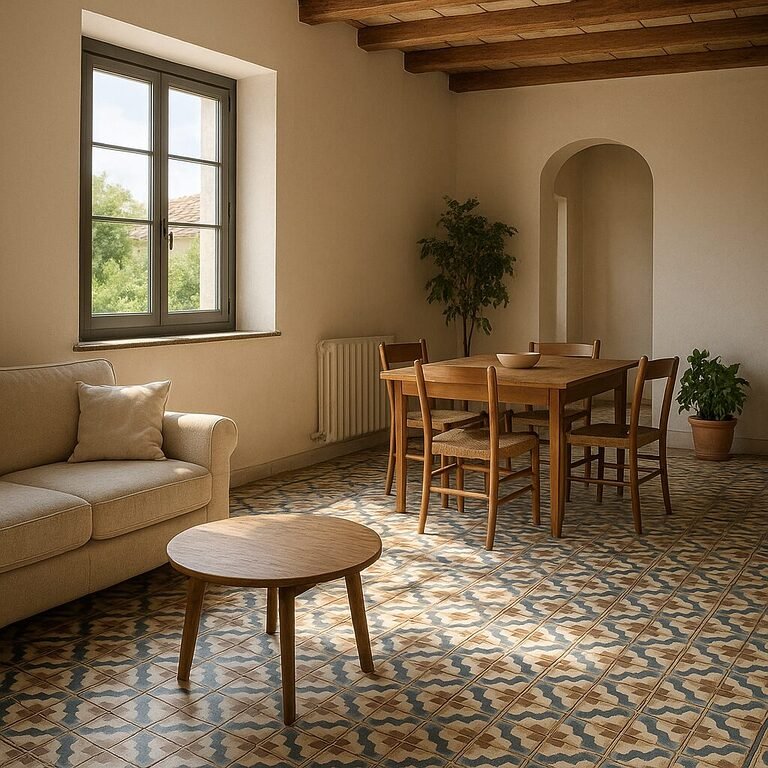
Have you noticed that a house with cement tile floors “feels” cool in summer and more stable in winter? It is no coincidence. Beyond their design, cement tiles contribute to energy efficiency thanks to their thermal mass, the way they respond to heat and their durability. If you are planning a renovation or a new build, here is why this classic floor covering is a modern ally of comfort and savings.
How cement tiles improve indoor energy efficiency
Cement tiles (also known as encaustic or hydraulic tiles) are pieces made of pigmented cement and mineral aggregates. That composition gives them thermal inertia: they store heat or coolness and release it slowly. The result? Fewer temperature peaks, a more stable microclimate and less reliance on air conditioning or heating.
Thermal mass: the “bank” for storing heat and coolness
Think of thermal mass as a silent battery. During the day the floor absorbs some of the heat; as evening falls, it gives it back gradually. In summer, if you ventilate at night, the tiles “charge up” with coolness and help to soften the following day. In winter, with a local heat source or good sun exposure, that useful heat lasts longer. This effect fits very well with homes built to bioclimatic design principles or to Passivhaus-type standards, where thermal stability is key.
Transmittance and contact: the advantage of mineral floor coverings
Unlike highly insulating floors, cement tiles have a balanced conductivity that favours a feeling of thermal comfort to the touch without “stealing” too much heat. They do not replace insulation (that belongs in floor slabs, walls or under the screed), but they work with it to improve the whole: they store and modulate, while insulation reduces losses.
A perfect match for underfloor heating and efficient climate control
If you want performance with low consumption, combine cement tiles with underfloor heating. The system works at low temperature, the tiles spread the heat evenly and the thermal mass acts as a buffer that prevents constant switching on. Efficiency and comfort, with no further complications.
Even response, fewer peaks, lower consumption
Cement tiles distribute the energy from the radiant circuit very well. Because they bond well with the mortar and form a continuous surface, stratification is reduced: even heat, no cold spots and lower demand. Fewer peaks, fewer start-up cycles, more savings.
In summer: passive cooling without gimmicks
With night-time ventilation and daytime shading, the floor acts as a thermal “refuge”. Choosing light colours and matt finishes can also improve its behaviour under solar radiation: less incidental solar absorption and a floor that feels cooler. This is where mineral pigments come into their own, without losing colour over time.
Acoustic comfort and indoor well-being
Comfort is not just about temperature. The density of a cement tile floor helps to control vibrations and slightly improves perceived acoustics compared with hollow or very light floors. And although sealing reduces porosity (as it should, for maintenance), the floor as a whole contributes to a sense of stable humidity and temperature that is pleasant in everyday life.
Installation: details that boost energy performance
Efficiency starts on site. Careful installation makes the difference between “beautiful” and “beautiful and efficient”.
Stable base, suitable mortars and full contact
Look for a base that is well levelled, sound and dry. Use high-performance mortars or tile adhesive to ensure full contact, with no air pockets to break thermal continuity. A fine, well-grouted joint also helps heat to transfer evenly.
Sealing, water-repellent treatment and smart maintenance
Apply a sealer and a water-repellent made specifically for cement tiles. As well as protecting against stains and moisture, they stabilise the behaviour of the material and make cleaning with neutral products easier. A well-maintained floor keeps its thermal and aesthetic properties for decades, reducing the need for replacements and therefore the energy impact of future works.
Energy retrofit: where cement tiles fit in
If you upgrade the building envelope (façades, roofs, windows) and add a cement tile floor, you get a winning combination: lower losses through transmittance and a greater capacity to stabilise the indoor environment. In the energy retrofit of historic homes or Mediterranean-style houses, it is an option that respects their identity and improves comfort without clashing with the original architecture.
Sustainability and carbon footprint: durability that counts
The pieces are made from cement, aggregates and mineral pigments. Unlike ceramic tiles, they do not need firing, which saves energy in manufacturing compared with high-temperature processes. Their very long service life and the possibility of polishing them or replacing individual tiles reduce future work and the emissions that go with it. Less building work, less waste and a smaller carbon footprint over the whole life cycle.
Climate, use and style: when to choose them
In temperate and Mediterranean climates, the cool character of cement tiles really shines. In cold areas, combined with underfloor heating or passive solar gains, they provide stable, pleasant comfort. In kitchens and living areas, where everyday use generates heat, the thermal mass makes the most of it; in bedrooms, it helps to keep nights balanced. And, of course, there is the design: patterns, colours and geometries turn the floor into a “mineral rug” that never goes out of fashion.
Quick tips to get the most out of them
Plan for light and solar gains
Increase shading in summer and let in the low winter sun. The floor will do the rest, storing or releasing energy naturally.
Combine them with good insulation
Thermal mass modulates, insulation prevents losses. Together they make your home efficient, comfortable and easy to heat and cool.
Mind the colour and finish
Light tones multiply brightness and can reduce surface heat absorption in very sunny areas; dark ones bring character and visual warmth. Matt finishes tend to be “kinder” to diffused light.
At Demosaica, design and performance go hand in hand
At Demosaica we make cement tiles with high-quality materials so that you can enjoy good looks, energy efficiency and strength. If you are looking for a floor with soul that also takes consumption, comfort and sustainability into account, cement tiles are that discreet ally that transforms your daily life without seeking the spotlight, like a good thermal “regulator” underfoot.