A cement tile floor works in living rooms, hallways and entrances because it is made of cold-pressed mortar, with a colour layer several millimetres thick that does not wear away underfoot. The twelve real projects brought together here — from Seville, Granada, Mallorca and Tarragona to Hanover and the Czech Republic — show what has to be decided in each room: a tile rug or a continuous floor, the border, the skirting and the colours.
Why do cement tile floors work in living rooms, hallways and entrances?
Because the pattern is inside the tile, not printed on top: the wear layer is pigmented cement pressed onto a mortar base. It is not fired; it sets. And because these are the three rooms where the floor is seen in full, with no kitchen units or bathroom fittings covering it. That is why the projects in this article almost always come down to the same choice: a framed tile rug that brings order to the space, or a continuous floor that draws the eye through to the far end.
Four living rooms with cement tile floors and the designs used
Four projects, each giving the floor a different degree of prominence.
Living room in Mallorca: Mod. 210 tile rug with a plain MC40 border

The field of the rug is Mod. 210, a floral and geometric design by our London-based designer Maria Starling, customised in dark green (MC40), light grey (MC41) and dark grey (MC48). The frame was made with the plain Mod. MC40 tile from our stock catalogue, in the same green, so that the pattern in the field stands out.

Living room in Tarragona: stock Mod. 288 in white and grey

There is no rug here: the whole living room was laid with Mod. 288, a delicate floral design with an updated classic feel. It comes from our catalogue of cement tiles in stock (20 × 20 cm, 15 mm thick and 1.30 kg per tile), so it was supplied with no production lead time. All our cement tiles are certified asbestos-free.
Living room in Pilas (Seville): Mod. 204 with a Mod. 9 border and plain skirting

A traditional style and neutral tones: Mod. 204 in white (MC1), navy blue (MC44) and dark grey (MC47), a Mod. 9 border in the same shades and plain white skirting. When floor, border and skirting share one palette, a patterned floor does not look like a patch.
Living room in Pilas: Mod. 127 in white, red and black

The opposite extreme: Mod. 127 in white (MC1), red (MC22) and black (MC49), a traditional design that forms geometric flowers when the tiles are laid in groups of four. In a living room of this size the pattern holds its own; in a small one it would swallow the space. It was made to order.
Which floors for hallways and entrances stand up to daily foot traffic?
They are the areas with the most traffic and the first thing you see when the door opens. The following three projects sum up the usual solutions.
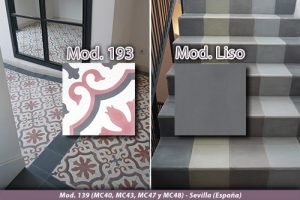
Entrance and hallway in Granada: Mod. 193 in cool tones

A continuous floor in Mod. 193, in white (MC1), turquoise (MC6), green (MC9) and sky blue (MC36). Cool, very bright tones give the house a fresh feel: the floral pattern is completed every four tiles and draws the eye towards the far end. As it was a made-to-order design, the client waited several weeks for the material.

Hallway in Hanover: Mod. 137 tile rug with a Mod. C6 border

We are not often asked for cement tile rugs for a hallway, and this order came from Hanover (Germany). The client combined Mod. 137 in white (MC1), green (MC11), aubergine (MC34) and greys (MC47 and MC48) with the Mod. C6 border and ogee skirting. Framing the rug has a practical advantage: the surrounding band takes up the leftover width, which almost never works out to a whole number of tiles. There are more ideas in our article on creating visual paths in hallways.
An entrance with Mod. 240, Mod. 243 and plain Mod. 100 tiles

In this entrance, designs 240 and 243 by the designer Blanca Gortari were combined with the plain Mod. 100 tile. The pattern colours were kept, but the background was changed to yellow (MC17), the same shade as the plain tiles, so the whole floor reads as a single piece. It is a project by our distributor in France, and it shows that cement tiles also fit into contemporary design.
How do you set out a cement tile rug?
From the centre of the pattern outwards, never from the wall. This is the order on site:
- Measure the room clear of fitted furniture and draw the rug to scale on the plan, border included.
- Mark the true centre of the room — or the visual centre as seen from the door, if the two do not coincide — and draw two perpendicular axes.
- Dry-lay the field tiles until you have checked that the pattern closes on all four sides.
- Lay the border first: it is what fixes the final size.
- Lay the field and then the surrounding floor, leaving the cuts against the skirting.
- Fill the joints with grout in the chosen shade and apply the treatment before the room is used.
Before you start, the screed or levelling compound must be dry — laying on a damp base encourages efflorescence — and the substrate must be clean and provide a good key. The rest is in our guide to laying cement tiles.
To work out quantities, start from the number of tiles per m² for each format:
| Format | Ref. | Size | Weight per piece | Units |
|---|---|---|---|---|
| Square | H02 | 25 × 25 × 1.8 cm | 2.30 kg | 16 pcs/m² |
| Square | H03 | 20 × 20 × 1.5 cm | 1.30 kg | 25 pcs/m² |
| Square | H04 | 15 × 15 × 1.5 cm | 0.79 kg | 45 pcs/m² |
| Rectangular | H11 | 30 × 15 × 1.6 cm | 1.45 kg | 23 pcs/m² |
| Rectangular | H13 | 20 × 10 × 1.5 cm | 0.62 kg | 50 pcs/m² |
| Hexagonal | H21 | 30 × 20 × 1.7 cm | 1.62 kg | 21 pcs/m² |
| Tile insert | H07 | 7 × 7 × 1.5 cm | 0.25 kg | 205 pcs/m² |
| Ogee skirting | HR11 | 20 × 10 × 1.5 cm | 0.64 kg | 5 pcs/linear m |
A 2 × 3 m rug in the H03 format takes 150 tiles for the field (6 m² × 25 pcs/m²), plus the border and the skirting. The full list, including less common formats such as the Chakar cement tile, is on our cement tile formats page.
Mistakes we see in these three rooms
- Centring the rug on the door rather than on the room.
- Choosing a busy pattern for a living room that will have a fabric rug and a sofa on top of it.
- Forgetting matching skirting: in Hanover and in Pilas, it is what finishes off the whole scheme.
Can cement tiles be laid over underfloor heating?
Yes. This sitting room in England has Mod. 308 in white (MC1) and turquoise (MC6) laid over underfloor heating, and running the heating has not damaged the tiles. Cement tiles are made of cement mortar: they conduct heat well and have no plastic layers that could come unstuck with the heat.

Mod. 308 is also a good example for a small room: geometric and with little detail, it does not overload the space even though the colours are bright. You do need to respect the setting times and bring the heating up gradually; the most common failures are covered in our article on mistakes when laying cement tiles over underfloor heating.
Which colours should you choose for the light in each room?
The less natural light there is, the lighter the background and the fewer different colours in the pattern.
- Windowless hallways and entrances: a white (MC1) or off-white (MC3) background with the pattern in one or two cool tones, like Mod. 193 in Granada.
- Grey cement tiles: the greys that come up most often here are MC46, MC47 and MC48, almost always on a white background. The safest option if the living room already has wood or coloured fabrics.
- Blue cement tiles: navy blue MC44 appears in the Pilas living room and in the Czech house; the sky blues MC36 and MC37 and turquoise MC6 are softer.
- Black and white: MC1 and MC49, in a chequerboard or a geometric pattern, like Mod. 123-A in Cortegana.
- Living rooms with plenty of light: they can take dark greens and deep greys, like the MC40 and MC48 in Mallorca.
All the shades mentioned are from the MC1–MC49 cement tile colour chart; on single-colour tiles, variations in shade are more noticeable.
Can cement tiles take the traffic of an entrance? What the tests say
Yes. The test reports for our products are published and signed by Elabora, a laboratory listed under number AND-L-155 in the Register of Testing Laboratories of the Junta de Andalucía, the Andalusian regional government.
| Product tested | Property | Result | Standard and test report |
|---|---|---|---|
| Cement tile | Format tested | 200 × 200 × 15 mm | UNE-EN 1339:2004 · test report no. 9102 (28/05/2024) |
| Hydraulic terrazzo 20 × 20 cm | Slip resistance (Rd, wet pendulum) | 59.5 → class 3 | UNE 41901:2017 EX · test report no. 4718 |
| Hydraulic terrazzo 20 × 20 cm | Water absorption | 5.9 – 6.2 % | UNE-EN 13748-1 · test report no. 4718 |
Two caveats. The slip resistance value is for the hydraulic terrazzo, not for the patterned cement tile: they are different products, and their figures should not be mixed. And class 3 is the top of the scale in the Spanish Building Code (CTE, DB-SUA 1), the class required outdoors, in swimming pools and in showers; a dry living room or hallway sits at the opposite end. You can download the full test reports and cite them in a project specification.
What does a home with cement tile floors throughout look like?
Cement tiles rarely stay in just one room: once they come in through the front door, they usually carry on into the kitchen, the bathrooms or the courtyard.
Mrs Dobson’s house (France)

In the kitchen, Mod. 189 by Yela Álvarez Ariza in off-white (MC3), turquoise (MC6) and dark green (MC9). The private bathroom has Mod. 160 with a plain Mod. 100 border and skirting in white (MC1), sky blue (MC37) and blue (MC39); the shared one has Mod. 189 with a Mod. 43 border in greens. All of them are custom designs.
House in the Czech Republic: patchwork in the kitchen and bathrooms

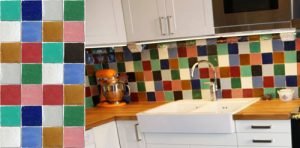
In the kitchen, twelve designs — 123-B, 123-C, 124, 133, 139-A, 140, 144, 154, 181, 210, 221 and 252, some from stock and some custom — were combined on the splashback and up to half height on the walls, finished with the Mod. 31 border. One bathroom repeats the idea with designs 133, 139, 140 and 210. Patchwork is the answer when you want character without committing to a single pattern.
Rustic house in Vejer de la Frontera: stock Mod. 211

Mod. 211, also by Maria Starling, comes in white (MC1), green (MC9), pinks (MC28 and MC29) and greys (MC46 and MC48): a soft combination that works with whitewashed walls and wooden joinery. Being a stock design, it was shipped as soon as the order was confirmed.
Inner courtyard in Cortegana: Mod. 123-A in black and white

Mod. 123-A rugs across the courtyard, the steps and the window sills, with a plain white border and an MC49 tile marking the drain. All in 20 × 20 cm, at 1.30 kg per tile. We do not recommend cement tiles outdoors, because sun exposure makes the colours shift. It worked here because this is an inner courtyard that gets little sun.
Cement tile living rooms, hallways and entrances: frequently asked questions
Which floor is best for a narrow hallway?
A pattern with a small repeat, or a rug framed by a border, works better than a continuous floor with a large pattern. With a small repeat, the cuts against the wall go unnoticed and the hallway reads as orderly; with a large pattern, every cut tile stands out.
Can I lay cement tiles in the living room only and keep wood everywhere else?
Yes, it is a common combination. The key is where the two floors meet: set out the cement tile area first, bring both floors to the same level and close the joint with a transition strip or by adjusting the last row. Decide this before you buy, because it determines the thicknesses.
Does the pattern wear off with foot traffic in an entrance?
No, because the colour is not a surface print: it is a wear layer of pigmented cement several millimetres thick, pressed together with the rest of the tile. What does wear away is the protective treatment, which should be renewed depending on use: always clean with pH-neutral soap, never with bleach or acids.
How many tiles do I need for a 2 × 3 metre rug?
With the 20 × 20 cm square format (ref. H03, 25 pcs/m²), you need 150 tiles for the 6 m² field, plus the 10 linear metres of surrounding border and the skirting, if there is one. Always add extra for cuts and replacements.
Are there grey or black and white designs ready to ship?
Yes. Some designs and colours are in the stock catalogue and are supplied with no production lead time, such as Mod. 288 in Tarragona or Mod. 211 in Vejer. Custom designs do have a lead time: the made-to-order jobs in this article waited several weeks. Check availability with the workshop before setting dates for the work.
Can I use cement tiles for an outdoor entrance or a porch?
We do not recommend it: direct sun exposure makes the colours shift over time. In inner courtyards that get little sun, like the one in Cortegana, it has worked well. For outdoor areas, it is better to consider another product family and discuss it with the workshop.
If you are choosing the floor for a living room, a hallway or an entrance, the next step is to see more of the material in real settings in our cement tile photo gallery. Tell us the measurements of the room and we will tell you which designs would suit it and which are in stock.