Zellige is a glazed clay tile, fired and cut by hand in Morocco, used above all as a wall covering: kitchen backsplashes, bathroom walls and floors, stair risers, courtyards, showers and swimming pools. Here we have gathered zellige projects built in Spain, Italy and Finland, with the model, the format and the colour reference used in each one.
Which parts of the house does zellige work well in?
On any vertical surface, and on floors with moderate domestic use. It is a porous material cut piece by piece: the more water and the more traffic there is, the more the substrate, the joint and the subsequent treatment matter. This is how it was resolved in these projects with handmade Moroccan zellige.
| Area | How it was used | Formats that fit best | What to watch out for |
|---|---|---|---|
| Kitchen backsplash | Patchwork, horizontal border or full panel | Mjeddij 10×10 and 5×5, panels, 3×3 pieces | Grease and properly sealed joints in the cooking area |
| Countertop and splashback | Terracotta grid with zellige diamonds | 10×10 terracotta with small pieces | Household acids on unsealed joints |
| Bathroom wall and shower | Full-height or half-height tiling | Mjeddij 10×10, Bejemat 15×5, Chakar 5×5 | Waterproof the substrate before tiling |
| Bathroom floor | A “rug” of panels framed within another floor | 29×29 and 30×30 cm panels | Domestic use and sealer; not for heavy traffic |
| Staircase | Motifs and borders on the riser | Mjeddij 10×10 and 5×5, carved pieces | Leave the tread in a harder material |
| Courtyard, fountain and pool | Floors, walls, ceilings, fountains clad piece by piece, pool shell | Loose 10×10 and 5×5 pieces, panels | Frost risk and watertightness of the substrate |
What does a zellige kitchen backsplash look like?
This is the application that gets the most out of the material: a small, highly visible surface with no traffic, where the uneven sheen of the glaze shows from day one. There are three ways to approach it and all three appear in these projects: a patchwork of colours, a horizontal border or a full panel.
A ten-colour patchwork in Helsinki
This Finnish client designed his own backsplash by combining ten references from our zellige colour chart: ZC201, ZC202, ZC206, ZC210, ZC211, ZC214, ZC215, ZC220, ZC221 and ZC228. The pieces are Mjeddij, 10×10 cm and 1 cm thick, weighing around 0.16 kg each, at 100 units per square metre: a 3 m² backsplash is covered with about 300 pieces plus an allowance for cuts. Within a single colour there are variations in tone and sheen: in a patchwork, that irregularity is the design.


A border as the axis of the tiling, in Ravenna
In this Italian kitchen, laid by the ceramicist Elisa Simoni, our zellige Border 2 was used: two neutral shades — white ZC1 and brown ZC8 — plus a pink ZC12 that lifts it. The order of work matters: the border was set out first at the chosen height and, from that line, the rest of the wall covering. This prevents a decorative band from ending up out of square with the units and the countertop.


Nzik panel with a 3×3 border
Another kitchen was resolved with one of our zellige panels: the Nzik panel mixed in two very close shades — ZC215 and ZC216 — and finished with a border of 3×3 cm pieces in ZC215. The loose Nzik piece (ref. ZS21, 14.5 × 8.5 cm) is an elongated diamond that yields 168 units per square metre: it covers little ground, but it draws a great deal.
Zellige and terracotta countertops in Cádiz
In the kitchens of a holiday resort in the province of Cádiz, the zellige came off the wall and onto the countertop. The top combines square 10×10 cm terracotta with zellige diamonds in yellow ZC16, green ZC21 and blue ZC28, and the edge is finished with a wooden batten. The splashbacks are covered with square Mjeddij pieces and closed off with rectangular terracotta; hand-painted basins were fitted as sinks.


How do zellige and cement tiles work together in a bathroom?
The formula that keeps coming up is simple: a patterned hydraulic floor with a single-colour zellige wall, or the other way round. If both carry a pattern, the bathroom becomes saturated. The three criteria that work in these projects:
- Only one of the two materials carries a pattern.
- A bridging colour that repeats on floor and wall.
- A skirting board or border to resolve the junction.
Patterned floor, plain wall
In two bathrooms, hydraulic tile model 189 was used with a variation: the original design has four corners in a different colour, and here they were ordered in the background colour, which completely changes how the pattern reads. In a home in Ávila the floor is a checkerboard of plain tiles alternating with model 155, and the wall is finished in 10×10 zellige in one of the pinks from the chart.
Zellige diamonds over a floral model
Hydraulic tile model 126B — dark pink MC29 background with a white MC1 pattern, 20×20 cm format — completes its design when the pieces are grouped in fours. Above it, Nzik zellige diamonds (ZS21) in ZC204 and ZC226, and a cove skirting board in MC1.

Zellige rugs on the bathroom floor
A device that works in small bathrooms is to frame a zellige “rug” within the floor: in one of them, with the Muthaman panel in ZC204 and ZC211. In a rental apartment in Toledo, the 29×29 cm Katyani panel (ZC202, ZC211 and ZC223) was used on the wall, forming a rug alongside the 30×30 cm Mdoudab panel in ZC211. We explore this mixing of materials in our article on how to combine hydraulic tiles and zellige in a single project.
Can zellige be used on a staircase or on the floor?
On the riser — the vertical face of the step — without reservation: it is the ideal surface for a colour motif and nobody treads on it. On the tread it needs to be assessed. Our 10×10 zellige showed visible defects at 750 revolutions in the abrasion test (UNE-EN ISO 10545-7), which places it in class 3 — moderate domestic use — and rules it out for a shared landing or a business with continuous footfall.
One project in communal areas combined both: a zellige mural with a twelve-pointed star in shades of blue, zellige on the stair risers and, on the floor of the central courtyard, fired clay in the 15×5 cm Bejemat format laid in a herringbone pattern. Another staircase was clad entirely in the Mdoudab panel. The practical rule: colour goes on the vertical, wear goes on a floor of clay, terrazzo or cement tile.
A note on slip resistance: the pendulum test requires an area of 124 × 76 mm, so with small pieces it has to be carried out on an already installed sample. If the project requires class 3 of DB-SUA 1 of the Spanish Technical Building Code to be justified, the measured figure we hold is the one for 20×20 cm hydraulic terrazzo: a PTV of 59.5 in wet conditions, test report no. 4718, published together with the rest of our laboratory test reports.
Does zellige hold up in courtyards, showers and pools?
Yes, and there are projects that prove it, on two conditions: a waterproofed substrate and a climate without hard frosts. Glazed zellige has an average water absorption of 15.7 % according to UNE-EN ISO 10545-3, and the water held in the pore expands as it freezes and breaks the piece from within.
| Material | Water absorption (average coefficient) | Test method |
|---|---|---|
| Glazed zellige 10×10 cm | 15.7 % | UNE-EN ISO 10545-3 |
| Terracotta clay 15×5 cm | 16.9 % | UNE-EN ISO 10545-3 |
| Hydraulic terrazzo 20×20 cm | 5.9 – 6.2 % | UNE-EN 13748-1 |
| Porcelain stoneware (market reference) | below 0.5 % | — |
On one rooftop, the pool was clad in hand-carved tile in the 10×10 cm Guijo model and the shower in 5×5 cm Chakar in two shades, ZC201 and ZC220.
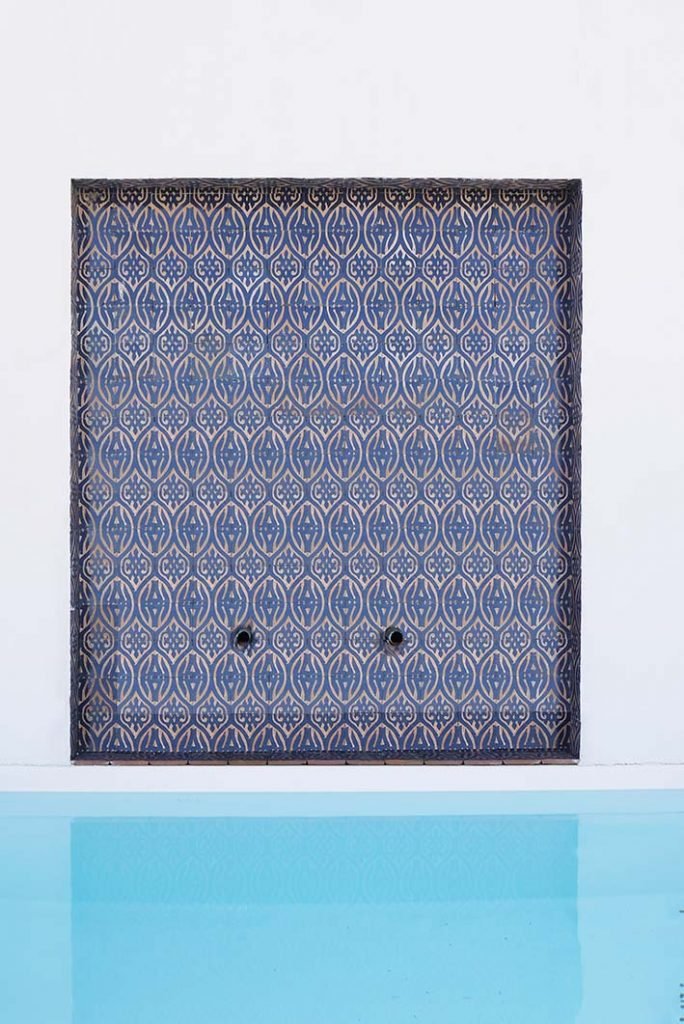
From a village in Seville we were sent photos of a courtyard resolved entirely in zellige and terracotta: floor, walls and even the ceilings, with loose pieces, panels and fired clay in several formats. The fountain was clad in zellige piece by piece to respect every corner, and the table combines zellige with wrought iron. In another design-led house, 10×10, 20×10 and 15×5 cm terracotta was composed with 5×5 Mjeddij zellige and 15×5 cm Bejemat in ZC201 and ZC220.

For porches, gardens and terraces, we go further into ideas and precautions in our article on using zellige in outdoor spaces.
How many zellige pieces are needed per square metre?
It depends on the format: from 100 pieces per square metre with the 10×10 Mjeddij to 1,111 with the 3×3 pieces. These are the formats that appear in the projects on this page.
| Model | Ref. | Dimensions | Weight | Units / m² |
|---|---|---|---|---|
| Mjeddij | ZS02 | 10 × 10 × 1 cm | 0.16 kg/unit | 100 |
| Mjeddij | ZS03 | 5 × 5 × 1 cm | 0.05 kg/unit | 400 |
| Mjeddij | ZS04 | 3 × 3 × 1 cm | 0.02 kg/unit | 1,111 |
| Bejemat | ZS15 | 15 × 5 × 1.5 cm | 0.18 kg/unit | 134 |
| Nzik | ZS21 | 14.5 × 8.5 × 1 cm | 0.10 kg/unit | 168 |
| Chakar | ZS33 | 5 × 5 × 1 cm | 0.02 kg/unit | 800 |
The full list of zellige formats covers the remaining families — Fekroun, Darj, Kora, Ders — with dimensions, weights and units per square metre. An allowance for cuts, breakages and replacements should always be added to the calculated quantity: as this is a handmade product, two batches made at different times are never identical.
How do you order and lay a zellige project?
The order matters: almost every disappointment with zellige tiling comes from choosing the colour without seeing the piece, or from laying without mixing boxes.
- Measure the actual surface of the backsplash, wall or pool shell and add an allowance for cuts and replacements.
- Choose the format first and the colour second. The size of the piece sets the rhythm of the wall; the colour only shades it.
- Ask for physical samples and look at them in the space itself, vertically and at different times of day: the glaze changes considerably with the light. Confirm availability and lead times with the workshop as well, because some models are held in stock and others are made to order.
- Mix pieces from several boxes before laying, so the variations in tone are spread across the whole wall instead of being concentrated in one corner.
- Prepare the substrate: flat, dry, stable and — in a shower, courtyard or pool — waterproofed. Use the double-buttering method with a flexible adhesive, with no air pockets under the piece.
- Grout, treat and clean. Zellige is laid with a minimal joint and the tone of the grout defines the result; afterwards, apply a sealer in wet areas and clean with neutral products, avoiding abrasives and strong acids.
Frequently asked questions about zellige projects
Can zellige be laid on the floor?
Yes, on floors with moderate domestic use and always sealed. The abrasion test on our 10×10 zellige showed visible defects at 750 revolutions (class 3, UNE-EN ISO 10545-7), so in areas with continuous footfall it is best kept for walls, resolving the floor in clay, terrazzo or cement tile.
Does zellige withstand outdoor use and frost?
In a mild climate it works well, and there are courtyards, showers and pools resolved this way. The critical point is frost: with an average absorption of 15.7 %, the water retained in the pore expands as it freezes and can burst the piece. Its durability depends on the substrate being waterproofed and the joint sealing properly.
Can zellige be combined with cement tiles or terracotta?
Yes, and it is one of the combinations that recurs most in these projects: a hydraulic floor with a zellige wall, terracotta countertops with zellige diamonds, or courtyards where all three materials live together. The rule is that only one of them carries a pattern while the others accompany it in plain colours.
How many colours should be mixed in a kitchen backsplash?
It depends on the role you want it to play. With one or two close shades — such as the Nzik panel in ZC215 and ZC216 — the backsplash acts as a background; with ten, as in the Helsinki patchwork, it becomes the main feature. If the units already have colour or grain, the first option is the better one.
What is the difference between a zellige panel and a loose piece?
The loose piece is the individual tile (Mjeddij, Bejemat, Chakar, Nzik…) and allows free composition. The panel is a ready-made design, such as Muthaman, Katyani, Mdoudab or Nzik, which arrives ready to be repeated across the wall or framed as a rug. Both are supplied in the colours of the ZC chart.
Why are no two zellige pieces alike?
Because they are moulded, glazed and cut by hand, one by one. The edges and profiles may show small imperfections and the size varies slightly from piece to piece. That variation in shape, sheen and tone is what gives a zellige wall a life of its own compared with an industrial tile.
In the zellige photo gallery there are more finished settings. Once you have two or three candidate colours, write to us and we will prepare samples so you can see them in the light of your own home before deciding.