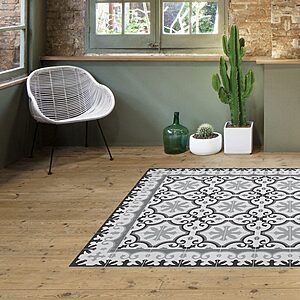
A geometric border is a narrow decorative band in which a motif is repeated along a line to frame, divide or finish off a surface. The Spanish word for it, cenefa, comes from Andalusi Arabic ṣanífa, “edging”. In flooring and wall tiling, geometric border tiles may be cement tiles, zellige, fired clay or painted ceramic: their strength lies not in the individual piece but in the rhythm of the repetition.

What is a border, and what else is it called?
A border is a long, narrow ornament, usually cyclical or repeated, used in architecture, ceramics, interior decoration and dressmaking. Its role is relational: it marks where one surface ends and another begins, which is why it almost always contrasts with its surroundings.
Depending on the trade, it goes by other names—edging, band, Greek key, frieze or listello—and the Spanish word, cenefa, is sometimes misspelt senefa. In traditional Spanish architecture, and especially in Andalusia, the ceramic border does four specific jobs:
- It caps wall tiling that stops short of the ceiling.
- It closes off the perimeter of a tile rug on the floor and frames the central pattern.
- It separates two different floor or wall finishes without leaving an untidy junction.
- It highlights a dado, a step or the edge of a staircase.
That last function—resolving a junction—explains why it survives changes in fashion. A change of material always needs a joint, and a well-drawn joint is exactly what a border is.
What is a border pattern in mathematics?
In mathematics, a border pattern—or frieze pattern—is the figure obtained by repeating a basic motif by translation along a straight line, combining that translation with rotations and reflections. And here is a surprising fact: there are only seven possible ways of organising that repetition, the seven frieze groups.
Four movements of the plane come into play: translation, 180° rotation, reflection (mirroring the motif across an axis) and glide reflection, which mirrors and shifts at the same time. Any border, whether woven, painted or tiled, falls into one of these seven cases.
| Group | Movements that generate it | How it reads in tiling |
|---|---|---|
| p1 | Translation only | The same motif, always identical; the easiest to lay |
| p11g | Glide reflection | The motif alternates up and down, like a trail of footprints |
| p1m1 | Translation and reflection in a vertical axis | Motifs facing each other as mirror images, in pairs |
| p2 | Translation and 180° rotation | The motif repeats inverted, upside down |
| p11m | Translation and reflection in a horizontal axis | The band is symmetrical about its centre line |
| p2mg | 180° rotation, reflection in a vertical axis and glide reflection | Zigzag: the motif advances as it turns |
| p2mm | Vertical and horizontal reflections plus rotation | The motif is mirrored on both axes: the most self-contained and static |
For anyone designing a border, this is not theory: choosing the group means choosing the rhythm. A p1 reads as calm, a p2mm feels solemn and stops the eye, and a p11g pushes you forward along long corridors.
This is also why geometric borders suit ceramic and cement so well: the tile is modular, the basic motif matches it and the pattern joins up on its own. In our guide to popular cement tile patterns you will see the same grammar applied to the centre of the floor.
What types of border are there?
Borders are classified by where they go, what they are made of and what they depict. All three affect laying, maintenance and the end result.
By location
- Floor: a perimeter frame for a rug, a dividing strip between rooms or the finish on a step.
- Wall: the top edge of wall tiling, a band at mid-height or the side edge of a tiled panel.
- Ceiling: rare in ceramics, common in plaster, wood or wallpaper.
- Outdoor: the edges of courtyards, swimming pools, steps and flower beds, where slip resistance and frost are what count.
By material
- Cement tile: pigmented cement, pressed cold. It is not fired; it sets. The pattern is not just on the surface: it is part of the body of the tile, in a colour layer several millimetres thick, and it does not wear off with use.
- Zellige: clay that is fired and glazed by hand. Each piece varies in size, edge and shade, so the border comes alive instead of repeating exactly.
- Fired clay or terracotta: warm-coloured, highly porous tiles that always need a water-repellent.
- Hand-painted tile: the classic Sevillian border, with the motif painted on the glaze.
- Tile insert: the 7 × 7 cm piece that is set between larger tiles or lined up to form a narrow band.
- Non-ceramic materials: vinyl, wallpaper, wood or textile. Reversible and inexpensive, but not suitable for wet areas or for walking on.

By pattern
- Geometric: diamonds, triangles, meanders, chequerboard, hexagons and zigzag lines.
- Interlace, Arabic or Moorish: interwoven bands that form stars and polygons, a legacy of Nasrid tile mosaic.
- Plant or floral: chains of stems and leaves, typical of painted tiles.
- Greek key: the Graeco-Roman meander, the oldest geometric border still in use.
- Single-colour contrast: no pattern, just a change of colour.
What are the current trends in geometric border tiles?
The border is back for a practical reason: it brings in colour and pattern in small doses. These are the formulas that work best.
The tile rug with a perimeter border
It is the most dependable application and the one least likely to date. A central pattern, a border frame and a plain field around it: the room gains a centre.
In one of our workshop suggestions we started with two plain colours from the colour chart, off-white MC3 and aubergine MC34. The floor was done in Mod. 100 in MC34, the wall in the same Mod. 100 in MC3 and, between the two, a Mod. 16 border in both colours to stitch the scheme together.


We have gathered more compositions of this kind in our article on cement tile rugs.
High-contrast two-tone
Black and white, off-white and bottle green, cream and aubergine. Limiting the border to two references from the cement tile colour chart, which runs from MC1 to MC49, makes the pattern legible from a distance and avoids a cluttered look. Taken to the extreme, the motif disappears altogether: a plain tile and two colours are enough to draw the line.
Mid-height border
Instead of finishing the tiling right at the top, the border is placed at eye level and divides the wall in two: tiles below, paint above. It is an old solution that has made a strong comeback, and one we cover in our article on half-height wall tiling.
Relief instead of pattern
Zellige offers another route: the border does not draw a pattern; it changes texture and sheen. A strip of 15 × 5 cm Bejemat laid in a half bond, or a vertical band of small pieces, creates a line that responds to the light throughout the day. You can see examples among our zellige border tiles.
How do you design a geometric border step by step?
A border almost always fails for the same reason: nobody measured the run or worked out the corners before ordering the material.
- Choose the basic motif. This is the unit that repeats: a diamond, a star, a quarter of a flower, a zigzag line. The cleaner it is, the better it stands up to repetition.
- Decide how it repeats. Pure translation, mirrored or rotated 180°. That rhythm changes the character of the band without changing the tile.
- Measure the run and divide it by the length of the tile. If it does not come out as a whole number, decide where the cut falls: at the corner, in the centre or shared between the two ends.
- Work out the corners. There are three options: a dedicated corner piece, a mitre cut, or interrupting the pattern with a plain tile that acts as a corner block. It is best decided on the drawing, not as you go.
- Match the width to the scale of the space. A 10 cm band is a border in a bathroom but disappears in a living room: it has to read from the doorway.
- Set the colour contrast. Two shades from the same family give a discreet result; two opposites make the border the main feature. Decide with physical samples.
- Dry-lay it before you fix anything. Lay out a metre or two on the floor, with the real joints, and look at it standing up and from a distance. It is the test that prevents surprises.

If the motif you are looking for is not in the catalogue, the mould can be made: we explain how in our guide to custom cement tiles.
How many tiles do you need per linear metre of border?
A border is measured in linear metres, not square metres: divide 100 cm by the longest side of the piece, then add the corners and an allowance for cuts. These are the formats in our catalogue most often used to make up bands.
| Piece | Ref. | Size | Weight | Units per m² | Pieces per linear metre |
|---|---|---|---|---|---|
| Cement tile insert | H07 | 7 × 7 × 1.5 cm | 0.25 kg | 205 | ≈ 14 |
| Cement tile | H06 | 10 × 10 × 1.5 cm | 0.35 kg | 100 | 10 |
| Cement tile | H13 | 20 × 10 × 1.5 cm | 0.62 kg | 50 | 5 |
| Plain cement tile skirting | HR01 | 20 × 10 × 1.5 cm | 0.66 kg | — | 5 (catalogue) |
| Zellige Bejemat | ZS14 | 20 × 5 × 1.5 cm | 0.39 kg | 100 | 5 |
| Zellige Bejemat | ZS15 | 15 × 5 × 1.5 cm | 0.18 kg | 134 | ≈ 7 |
| Zellige Darj | ZS52 | 5 × 5 × 1 cm | 0.02 kg | 800 | 20 |
Two caveats: zellige is handmade and the size of each piece varies, so the number per linear metre is an approximation; and the figures do not include the joint, which reduces the number of pieces needed.
Which material should you choose: cement tile, zellige or terracotta?
It depends on where the border goes and how much water it will get. Water absorption sums this up better than any other figure: it determines how easily the material stains and, outdoors, how well it resists frost.
| Product tested | Water absorption (E) | Method | Report no. |
|---|---|---|---|
| Hydraulic terrazzo 20 × 20 cm | 5.9 – 6.2 % | UNE-EN 13748-1 | 4718 |
| Glazed zellige 10 × 10 cm | 15.7 % | UNE-EN ISO 10545-3 | 9103 |
| Terracotta 15 × 5 cm | 16.9 % | UNE-EN ISO 10545-3 | 7539 |
In practical terms: zellige and terracotta are porous by nature and need a water-repellent, especially behind a worktop or in a shower. Hydraulic terrazzo, at 6 %, behaves differently.
For floors there is a second figure. Our 20 × 20 cm hydraulic terrazzo achieved a PTV of 59.5 in the wet pendulum test, which puts it in slip resistance class 3: the level that the Spanish Building Code (CTE) requires in its Basic Document DB-SUA 1 for outdoor areas, swimming pools and showers. It is recorded in test report no. 4718, which you can consult on our laboratory tests page.
Do not mix up the standards: cement tiles and terrazzo are concrete tiles and are tested to UNE-EN 1339 (the Spanish version of EN 1339); zellige and terracotta are ceramics and are governed by the UNE-EN ISO 10545 series. Expecting a ceramic classification from a cement tile leads to comparing figures that are not comparable.

Frequently asked questions about geometric border tiles
What is a border?
A border is a narrow decorative band, made up of repeating elements, that runs along walls, floors or ceilings to frame, divide or finish off a surface. The Spanish term, cenefa, comes from Andalusi Arabic ṣanífa, “edging”. Borders are made in ceramic, cement, wood, paper or fabric.
What is the difference between a border, a Greek key and a frieze?
“Border” is the general term for any repeated decorative band. “Greek key” refers to a specific motif: the meander of angular lines of Graeco-Roman origin. “Frieze” has two meanings: in classical architecture it is the band of the entablature and, in mathematics, the technical name for a pattern that repeats in one direction.
What is an Arabic or Moorish border?
It is a band of tile mosaic made of interwoven strips that form stars and polygons, the pattern known as interlace or strapwork. It was cut piece by piece and used to finish off dados and frame wall panels, as in Nasrid tile mosaics. Today it is reinterpreted with modular pieces of zellige or cement tile.
At what height should a border go in a bathroom or kitchen?
There is no standard height. The sensible thing is to align it with a line that already exists: the top of the tiling, the worktop, the edge of the mirror or the door lintel. The technical requirement, however, is firm: the horizontal joint of the border must line up with that of the wall tiles, or the tiled wall will end up out of true.
How much extra border should you order?
On site it is usual to add between 5 and 10 % to the measured quantity to cover cuts, breakages and corners. With a border, that margin matters more than with a floor, because every cut shows and the corner finish uses up whole pieces. Also keep a few spare pieces in reserve.
Can geometric borders be made to your own design?
Yes. Cement tiles are pressed using a metal template called a divider, and that divider can be made for a new design. The usual approach is to start from a motif, adjust it to the tile format and check that it joins up when repeated. Ask the workshop about lead times and minimum quantities.
The next step is to see the pattern at full size and in its final colour: browse the designs on our cement tile borders page and ask us for physical samples through the contact page. If you tell us the linear metres and the number of corners in the run when you write, we can answer your enquiry much faster.