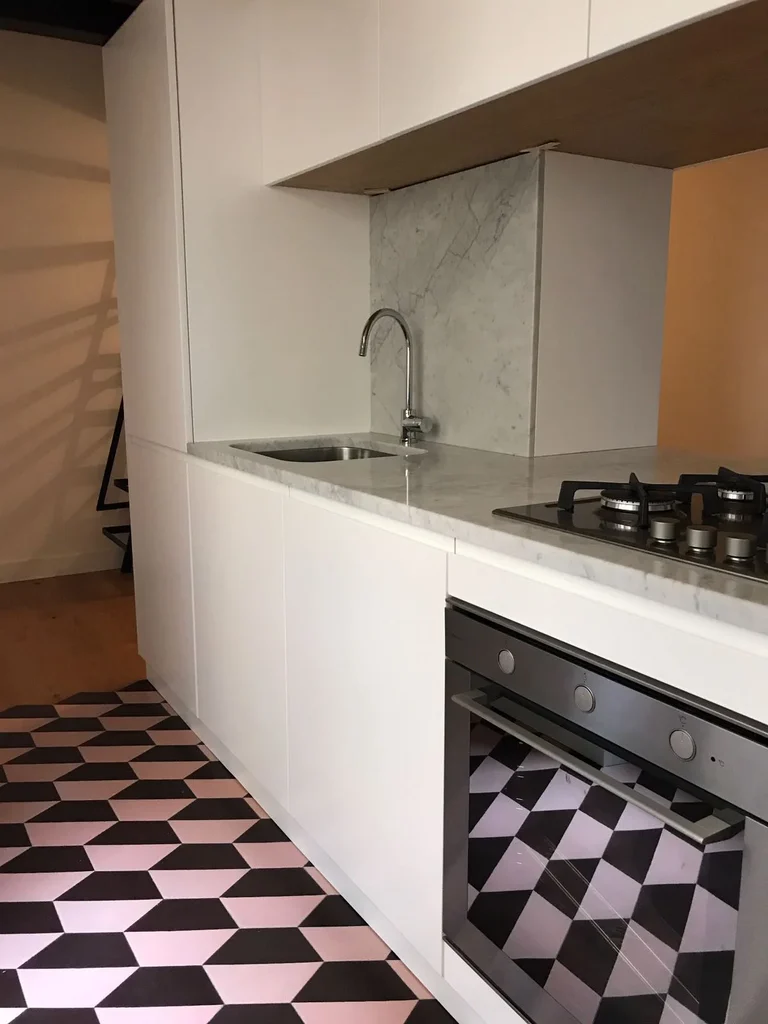
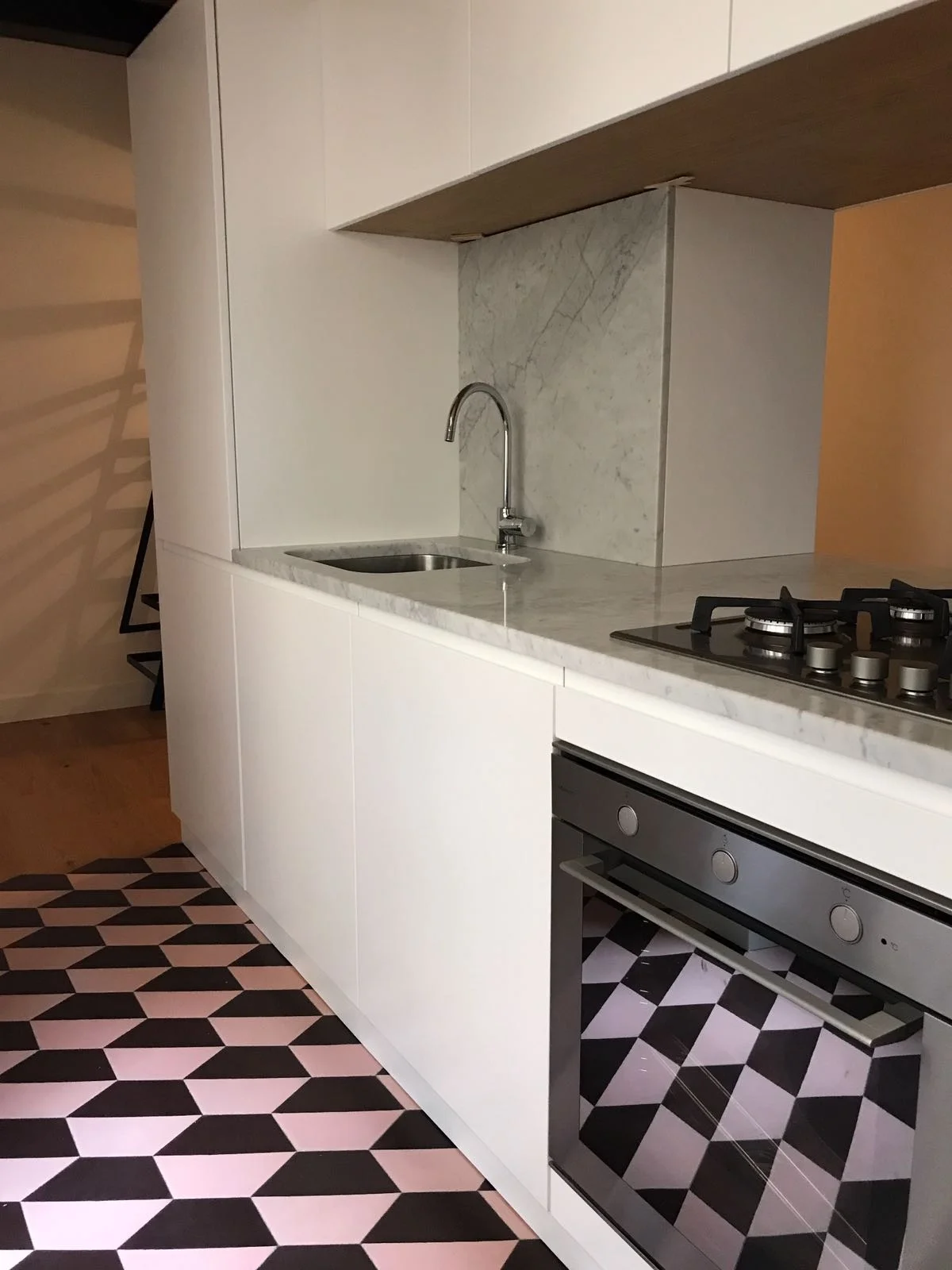
The price of a cement tile floor is never a single figure: it is built up from material, special pieces, transport, laying and treatment. Within the material, what moves the quote most is the format, the number of colours in the pattern, whether the model is already in the catalogue or calls for a new divider mould, and the quantity. That is why two quotes for the same surface can look nothing alike.
This article does not publish a price per square metre: any figure given without seeing the project stops being true as soon as the format, the colours and the linear metres of trim come into play. What it does explain is how a quote is put together and which details you need to supply to get a reliable figure.
Which items make up the price of a cement tile floor?
Five or six items, and they almost never come from the same source. As a rule, the workshop quotes the material, the special pieces and the transport, while the tiler quotes labour, adhesive, grout and substrate preparation. Comparing a material quote with a supplied-and-laid quote is the most repeated mistake.
| Item | How it is measured | What pushes it up |
|---|---|---|
| Tile | m² of surface, plus wastage | Format, number of colours, catalogue or custom design |
| Special pieces (skirting, border, corners) | Linear metres, not m² | Perimeter of the room, corners, changes of direction |
| Packing and transport | Weight and volume of the order | Distance, lorry access, unloading by hand or by forklift |
| Substrate preparation | m² | Removing the old floor, levelling, damp |
| Laying | m², sometimes per day worked | Layout pattern, cuts, rug panels and borders |
| Treatment (water repellent and sealer) | m² and number of coats | Product chosen, porosity of the material, use of the room |
Ask for every line to be itemised. A single closing figure makes it impossible to see whether the cost sits in the tile or in the work underneath it.
Why does the number of colours in the pattern change the price?
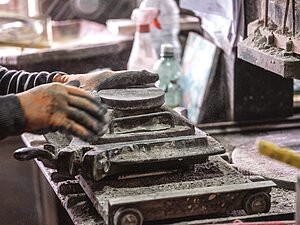
Because each colour is a separate manual operation. When a cement tile is made, the trepa —the metal mould that keeps each colour apart— is filled colour by colour with its own cement and pigment paste; once they are all in, the mould is lifted out, the backing layers are added and the piece goes through the press. A four-colour pattern does not involve slightly more work than a two-colour one: it involves twice as many pours, each one just as careful.
Hence a useful rule before ordering anything: for the same format, the fewer colours the pattern has, the less handwork each piece accumulates, and a plain single colour is the starting point. Recolouring a catalogue model with another combination from the MC1–MC49 colour chart does not change the number of pours as long as you keep the same number of colours; swapping the pattern for one with more colours does.
How much does the format affect the cost per square metre?
A great deal, and in two directions at once: pieces per square metre and kilos per square metre. The more pieces that fit into a metre, the more pressings, the more handling and the more laying time behind it. The figures come from our format table; the weight per metre is the weight of the piece multiplied by the units that fit into a square metre.
| Format | Ref. | Dimensions | Pieces / m² | Approx. weight / m² |
|---|---|---|---|---|
| Square | H02 | 25 × 25 × 1.8 cm | 16 | 36.8 kg |
| Square | H03 | 20 × 20 × 1.5 cm | 25 | 32.5 kg |
| Square | H04 | 15 × 15 × 1.5 cm | 45 | 35.6 kg |
| Square | H06 | 10 × 10 × 1.5 cm | 100 | 35.0 kg |
| Rectangular | H13 | 20 × 10 × 1.5 cm | 50 | 31.0 kg |
| Hexagonal | H21 | 30 × 20 × 1.7 cm | 21 | 34.0 kg |
| Hexagonal | H23 | 11.5 × 10 × 1.5 cm | 116 | 40.6 kg |
| Olambrilla (insert tile) | H07 | 7 × 7 × 1.5 cm | 205 | 51.3 kg |
The weight column is the one almost nobody looks at and the one that decides the transport: a 30 m² living room in the 20 × 20 format is close to a thousand kilos of tile, and that governs the freight, the unloading and whether the order fits on one pallet or two. The dimensions and weights of every format are in our cement tile format table.
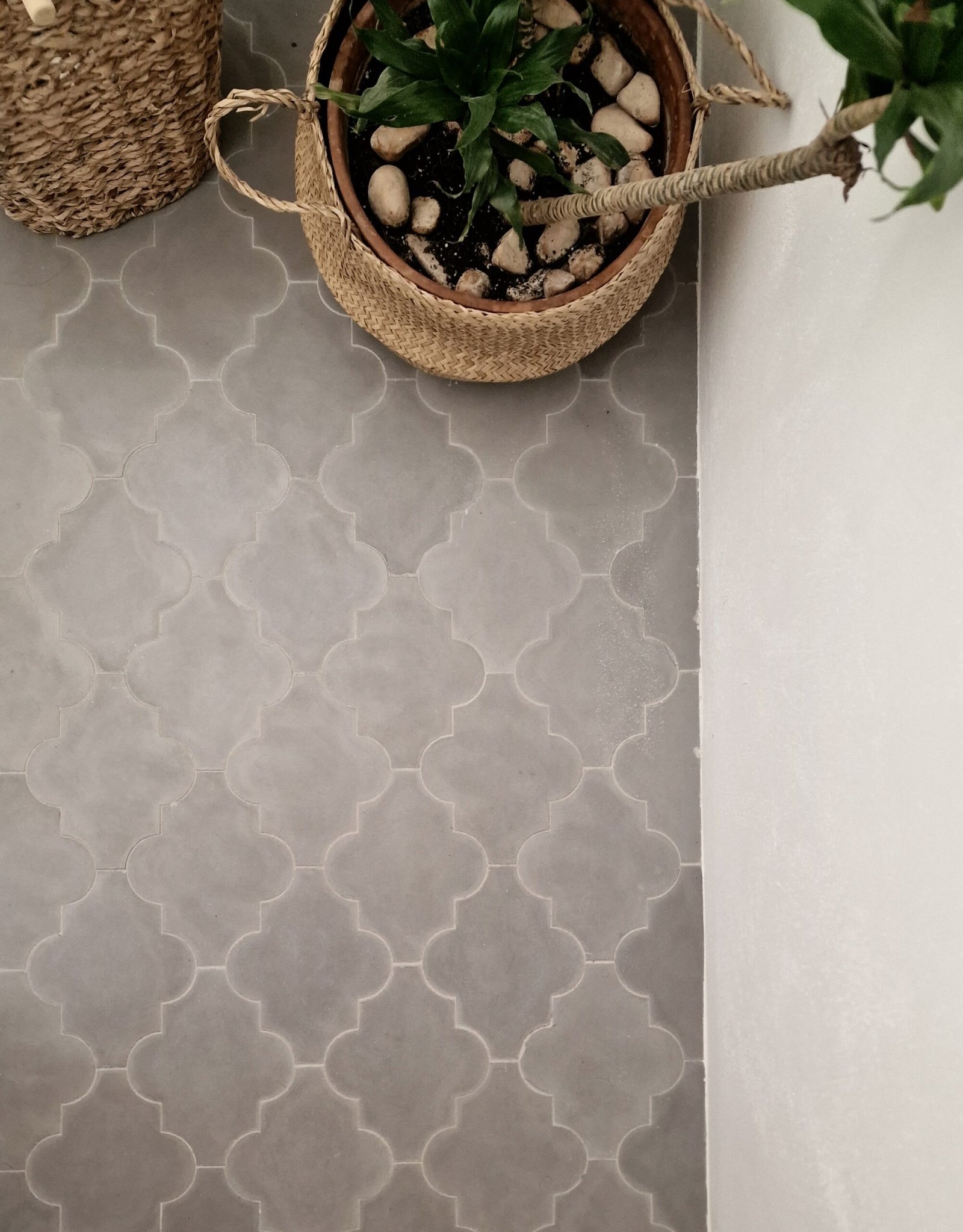
Formats that are not square —hexagonal, Laghaz, Labrys, Chakar, Diamante— add one more factor: the trim against the wall is resolved by cutting pieces, and that cutting generates wastage that appears in no catalogue but does appear in the order.
Catalogue, stock or custom design: what changes in each case?
What changes is where the piece comes from and how much preparatory work has to be paid for before the first metre is made. It is worth deciding early: it governs price and lead time at the same time.
Catalogue model versus a new mould
A catalogue model already has its mould made. A new pattern calls for a trepa to be built by hand, bending and assembling the metal strips that separate each colour. That work is done once and spread over the metres you order: the same mould shared between six metres or between sixty does not weigh the same per metre. Before commissioning a custom design, it is worth checking whether an existing catalogue model recoloured already solves the idea.
Stock versus made to order
Stock is material already made and cured, ready to leave: in cement tiles in stock you choose from what there is —models, colours and quantities available— and you gain time. Ordering production means you can choose any model and any colour from the chart, but the project takes on the pressing, setting and curing time. Check lead times and minimum orders with the workshop before splitting the order between what you buy now and what you leave for later.
How much do laying and treatment weigh in the total?
Rather more than most people allow for, and they are the two items where improvising works out worst. Laying cement tiles does not cost the same with a plain running floor as with a central rug panel, a perimeter border and mitred corners: every change of layout means cuts, setting out and hours.
What pushes labour up:
- Rooms with many corners, columns or doorways: more trim cuts per metre.
- Rug panels, borders and edgings: they call for setting out beforehand and a drawn layout plan before any adhesive goes down.
- Small formats: more pieces to bed and more joint to grout in the same metre.
- Uneven or damp substrates: levelling is an item in its own right, not a last-minute extra.
Treating the tile is the other line you should not trim: the water repellent and the sealer are quoted per square metre and per number of coats, and without them a cement floor stains.
Why does it cost more than a porcelain tile that imitates it?
Because it is neither the same product nor the same process. Porcelain prints the pattern onto a piece fired in series; a cement tile is assembled colour by colour, pressed and left to set —it is not fired—, and every single unit passes through someone’s hands several times. If you want the look at the lowest cost, porcelain wins; if you want the material, they are not interchangeable. You can see the real material in our photo gallery of cement tile floors.
They do not behave the same way either, and that is also money over ten years. Porcelain stoneware absorbs less than 0.5 % water; concrete tiles —cement tile and terrazzo— are more porous, which is why they are given a water repellent. In our laboratory tests we publish the full report for each product: report no. 4718 is the one for the 20 × 20 cm hydraulic terrazzo, with 5.9–6.2 % absorption (UNE-EN 13748-1, the Spanish version of the European standard EN 13748-1) and a wet PTV of 59.5, class 3 under the Spanish CTE building code; the cement tile report is no. 9102, tested to UNE-EN 1339 (EN 1339) on 200 × 200 × 15 mm pieces. They are different products and their figures are not interchangeable. What they do share is the way they age: a floor like this is repaired piece by piece and can be re-polished, whereas a scratched porcelain tile is replaced.
How do you ask for and compare quotes without getting it wrong?
By sending everyone exactly the same information and then checking that they all include the same things. It is the dullest part and the one that saves the most money.
The information you need to send
- Actual square metres and, if possible, a dimensioned plan or sketch of the rooms.
- Intended use: home, commercial premises, indoors or outdoors, with or without underfloor heating.
- The format you want, or at least whether you are after square, rectangular, hexagonal or a special shape.
- Catalogue model or reference; if it is an idea of your own, a photo or a drawing of the pattern.
- Colours from the MC chart, or the approximate range if they are not decided yet.
- Linear metres of skirting and border, counted on the real perimeter.
- Delivery address, floor level, lorry access and whether there is a lift.
- Expected date of the works: it decides whether to draw on stock or whether there is room to produce.
If something is undecided, say so. Better to quote two real scenarios than one invented one.
The seven checks when comparing
- Is the price for material delivered or for a floor supplied and laid? They are not the same figure.
- Is VAT included? It is the commonest difference between two offers that looked identical.
- Do the format and thickness match? A 20 × 20 at 1.5 cm and a 25 × 25 at 1.8 cm cannot be compared per metre.
- Does the number of colours in the pattern match? It is the variable that moves the material price most.
- Are the special pieces included? Skirtings and borders are measured in linear metres and usually go separately.
- What wastage has been allowed for, and who pays for it? If one offer includes it and the other does not, the cheap one stops being cheap.
- Does it include transport, unloading and treatment? Three lines that turn up late if you do not ask about them first.
What pushes a quote up without you noticing?
- Wastage that has been miscalculated. Trim cuts are not recovered, and material that runs short forces a second order.
- Late replacements. Ordering a few metres of the same model months afterwards means setting a new production run in motion.
- Special pieces ordered at the end. Skirtings and borders that were not in the first order travel on their own, and that freight is not shared out.
- Changing the model halfway through the job. Redoing the setting out and throwing the layout off costs more hours than it looks.
- Access. Unloading by hand in a street with no room for the lorry, or carrying nearly a tonne of tile up to a third floor with no lift, is a works item in itself.
- Treatment put off. A porous tile with no water repellent stains in the first few weeks, and removing a settled stain costs more than avoiding it would have.
Frequently asked questions about the price of cement tile floors
How much does a square metre of cement tile cost?
There is no price per square metre valid for every case, and it is worth being wary of anyone who gives one without asking anything. The figure depends on the format, on the number of colours in the pattern, on whether the model is in the catalogue or calls for a new mould, on the quantity and on whether there is stock available. With those five details a firm quote is possible; without them, any number is only indicative.
Is there such a thing as a cheap cement tile floor?
There is a more economical cement tile floor, which is not the same thing. You get there by choosing a plain single colour or a pattern with few colours, a standard format, a catalogue model rather than a new design and, if it suits the project, material that is already in stock. What does not really make it cheaper is cutting back on the treatment or on the substrate preparation: that gets paid for later.
Is terracotta or cement tile more expensive?
They are different processes and they do not always rank the same way round: terracotta is moulded and fired in a kiln, while a cement tile is assembled colour by colour, pressed and left to set without firing. In both cases the format and the quantity count for more than the material itself, and terracotta adds compulsory treatment because of its high absorption. Ask for both quotes on the same metres.
Is zellige calculated by the square metre or by the piece?
It is calculated by the square metre, even though it is made and counted in pieces, and that is where the real difference in cost lies. A 10 × 10 cm zellige means 100 pieces per square metre; a 5 × 5 cm one, 400. The more pieces per metre, the more hours of tiling and the more joint to grout, so a small format makes the job dearer even if the material looks similar.
How much extra material should you order?
Always somewhat more than the metres measured: trim cuts are not recovered and the odd piece breaks on site. The exact amount depends on the format, on the layout and on how many corners the room has, because irregular formats and diagonal patterns generate more offcuts. Keep spare pieces from the same batch as well: repeating a small order months later works out dearer than having ordered too much.
Does the workshop’s quote include laying?
Normally not. The workshop quotes the material, the special pieces and the transport; the tiler quotes labour, adhesive, grout and substrate preparation. That is why, when comparing two offers, the first thing to look at is what each one covers. If you need a single closed figure for a floor supplied and laid, you will have to add the two parts of the quote together.
If you already have the metres measured and the model chosen, send those details from the contact page of our workshop in Seville and ask for the quote itemised line by line. If you are still deciding on format or colours, ask for samples first: seeing and touching the piece avoids changing the model halfway through the job, which is what really makes a cement tile floor expensive.