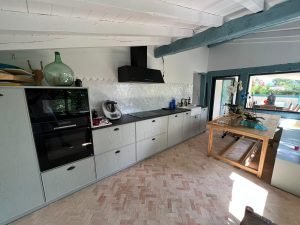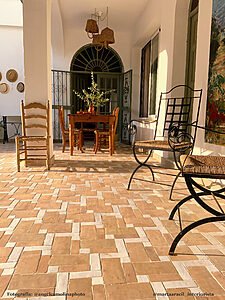
Terracotta is handmade fired clay: its water absorption is 16.9% in our laboratory test and it needs a water-repellent sealer from day one. Terracotta-effect flooring is pressed, vitrified porcelain stoneware, below 0.5% absorption: it asks for no treatment, but it never ages either. In a rustic house fired clay pays off if you are after patina; porcelain, if the priority is having nothing to maintain.
How do terracotta and a terracotta-effect floor differ?
In the material and in the process, not in the pattern. Terracotta is clay shaped piece by piece and fired until it hardens, with an open pore and the same colour right through its thickness. A terracotta-effect floor is porcelain stoneware: a body pressed at high pressure and fired until it vitrifies, with the look of clay printed or textured on the face.
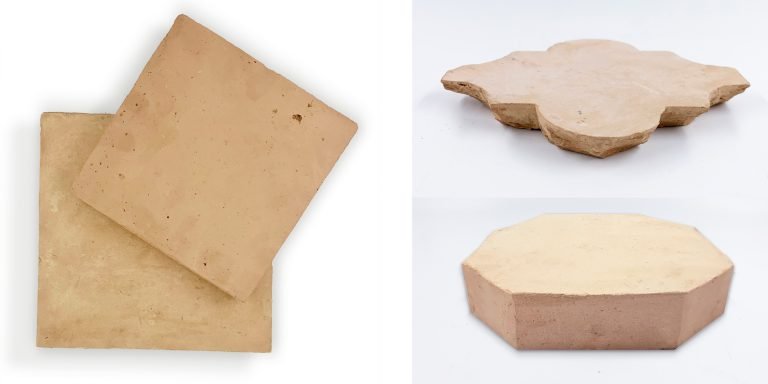
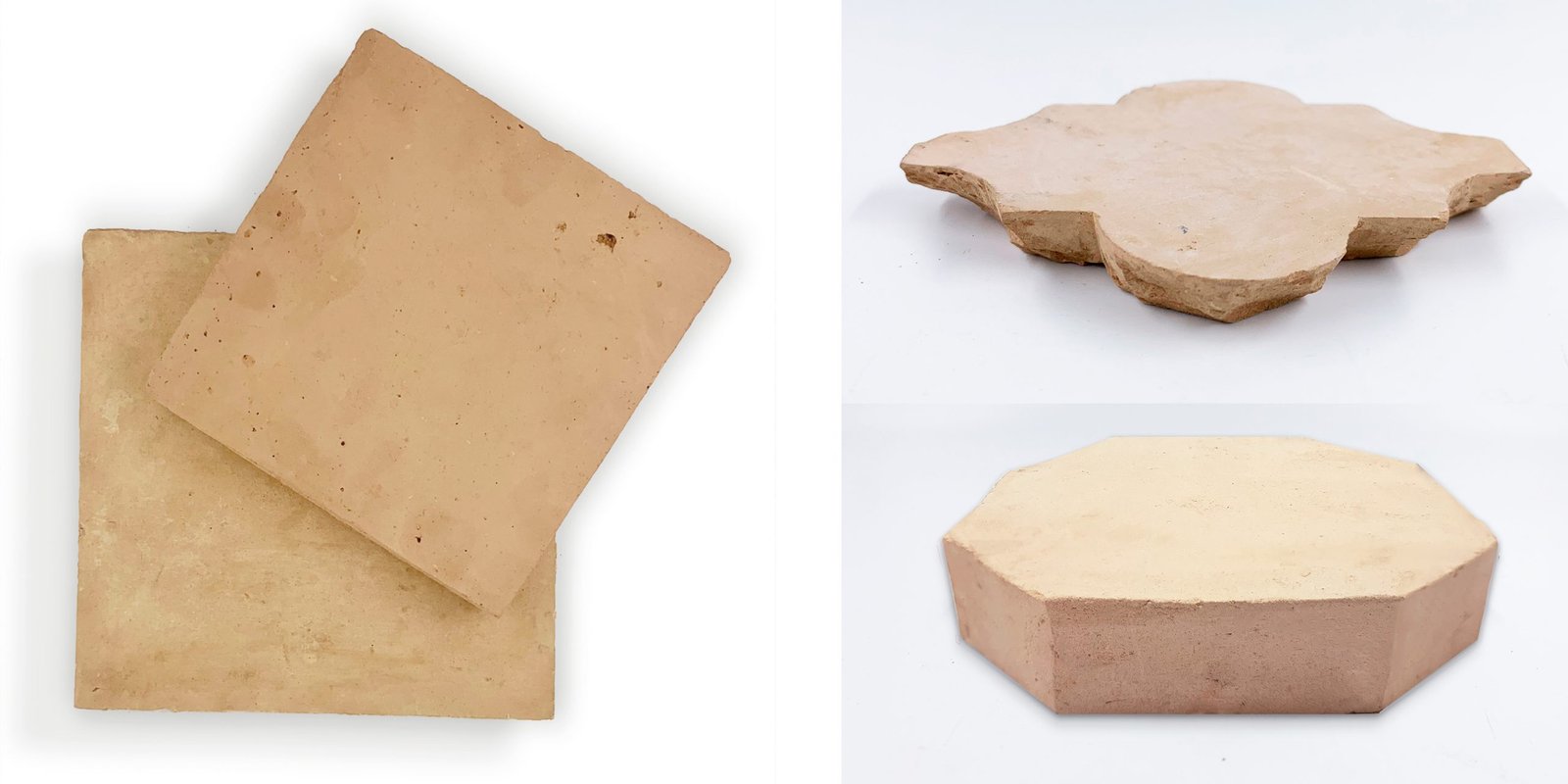
Our terracotta is made one piece at a time from Moroccan clay and reaches the Seville workshop unglazed. Every tile comes out a different shade because the kiln does not spread its heat evenly: that is the effect an industrial catalogue tries to reproduce by rotating a set of printed faces.
Both are ceramic and both are classified under the same standard, the Spanish UNE-EN 14411 (the Spanish version of the European EN 14411), but in opposite groups: fired clay falls into group AIII (absorption above 10%) and porcelain into BIa (absorption of 0.5% or less). The whole comparison follows from there.
How much water does each one absorb, and what changes in practice?
The difference is not a nuance, it is a matter of scale. In test report no. 7539, on 150 × 50 × 15 mm pieces and using the EN ISO 10545-3 method (UNE-EN ISO 10545-3 in its Spanish version), our fired clay gave a mean absorption coefficient of 16.9%. Porcelain stoneware sits below 0.5%.
That figure is not a defect: it is the definition of the material. But it explains the three things that matter in a house. Stains: untreated, oil and wine get into the pore. Frost: water lodged inside expands when it freezes. And damp from the screed, which fired clay takes up and gives back.
We publish the full test reports, with number, date and signature. They are issued by Elabora, entered in the Register of Testing Laboratories of the Regional Government of Andalusia under number AND-L-155.
| Figure | Terracotta (fired clay) | Porcelain stoneware |
|---|---|---|
| Water absorption (E) | 16.9% on average (test report no. 7539, UNE-EN ISO 10545-3) | Below 0.5% |
| UNE-EN 14411 group | AIII (high absorption) | BIa (low absorption) |
| Flexural strength | 8.7 – 10.3 N/mm² over ten pieces (UNE-EN ISO 10545-4) | The standard requires at least 35 N/mm² of group BIa |
| Stain resistance | Class 2 (UNE-EN ISO 10545-14): the stain comes out, but it needs a solvent | Class 3 as a minimum on glazed tile; the scale goes up to 5 |
| Treatment | Water-repellent and stain-proof sealer on site, renewed periodically | None |
| Thickness | 15 mm on the tested piece | Usually 9 – 10 mm |
| Recommended joint | 3 – 5 mm with white grout | 1.5 – 2 mm on rectified tile |
| Colour at the cut | The same right through the thickness | The body colour, different from the face |
When is porcelain stoneware better? We say it even though we sell fired clay
When nobody is going to look after the floor, or the use is punishing, porcelain wins hands down. These are the cases where we recommend it without reservation:
- Holiday lets and properties with a turnover of tenants. The sealer on fired clay has to be renewed; in a home that changes hands every week, nobody renews it.
- Hard-working kitchens with no patience for maintenance. Oil is the most stubborn stain on untreated fired clay.
- Renovations where the floor level cannot go up. Between 15 mm of fired clay and 9 mm of porcelain, plus the adhesive, there is a centimetre that sometimes decides whether the door closes.
- Outdoors in areas with repeated frost, unless the tile and the treatment are chosen for it. There it is worth reading first what a fired clay floor can take outdoors, because the criteria are not the same in a Seville courtyard as in a mountain house.
- Large areas on a tight deadline. The industrial catalogue has stock and uniform batches; handmade fired clay is made to order, and the shade varies from one firing to the next.
- Premises cleaned by machine with aggressive products, where the treatment does not last a season.
Anyone who sells you fired clay without mentioning any of this is not selling you a floor: they are selling you a photograph.
When does terracotta really pay off?
When the floor has to age with the house and there is someone willing to look after it. In a rustic house that happens more often than it seems:
- Continuity with what is already there. In a refurbishment, new fired clay picks up the old floor in format and in shade. Porcelain, however good, marks the change at the transition.
- Formats the industry does not make. Our terracotta catalogue has 15 × 5, 20 × 10, 30 × 15, 10 × 10, 15 × 15 and 20 × 20 cm pieces, as well as octagons and cut profiles. The 15 × 5 laid herringbone is a traditional pattern that no large format imitates.
- Real patina. The shade variation comes from the firing, not from a limited set of printed faces. After ten years fired clay has a history on it; porcelain has the same face as on day one.
- It can be repaired. Scratched or stained fired clay is stripped, sanded and treated again. A scratched glaze cannot be recovered: you replace the tile, if any are left.
- Feel and temperature. A porous material conducts heat less readily than a vitrified one: fired clay feels less cold underfoot.
- Less energy at the factory. Fired clay is fired at a lower temperature than porcelain, which has to go above 1,200 °C to vitrify.

Can you tell a terracotta-effect floor from real fired clay?
Yes, and almost always by three details: the repetition, the joint and the edge. None of them has anything to do with colour, which is where everybody looks.
The repetition
Porcelain rotates a limited number of different faces, what catalogues call shade or graphic variation. Walk across a laid sample and count tiles until you find two that are identical. With fired clay that never happens.
The joint
Terracotta calls for a 3 to 5 mm joint and white grout, with no tinted slurry. Rectified porcelain is laid at 1.5 or 2 mm. A perfect grid of hairline joints gives the material away before any other detail does.
The edge and the thickness
Fired clay has an irregular border, rounded by the mould and by hand, and is 15 mm thick. Porcelain arrives with a sharp edge and 9 or 10 mm. And if there is a cut on view, look at the colour inside: fired clay is the same shade top to bottom.
The touch test
On many porcelain tiles the mould texture does not line up with the printed pattern: you see a pore your hand cannot find. Run your palm over it with your eyes closed: that mismatch between what you see and what you touch is what separates a good terracotta-effect tile from a bad one.
When you compare quotes, ask for the technical data sheet of both materials and look for three figures: water absorption, UNE-EN 14411 group and slip class.
Maintenance: what each floor asks for over ten years
Fired clay asks for a treatment on site and for that treatment to be renewed from time to time; porcelain asks to be mopped. That is the whole difference, and it is worth accepting before you buy.
On terracotta, the water-repellent and stain-proof sealers are applied during installation, before the floor comes into use. After that, pH-neutral soap is enough: no bleach, no ammonia, no hydrochloric acid, no acids at all. There is an honest nuance in our test reports: fired clay stands up to chemicals very well — classes UA, ULA and UHA with no visible effect — but the treatment on top of it does not. What an aggressive cleaner ruins is not the tile, it is the protection. How often it has to be renewed depends on traffic and exposure; ask the workshop for the detail of your case.
On porcelain the weak point is not the tile: it is the joint, which gets just as dirty as on fired clay, and the glaze, which scratches where sand is dragged in at the entrances. No catalogue tells you that.
| Criterion | Terracotta | Porcelain stoneware | Winner |
|---|---|---|---|
| Yearly maintenance | Mopping plus a periodic water-repellent sealer | Mopping | Porcelain |
| Oil stains on untreated tile | They get into the pore (class 2) | They do not get in | Porcelain |
| Thickness over an existing screed | 15 mm plus adhesive | 9 – 10 mm plus adhesive | Porcelain |
| Repeated frost | Calls for the right tile and treatment | Absorption below 0.5% | Porcelain |
| Repairing a damaged area | It is stripped, sanded and treated again | A scratched glaze cannot be recovered | Terracotta |
| Replacing tiles ten years on | The handmade format stays in the catalogue | Industrial ranges are renewed often | Terracotta |
| Continuity with an old floor | It matches in format and in shade | The change shows | Terracotta |
| Look after ten years | Patina | Just like day one | Depends what you are after |

And what if the answer is neither of the two?
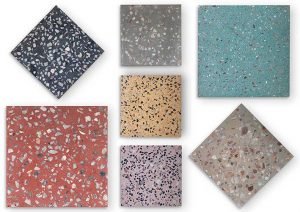
In a rustic house there is a third way that almost nobody puts on the table: hydraulic terrazzo and cement tile. They are not ceramic — they are not fired, they cure — and they are tested to a different standard, the Spanish UNE-EN 1339 (European EN 1339), so they fall outside the table above but not outside the decision.
Our hydraulic terrazzo in 20 × 20 cm gives a mean absorption coefficient of 5.9 to 6.2% under UNE-EN 13748-1 and reached a PTV of 59.5 in the wet pendulum test: class 3, the top of the scale and the level the Spanish Building Code requires outdoors, around pools and in showers. Both figures come from test report no. 4718 and refer to the hydraulic terrazzo, not to the cement tile, which was tested separately in test report no. 9102.
And nothing obliges you to choose a single material for the whole house. Fired clay in the courtyard, cement tile in the living room and porcelain in the utility room is a frequent and sensible combination.

How to decide in five steps
- Measure the real exposure. Write down whether there is frost, direct sun, rainwater or a screed with damp in it. That section decides more than taste does.
- Put a name to whoever is going to maintain it. If nobody is going to renew the treatment, the answer is porcelain and there is nothing wrong with that.
- Check the floor level. Measure the clearance under the doors before falling in love with a 15 mm material.
- Ask for samples of both and look at them in the house. Catalogue colour and colour in the real light of a courtyard are nothing alike. Wet them: fired clay changes shade with water and porcelain does not.
- Compare data sheets, not photographs. Water absorption, UNE-EN 14411 group and slip class. Those three figures settle half the doubts.
Frequently asked questions about terracotta and terracotta-effect floors
Which is better for a rustic house, fired clay or terracotta-effect porcelain?
It depends on who is going to maintain the floor. If there is continuity with an old floor, an appetite for patina and a willingness to renew the treatment, fired clay has no substitute. If the house is let out or nobody is going to deal with the sealer, terracotta-effect porcelain is the sensible decision.
Does fired clay stain easily?
Untreated, yes. In the UNE-EN ISO 10545-14 test our fired clay was rated class 2: the stain can be removed, but it needs a solvent. That result is the reason the water-repellent and stain-proof sealers are applied during installation, and not as a later remedy.
Can a terracotta-effect floor be used in a courtyard or on a terrace?
Yes, as long as the finish has a high enough slip class: the Spanish Building Code requires class 3 outdoors, around pools and in showers, and every country sets its own slip-resistance requirement, so check the one that applies to your project. With natural fired clay the conversation is longer, because absorption, frost and treatment all come into play, and we look at that in a separate article.
How much does each one cost?
We do not give catalogue prices on the blog because they depend on the format, the quantity and the destination. What is worth comparing is the complete cost: material, installation, the initial treatment on fired clay and the renewals you can expect. Ask for a quote for both options with those items itemised.
Do both work with underfloor heating?
Yes. Our terracotta is compatible with underfloor heating, just like porcelain stoneware. The difference is in the inertia: 15 mm of fired clay takes a little longer to warm up than 9 mm of porcelain, and holds the heat for longer. Ask the workshop about the laying detail for your case.
Can terracotta be combined with cement tile or zellige?
Yes, and it is one of the most common combinations in Andalusian country houses: a fired clay floor with olambrilla inserts or a cement tile border, and zellige on the kitchen splashback or in the bathroom. The key is to resolve the thickness at the transition properly and to keep the same joint criterion.
If you are facing this decision, the most useful thing is to have both tiles in your hand and in the house. You can see formats and shades in our handmade terracotta catalogue, look at finished projects in the terracotta photo gallery and write to us for samples, telling us where the floor is going.