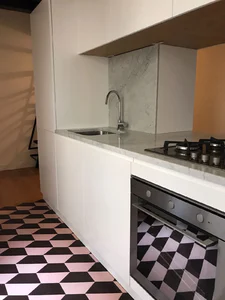
When a renovation uncovers an old cement tile floor there are three ways out: keep it where it is, lift it and relay it replacing whatever is missing, or reproduce the pattern with new tiles. The decision is not a matter of taste but of four measurable facts: how many tiles are sound, whether the bed sounds hollow, whether there is active damp, and what floor level the rest of the job can absorb.
This guide is not about dating a tile or the chemistry of cleaning it. It is about the building work: what gets decided, and what you should demand from whoever does the lifting.
When do you keep an old cement tile floor and when do you have to lift it?
You keep it whenever the bed is sound, there is no rising damp and the floor level fits the rest of the house. You lift it when services have to be chased into the floor, when the fill has broken down, or when it sounds hollow over large areas rather than in isolated tiles. The commonest mistake is deciding on day one, with the floor still filthy: it always looks worse than it is.
The initial survey, in six checks
- Sound. Tap tile by tile with your knuckles and mark the ones that ring hollow: those have come away from the mortar, which is not the same as being broken.
- Missing tiles. Count the broken, chipped and missing ones against the total. A dozen scattered across a room is not the same problem as a whole corner.
- Wear layer. Wet a patch with clean water: if the pattern comes back sharp, the colour layer is still alive; if it stays dull and the grey of the mortar shows through, it is worn out and will not take polishing.
- Damp. Dark patches along the walls, white efflorescence in the joints, swollen skirtings. With active capillary rise no floor survives.
- Levels. Measure from the floor to the underside of the doors, the stair landing and the street threshold. That margin decides more renovations than the condition of the tiles.
- The whole pattern. Photograph every room square-on before touching anything: it will be the only reliable drawing you have when the time comes to make good or reproduce.
The wear layer is three to five millimetres thick, and all the pigment is in it. Every polish comes out of that thickness: a floor that has been polished twice will rarely take a third pass.

Keep, make good or reproduce: the decision table
Each combination of condition, services and floor level leads somewhere different:
| What you find | Sensible option | What it means on site |
|---|---|---|
| Complete, sound, dry and at a compatible level | Keep it in place | Protect it throughout the job; clean and seal at the end |
| Complete but dull, stained or with open joints | Restore in situ | Stripping, light polishing and regrouting; no breaking out |
| Isolated tiles missing and the pattern repeats | Keep and make good | Take tiles from hidden areas or have the missing ones made |
| Services have to be chased into the floor | Lift the affected strip and relay it | Hand lifting, numbered stacking and a new mortar bed |
| Hollow over large areas or the fill is giving way | Lift the lot and relay whatever is whole | New bed and a full relay: the slowest option |
| Active rising damp | Deal with the damp first | Barrier and ventilation before touching the floor |
| More than half missing or the pattern beyond recovery | Reproduce with new tiles | A made-to-measure brass mould or an equivalent catalogue pattern |
The first three rows are cheap in materials and expensive in labour; the last two, the other way round.
How do you lift an old cement tile floor without breaking it?
By hand, tile by tile, with a wide chisel and a lump hammer, and accepting that every tile comes up with its mortar attached. A breaker destroys far more than it recovers.
- Open a one-square-metre trial area in an out-of-the-way corner and count how many tiles come up whole. That real percentage decides what to do with the rest of the house.
- Sacrifice the first tile: break it on purpose to open a gap and get at the neighbouring ones from the edge.
- Work outwards from that gap, chisel in the joint, levering against the mortar and never against the tile next door.
- Do not clean off the mortar while it is still damp: scraping a tile you have just lifted is the quickest way to chip it.
- Number and group the tiles by room, following the overhead photograph. Borders, corners and edge pieces go separately: you never end up with too many.
- Stack them on edge, face to face, with cardboard between them; laid flat in tall piles, the bottom ones chip on their own.
- Do the arithmetic on weight: a square metre of 20 × 20 cm tiles weighs about 32 kg and one of 25 × 25 cm about 37. Ten square metres come to over three hundred kilos, so do not concentrate them on one spot of an old floor structure.
- Keep the stack under cover and ventilated; wrapped in sealed plastic, the damp mortar brings out efflorescence.
Nobody can promise a recovery rate: it depends on how hard the bedding mortar is. On a sand bed a lot of material usually comes up whole; on rich cement, the trial area may well tell you not to bother. Our cement tile formats, with their sizes, weights and units per m², help you estimate what you are salvaging.
What do you do when there are not enough old tiles for the whole house?
There almost never are: between breakages, missing pieces and cuts, you end up with fewer usable square metres than you need. There are four sensible ways out.
- Concentrate. Keep the original for a single room — hall, living room or corridor — and finish the rest in a plain floor.
- Rug and border. Lay the old pattern as a central rug and finish the edge with plain tiles or a new border: the shortfall then falls where it does not break the pattern.
- Mix without hiding it. Alternate old and new tiles in a chequerboard or in bands. It works better than an invisible patch, which never is.
- Reproduce what is missing. The dearest option per square metre, but the only one that gives you the floor back complete.
What do you have to take to the workshop to reproduce an old tile pattern?
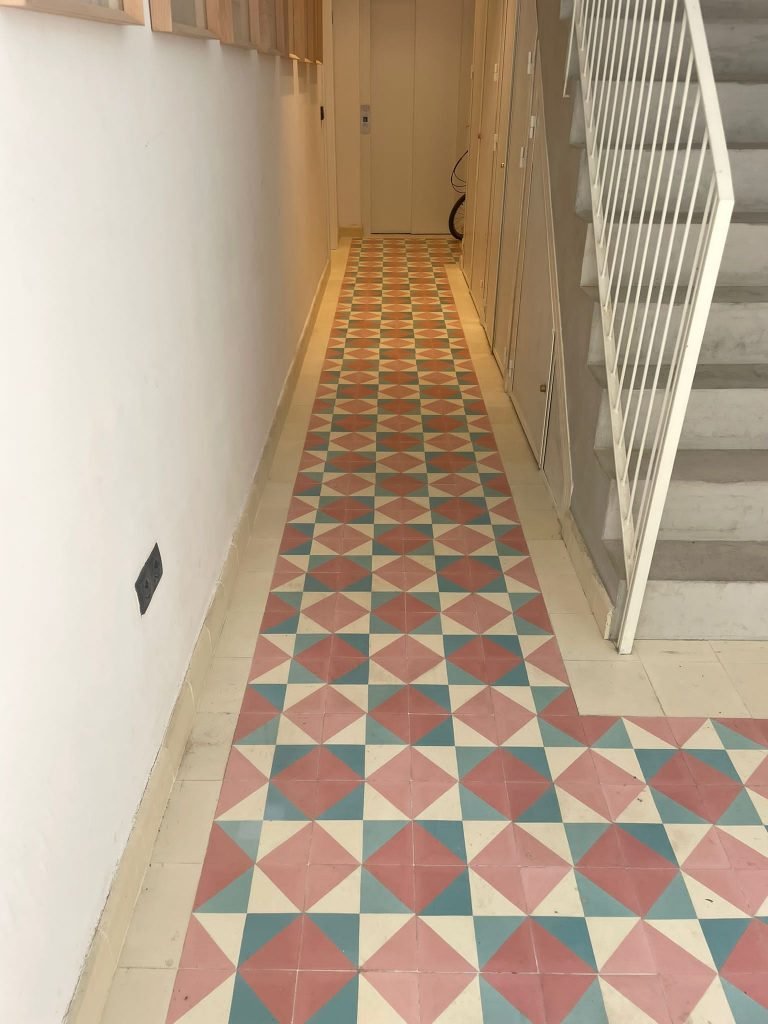
Two original tiles, even broken ones, and the exact dimensions of the format. From those a new brass mould is cut — the divider that keeps the colours apart — and the tile is pressed the traditional way. Pattern and format can be reproduced faithfully; what never quite matches is the aged tone of a tile that has been walked on for ninety years.
In order of usefulness, this is what the workshop asks for:
- The two tiles, even if they are in pieces: with two you can compare pattern, thickness and true colour under different lights.
- If none can be lifted, square-on photographs with a tape measure in shot, plus the exact dimensions of the tile and its thickness.
- The square metres per room and the split between field tiles, borders and corners, which is almost always forgotten.
From there you settle the format — the 20 × 20 cm square is the classic of the old house, alongside the hexagon, the octagon and the 7 × 7 cm olambrilla insert — and the colour, from the cement tile colour chart, MC1 to MC49. If the pattern is not going to be copied but adapted, that is a bespoke design job: talk it through with the workshop before you order.
One warning that saves grief: the lead time and the minimum run for a new mould depend on the pattern, so ask about both before you put them in the site programme.
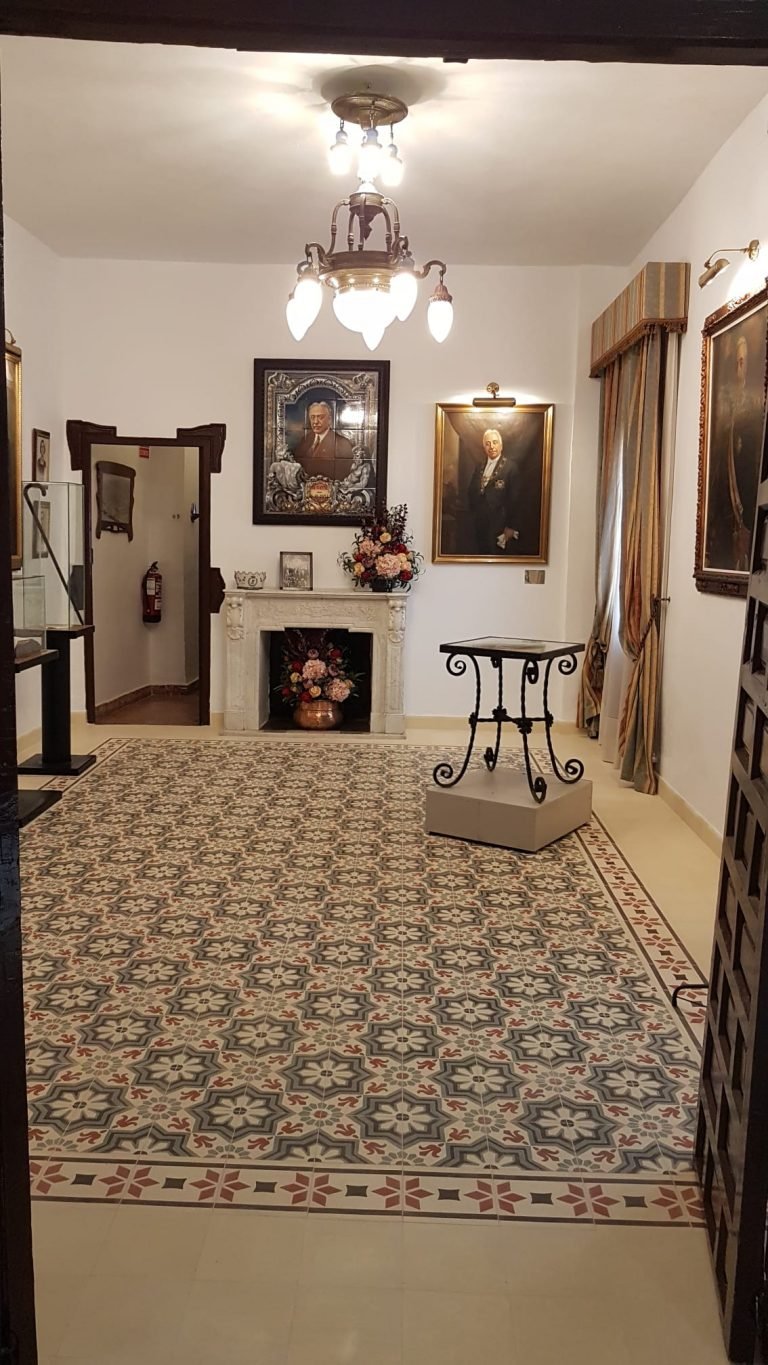
When the building is listed the decision stops being purely technical: what the floor is worth as heritage weighs as much as its physical condition.
How do you resolve the difference in level between the old floor and the new one?
By matching build-ups from the substrate, not from the surface. A cement tile is 1.5 to 1.8 cm thick depending on the format, against the usual 0.8–1.1 cm of a porcelain tile, and it also calls for a mortar bed rather than a thin coat of adhesive. The difference can be more than three centimetres.
| Format | Ref. | Dimensions | Weight per tile | Units per m² |
|---|---|---|---|---|
| Square | H02 | 25 × 25 × 1.8 cm | 2.30 kg | 16 |
| Square | H03 | 20 × 20 × 1.5 cm | 1.30 kg | 25 |
| Square | H04 | 15 × 15 × 1.5 cm | 0.79 kg | 45 |
| Rectangular | H11 | 30 × 15 × 1.6 cm | 1.45 kg | 23 |
| Hexagonal | H22 | 23 × 20 × 1.5 cm | 1.16 kg | 29 |
| Octagonal | H31 | 20 × 20 × 1.5 cm | 1.14 kg | 25 |
| Olambrilla insert | H07 | 7 × 7 × 1.5 cm | 0.25 kg | 205 |
| Plain skirting | HR01 | 20 × 10 × 1.5 cm | 0.66 kg | 5 units / linear metre |
There are four ways out: take the old floor level as the datum for the whole storey, dig out the substrate in the new rooms, play with the thickness of the bedding, or resolve the junction with a transition profile. And measure the clearance under every door leaf before raising the level: old doors cannot be trimmed indefinitely.

What should you put in writing to whoever carries out the work?
That lifting and protection appear as items in their own right, not buried inside the demolition. The rest fits on half a page of contract.
- Protection from day one with cardboard and boarding along the traffic routes. Never sealed plastic: it traps moisture and causes efflorescence.
- No using the old floor as a workbench, a cutting table or a place to stack bags.
- Hand lifting with chisel and hammer wherever tiles are to be recovered; breakers only where demolition has already been decided.
- Tiles come up with the mortar attached and are cleaned afterwards, dry.
- Numbering and an overhead photograph before work starts, with borders, corners and skirtings stacked separately.
- No spirits of salt, no acids and no descalers, either during the works or in the final clean.
- No dry cutting with an angle grinder on the floor itself: the disc scores the wear layer.
- Grouting with the tiles sealed beforehand and grout in the agreed colour: a grey grout on a porous tile stains the pattern.
- Final clean with a pH-neutral product.
- Handover of an agreed surplus of spare tiles, labelled with pattern and colour.
What the Spanish building code requires if you retile a bathroom floor
Basic Document DB-SUA 1 of the Spanish Technical Building Code (CTE) classifies floor finishes by their slip resistance, measured with the pendulum (Spanish standard UNE 41901:2017 EX): class 2 in wet interior areas laid to a fall and class 3 in showers, pools and outdoors. A salvaged tile has no test behind it, so where a project architect is involved the class of the replacement material will have to be justified.
It pays not to mix materials when justifying it. The published in-house figure is the one for 20 × 20 cm hydraulic terrazzo, which reached a PTV of 59.5 wet — class 3, the top of the scale — and an average absorption of between 5.9 % and 6.2 % under UNE-EN 13748-1, the Spanish version of EN 13748-1, in test report no. 4718. The cement tile was tested separately, in report no. 9102 and under UNE-EN 1339 (EN 1339), with no published slip value. Both test reports are published on our website.
FAQs about old cement tile floors in a renovation
Is it worth lifting the cement tile floor found under the terrazzo?
It depends on how the terrazzo was bedded. If it went down on sand or on a weak cement it usually comes away without dragging the tile with it and the rescue pays for itself; on rich cement or a modern adhesive the yield drops sharply. The only way to know is to break out a trial square metre and count the whole tiles.
How do you protect a cement tile floor during the works?
With heavy cardboard and timber boarding along the traffic routes, replaced whenever it gets wet. Avoid plastic taped down to the floor, because it traps moisture and encourages efflorescence, and clear up any spill of mortar, plaster or paint as soon as it happens: on an unsealed tile it ends up as a permanent stain.
How do you get the mortar off tiles that have been lifted?
Dry, once the mortar has set: scraper, wire brush and patience, with the tile laid flat and struck on the back, never on the face. Pressure washing saturates the pores, and acids eat the cement in the tile itself, which is made of the same material as the mortar.
Can you tell an old tile from a new reproduction?
Pattern and format match; tone, not entirely. A tile walked on for decades has lost saturation and gained patina, while a freshly made one arrives at full colour. That is why it works better to spread the new tiles out, in a chequerboard or by area, than to group them in a single block.
How many spare tiles should you keep once the renovation is over?
Enough to redo a complete area, not just to swap the odd tile: a water leak rarely affects a single tile. Store them under cover, on edge, labelled with the pattern, the colour and the format: tracking down a reference years later is far easier with it written down.
What happens to skirtings and borders when an old floor is made good?
They are the first thing to run short and what most conditions the result. They break more than field tiles when lifted, because they sit against the wall; and when replacing them you count by linear metre, not by square metre. If there are not enough, better to change the whole perimeter than to leave it patched.
With the survey done, the next step is to settle pattern, format and colour in the cement tile catalogue. Send us the overhead photograph of your floor together with one original tile and we will tell you whether it can be matched from the catalogue or whether a new brass mould is needed.