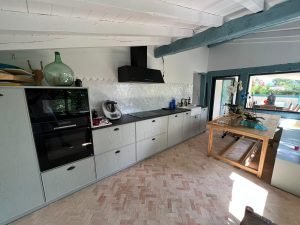
Coloured terrazzo is a tile of pigmented cement with exposed marble or glass chips, pressed, air-cured and polished until the chips show through. The colour comes from the pigment in the base and the aggregate chosen, and today it is made in almost any shade, from the classic grey to pink, green or terracotta, for floors, walls and worktops.
What is terrazzo and where does it come from?
Terrazzo is a composite material: chips of marble, and sometimes granite, quartz or glass, bound with cement and polished once it has set. It is not a ceramic: rather than being fired, it sets, and the chips stay visible, different on every piece.
From Venetian terraces to 1970s terrazzo
It was born in 15th-century Venice: craftsmen reused the marble offcuts from the palaces, bedded them in mortar and ground them down until the floor was smooth. The name comes from terrazza, the terraces where the mix was first used.
In Spain, terrazzo really took off with the homes built in the 1960s and 70s: a large share of flats were floored with 30 × 30 or 40 × 40 cm terrazzo, almost always grey with white and black chips. Today’s coloured terrazzo turns this on its head with light or bold bases and large chips. For more background, see the history of hydraulic terrazzo.
How is terrazzo made? The process, step by step
A hydraulic terrazzo tile is made cold, without a kiln, in much the same way as a cement tile:
- Face layer. Cement, marble powder, pigment and the chosen marble or glass chips are measured out. This is where the colour is decided.
- Base layer. On top goes a cement and sand mortar that gives the tile its body.
- Pressing. The two layers are compacted in a hydraulic press, hence the name.
- Curing. The tile sets and dries in the air for days: its strength comes from the hydration of the cement, not from firing.
- Polishing and sorting. The face is ground with progressively finer abrasives until the chips show through; then shade, flatness and edges are checked.
Our cement tiles are made one at a time, and that explains something common to all pigmented cement: within the same colour, the shade varies slightly from piece to piece. It is not a defect, and it is more noticeable on single-colour floors: mix tiles from several boxes as you lay them.
What types of terrazzo are there?
Terrazzo is classified by chip size, binder, format, use and finish. Telling them apart saves you from comparing products that have nothing in common.
- By chip size: micro-chip (fine, almost uniform aggregate), medium chip (the classic in Spanish homes) and large chip or Venetian, with big fragments and a highly decorative look.
- By binder: cement, the traditional choice, porous and polishable; or epoxy resin, laid in a thin layer, less porous and almost always used indoors.
- By format: precast tiles, which arrive polished from the workshop; or continuous terrazzo poured in situ, with no joints, which has to be ground and polished on site.
- By use: indoor, under standard UNE-EN 13748-1, and outdoor, under UNE-EN 13748-2, which calls for grip in the wet and limited absorption.
- By finish: polished, matt or honed, and textured or washed for outdoor use.
Our hydraulic terrazzo is of the first kind: a pressed, polished cement-based tile with real marble aggregate.
Cement terrazzo, poured terrazzo or terrazzo-effect porcelain
Much of what is sold as terrazzo tiles or terrazzo ceramics is porcelain stoneware with a printed graphic that imitates the chips.
| Feature | Cement terrazzo tile | Poured-in-place terrazzo | Terrazzo-effect porcelain |
|---|---|---|---|
| Composition | Pigmented cement with real marble or glass aggregate | Cement or resin with real aggregate, poured on site | Fired ceramic body with printed decoration |
| Chips | Real, different on every piece | Real, with no joints | Printed image, repeating pattern |
| Water absorption | 5.9–6.2 % (Demosaica hydraulic terrazzo, UNE-EN 13748-1) | Depends on the binder | Below 0.5 % (group BIa, UNE-EN 14411) |
| Usual thickness | 18 mm in the 20 × 20 cm format tested | From millimetres (epoxy) to centimetres (cement) | 8–10 mm |
| Repair | Can be re-polished to restore its look | Re-polished on site | Cannot be re-polished: the tile is replaced |
| Outdoors | Yes: measured slip resistance class 3 (PTV 59.5) | Yes, with suitable aggregate and finish | Only series with a non-slip finish |
Don’t mix standards when comparing data sheets: cement terrazzo is a concrete paving tile (UNE-EN 1339 and 13748) and porcelain is a ceramic (UNE-EN 14411), so their figures are not comparable. In how to read tile data sheets we look at which test matters in each case.
What terrazzo colours are there and how do you combine them?
The colour of terrazzo is the sum of two decisions: the shade of the pigmented base and the colour and size of the chips. Change one or the other and you go from the familiar grey to a pink with black chips or a green with glass.
At Demosaica the base colour is chosen from a colour chart: the cement tile chart has 49 shades, from MC1 to MC49, and terrazzo has its own, which you will find in terrazzo colours. As there are hundreds of combinations, it is best to start from the room and its light.

Which terrazzo colour to choose for each room
- Living rooms: a neutral base (off-white, light grey, beige) with contrasting chips; it will see you through changes of decor.
- Small bathrooms: a light base with fine or medium chips; pastels (pink, sage green, blue) go a long way in just a few square metres.
- Kitchens: a mid-tone base with mixed chips, which hides everyday wear; terracotta or ochre go well with wood.
- Patios and outdoor areas: earthy or beige tones that don’t show the dust, and large chips.
- Shops, bars and restaurants: black with white chips, or a bold base (bottle green, burgundy).
Four combinations are the most popular today: a white base with multicoloured chips, the confetti effect that has brought terrazzo back into fashion; a grey base with white and black chips, the 1970s terrazzo, laid with fine joints; a pink or terracotta base with white chips in bathrooms; and a black base with white chips on stairs. Another option is to pair it with a piece of a different shape, such as the Chakar cement tile (H61, 20 × 17 cm), or with metallic details.

Can coloured terrazzo be used on worktops, in bathrooms and on walls?
Yes. Besides floors, it is used on worktops, kitchen splashbacks, bathroom walls, stair treads and built-in benches. On one condition: seal it wherever it will be exposed to water, grease or acids, because cement and marble are porous and stain if left unprotected.
Terrazzo worktops: colours and how they are made
There are two ways to make them. The first is a continuous slab, made to measure or poured in situ and polished as a single piece. The second is a tiled worktop: a masonry base clad with terrazzo tiles, with minimal joints and white cement grout. Our hydraulic terrazzo comes as tiles, so the second route is the one that applies.
When it comes to colour, the worktop sets the tone for the whole kitchen: a light base with grey and black chips goes with any kitchen front; a green, terracotta or blue one calls for plain units. Lemon and vinegar etch the marble in the chips, so sealing is not optional. For more ideas, see tiles on furniture: tables, headboards and worktops.

Terrazzo in bathrooms: floors, walls and showers
In the bathroom it works on floors and walls, even inside the shower: our hydraulic terrazzo is rated class 3 for slip resistance in wet conditions, the class the Spanish Building Code (CTE) requires for showers and swimming pools. Half-height wall tiling works very well in small bathrooms.

Is terrazzo suitable for outdoor and wet areas?
Yes, provided the tile has enough grip when wet and moderate water absorption. In the wet pendulum test at 20 °C, our 20 × 20 cm hydraulic terrazzo achieved a PTV of 59.5 (individual values from 55 to 60) and water absorption of 5.9–6.2 % under UNE-EN 13748-1. Both results are recorded in test report no. 4718 from Elabora, a laboratory listed in the register of the Andalusian regional government, the Junta de Andalucía (AND-L-155); you can download the report from our laboratory tests page.
That PTV puts the tile in class 3, the top of the scale in the Basic Document DB-SUA of the Spanish Building Code (CTE):
| Rd value (PTV) | Class | Where it is required |
|---|---|---|
| Rd ≤ 15 | Class 0 | Not valid anywhere: the CTE requires at least class 1 |
| 15 < Rd ≤ 35 | Class 1 | Dry indoor areas with a slope of less than 6% |
| 35 < Rd ≤ 45 | Class 2 | Dry indoor areas with a slope of 6% or more and stairs; wet indoor areas (entrances, bathrooms, kitchens) with a slope of less than 6% |
| Rd > 45 | Class 3 | Wet indoor areas with a slope of 6% or more and stairs; outdoor areas, swimming pools and showers (our hydraulic terrazzo: 59.5) |
An absorption of 6 % is a far cry from the 15.7 % we measured on glazed zellige or the 16.9 % of fired clay. Even so, outdoors you should seal it, lay it to a fall and leave 3–4 mm joints. In areas with hard frosts, talk to us first: water that freezes in the pores breaks any cement floor from the inside.

What are the sizes, weights and units per m² of a terrazzo tile?
The hydraulic terrazzo we tested is the 20 × 20 cm square, 18 mm thick; the cement tile in the same format is 15 mm thick, so when you combine them the difference in level has to be made up with the adhesive. The table shows the workshop’s cement tile formats, with sizes, weights and units per m²; ask us which ones are also available in terrazzo.
| Format | Ref. | Size | Weight | Units |
|---|---|---|---|---|
| Square | H02 | 25 × 25 × 1.8 cm | 2.30 kg/pc | 16 pcs/m² |
| Square | H03 | 20 × 20 × 1.5 cm | 1.30 kg/pc | 25 pcs/m² |
| Square | H04 | 15 × 15 × 1.5 cm | 0.79 kg/pc | 45 pcs/m² |
| Rectangular | H11 | 30 × 15 × 1.6 cm | 1.45 kg/pc | 23 pcs/m² |
| Rectangular | H12 | 25 × 10 × 1.6 cm | 0.86 kg/pc | 40 pcs/m² |
| Rectangular | H13 | 20 × 10 × 1.5 cm | 0.62 kg/pc | 50 pcs/m² |
| Hexagonal | H21 | 30 × 20 × 1.7 cm | 1.62 kg/pc | 21 pcs/m² |
| Hexagonal | H22 | 23 × 20 × 1.5 cm | 1.16 kg/pc | 29 pcs/m² |
| Plain skirting | HR01 | 20 × 10 × 1.5 cm | 0.66 kg/pc | 5 pcs/linear m |
The table answers two common questions. How much the floor weighs: with the 25 × 25 cm tile, about 37 kg per square metre, a figure that matters in renovation work. And whether there is matching skirting: yes, five pieces per linear metre, including ogee and relief versions. The full list is in our cement tile formats; add 5–10 % for cuts and wastage.

How do you lay and look after a terrazzo floor?
Just like a cement tile: on mortar or adhesive, with a fine joint, grouted with white cement and sealed before use. Day-to-day care is simply water and neutral soap; acids are the enemy.
- Joints and grout. Grout with white cement: coloured grouts get into the pores and won’t come out.
- Sealing. Apply a sealer or water-repellent impregnator to a clean, dry surface, and renew it in wet areas.
- Cleaning. No hydrochloric acid, vinegar, lemon or limescale removers: they attack cement and marble.
- Underfloor heating. Compatible; respect the joints and bring the temperature up gradually the first time.
- Over the years. If it loses its shine or gets scratched, it can be re-polished to restore its look.
For products and how often to use them, see our tips for looking after cement tile floors, which also apply to terrazzo.
Frequently asked questions about coloured terrazzo
What is terrazzo and what is it made of?
It is a composite material made of marble, granite, quartz or glass chips bound with cement (or with resin in industrial versions) and polished to leave the chips exposed. As a tile it is pressed in two layers, the face layer with the aggregate and pigment and the mortar base, and it sets without firing.
What kinds of terrazzo are there?
By chip size: micro-chip, medium chip and large chip or Venetian. By binder: cement or epoxy resin. By format: precast tile or continuous terrazzo poured on site. By use: indoor (UNE-EN 13748-1) or outdoor (UNE-EN 13748-2). And by finish: polished, matt or textured.
Which terrazzo colours can I choose?
The shade of the pigmented base and the colour and size of the chips are chosen separately, so there are hundreds of combinations. The most requested today are light bases with contrasting chips and pastels for bathrooms, though there are also blacks, greens and terracottas. Ask for samples: colour changes with the light in each home.
Is a terrazzo-effect ceramic tile the same as a terrazzo tile?
No. A terrazzo-effect tile is fired porcelain stoneware with the chips printed on: it absorbs less than 0.5 % water, cannot be re-polished and repeats the same pattern. A terrazzo tile is cement with real marble aggregate, absorbs around 6 % and every piece is different.
Can you make a coloured terrazzo worktop?
Yes, in two ways: with a continuous made-to-measure slab, or by tiling a masonry base with terrazzo tiles, minimal joints and white cement grout. Either way, it has to be sealed and the sealer renewed, because acids such as lemon or vinegar mark the marble in the chips.
Is today’s terrazzo the same as the 1970s kind?
The material is the same, cement and marble, and it lasts for decades. What has changed is the design: back then it was almost all grey with white and black chips in 30 × 30 or 40 × 40 cm; today the base is pigmented in any colour and laid with fine joints. A 1970s floor in good condition can be re-polished.
If you are weighing up a coloured terrazzo floor or worktop, start with the terrazzo catalogue and shortlist two or three combinations of base and chips. Ask for samples and look at them at home in natural and artificial light. For lead times, minimum orders and special pieces, check with the workshop.