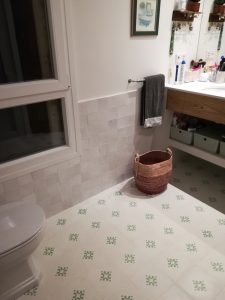
Zellige tiles are glazed clay pieces, fired and cut by hand in Morocco, that have been used to build geometric mosaics since the 10th century. Each piece varies in tone, sheen and size: that irregularity is its hallmark. Here we explain what zellige is, how it is made, how it differs from “zellige-effect” ceramics and how to use it in bathrooms, kitchens, floors and outdoor spaces.

What is zellige?
Zellige is a glazed terracotta tile from Morocco, made and cut by hand, which is laid as individual pieces or combined into geometric mosaics. The word comes from Arabic and means “small polished stone”: each piece is, quite literally, a tessera chipped out with a hammer.
It appeared in Morocco around the 10th century, in white and earth tones; from the 14th century onwards green, blue and yellow were added, and with them came the great tile mosaics of the madrasas of Fez. The same technique crossed over to al-Andalus: the dados of the Alhambra and of the Alcázar of Seville are mosaics of hand-cut pieces, close siblings of Moroccan zellige.
Today, anyone searching for “zellige tiles” usually has in mind the single tile — the 10×10 cm square or the Bejemat-style rectangle — laid with barely any joint in a bathroom or kitchen, rather than the traditional star mosaic. Both are zellige: one is the material, the other a way of putting it together. And a clarification: zellige is ceramic, fired and glazed clay; cement tile is pressed cement and is never fired.
You will recognise it by four features:
- A glossy glaze with ripples and bubbles that play with the light.
- An uneven tone: within a single colour, lighter and darker pieces sit side by side.
- Edges cut and bevelled by hand, with slight differences in size.
- A reddish clay body, visible on the edge and on the back.
How is zellige made by hand?
Zellige is made from clay that is shaped by hand, dried in the sun, fired, glazed on one face and fired again; each piece is then cut with a hammer into its final shape. The whole process is done by hand, which is why no two pieces are the same. Our article on the artisanal zellige-making process tells the story with pictures from the workshop.
- Preparing the clay. It is crushed, soaked and kneaded into a smooth, even paste; clay from the Fez area is the most highly prized.
- Moulding and drying. The paste is spread into square moulds, smoothed by hand and left to dry in the sun.
- First firing. The raw slabs come out of the kiln as terracotta biscuit.
- Glazing. The visible face of each piece is coated with a single-colour glaze.
- Second firing. This fixes the glaze; it is at this stage that the variations in tone, the bubbles and the crazing appear.
- Marking out the shape. The outline to be cut is painted on the glaze with a brush: square, rectangle, star, triangle.
- Cutting with the menqach. A sharpened hammer with which the master craftsman chips out the shape with short, sharp blows.
- Bevelling. A smaller hammer is used to pare back the edge from the underside, so that the pieces fit together almost edge to edge without their glazed faces knocking against each other.
From single tile to zellige mosaic
The traditional panels — eight-, twelve- or sixteen-pointed stars surrounded by interlacing strapwork — are assembled face down: the craftsman lays the pieces glaze-side down following the design, pours mortar over the back and, once it has set, has a panel that can be installed in one go. This is the technique behind the fountains, dados and columns of riads. At Demosaica, as well as single pieces, we have mosaic plates, borders and carved zellige for anyone looking for that traditional mosaic.
What is the difference between real zellige and “zellige-effect” ceramics?
Real zellige is glazed clay cut by hand, with high water absorption and every piece different; “zellige-effect” ceramic is industrial stoneware or porcelain that imitates that irregularity with digital printing, with almost zero absorption and calibrated pieces. In a photo they look alike; in the hand and on site, they do not.
Much of what comes up when you search for “zellige tiles” is made up of these imitations: 10×10 cm collections in a dozen shades with slightly irregular edges. They are not bad — they are porcelain and work on high-traffic floors and outdoors where there is frost — but they repeat the same pattern every few pieces and lack the depth of a glaze fired onto clay.
| Feature | Handmade zellige | “Zellige-effect” ceramic |
|---|---|---|
| Material | Clay fired and glazed by hand | Industrially pressed stoneware or porcelain |
| Water absorption | 15.7 % (10×10 cm piece, UNE-EN ISO 10545-3) | Below 0.5 % for porcelain |
| Variation between pieces | Every piece differs in tone, sheen and size | Repeated pattern, uniform calibre |
| Joint | Minimal or butt-jointed, no spacers | Standard joint with spacers |
| Floor use | Homes with moderate foot traffic (abrasion class 3) | Depending on each model’s PEI class, up to heavy traffic |
| Outdoor use | Only with a water repellent and no hard frosts | Yes, if the model is frost-resistant |
| Replacement | Piece by piece, not tied to a collection | Depends on the collection still being in the catalogue |
Is zellige less durable? On walls, no: glaze fired onto clay lasts for centuries, as the madrasas of Fez show. On floors, industrial ceramics are harder. And what most determines the service life of either is the installation: zellige on a substrate that has not been waterproofed fails sooner than well-laid porcelain, and vice versa.
The figures for our zellige are in the published test reports: water absorption of 15.7 % (UNE-EN ISO 10545-3, the Spanish edition of EN ISO 10545-3) and abrasion resistance class 3, with visible defects at 750 revolutions (UNE-EN ISO 10545-7), on a 100 × 100 × 12 mm glazed piece. This is test report no. 9103 from the Elabora laboratory, registered with the Andalusian regional government (Junta de Andalucía) under number AND-L-155.
On price: handmade zellige costs more per square metre than an imitation, and laying it takes more hours. In return, a broken piece can be replaced with another in the same colour without depending on a factory keeping the collection going. Check prices and lead times with the workshop.
What formats and colours does zellige come in?
The classic zellige format is the 10×10 cm square. Then come the Bejemat-style rectangles (from 30×10 to 10×5 cm), the small 5×5 and 3×3 cm squares and the pieces cut for mosaic. Each format changes the number of pieces per square metre, and with it the price and the installation time.
| Family | Ref. | Size (cm) | Weight per piece | Pieces per m² |
|---|---|---|---|---|
| Mjeddij (square) | ZS01 | 15 × 15 × 1.6 | 0.30 kg | 45 |
| Mjeddij (square) | ZS02 | 10 × 10 × 1 | 0.16 kg | 100 |
| Mjeddij (square) | ZS03 | 5 × 5 × 1 | 0.05 kg | 400 |
| Mjeddij (square) | ZS04 | 3 × 3 × 1 | 0.02 kg | 1,111 |
| Bejemat (rectangle) | ZS11 | 30 × 10 × 1.8 | 1.00 kg | 34 |
| Bejemat (rectangle) | ZS12 | 20 × 10 × 1.8 | 0.60 kg | 50 |
| Bejemat (rectangle) | ZS13 | 15 × 7.5 × 1.8 | 0.37 kg | 89 |
| Bejemat (rectangle) | ZS14 | 20 × 5 × 1.5 | 0.39 kg | 100 |
| Bejemat (rectangle) | ZS15 | 15 × 5 × 1.5 | 0.18 kg | 134 |
| Bejemat (rectangle) | ZS16 | 10 × 5 × 1 | 0.09 kg | 200 |
| Darj (mosaic piece) | ZS51 | 10 × 10 × 1 | 0.08 kg | 200 |
| Kora 6 (mosaic piece) | ZS61 | 14 × 12.2 × 1 | 0.30 kg | 78 |
Sizes are approximate: because the pieces are cut by hand, each one may vary slightly. The full table of zellige formats also includes Nzik, Chakar, Fekroun, Ders and Kora 8, with their weights and units per square metre. Among the rectangles, the 20×10 cm Bejemat (ZS12), 1.8 cm thick and with 50 pieces per m², is the most versatile: laid in a half bond, in herringbone or vertically.
The zellige colour chart runs from whites and ecrus to greens, blues, pinks and terracottas, with the characteristic glossy finish. As the tone is not uniform, ask for a physical sample before deciding: on screen, a bottle green and a sage green are easily confused; in your hand, they are not.
Metallic zellige: gold, silver, bronze and iridescent
Alongside traditional zellige, at Demosaica we have developed a collection of metallic zellige in four finishes — gold, silver, bronze and iridescent — obtained by vapour-depositing metals onto the glazed piece, in 10×10 and 5×5 cm (other formats to order). Being handmade, it shows variations in calibre, texture, design and tone that are not grounds for a complaint. Check availability and lead times with the workshop.

It calls for special care: handle it gently so as not to scratch it, fix it with the pieces clean and dry using a flexible adhesive such as Elasticer by Fixcer or similar, cut it with a water-cooled blade and clean it only with a soft damp cloth and neutral soap. Strong detergents and abrasive scourers damage it irreversibly; remove any adhesive or grout residue with a sponge and plenty of water before it hardens.

How much zellige do you need?
Multiply the square metres by the format’s pieces per m² and add between 10 % and 15 % for cuts, breakages and shade selection. A 4 m² kitchen splashback in Mjeddij 10×10 (100 pieces/m²) takes 400 pieces; with a 10 % margin, 440. The same splashback in Bejemat 15×5 (134 pieces/m²) takes 536 pieces, about 590 with the margin. Before settling on the quantity, check with the workshop for minimum orders and which formats are in stock.
Where can zellige tiles be used? Bathrooms, kitchens, floors and outdoors
Zellige works on any interior wall, including showers and kitchen splashbacks; on floors, only in areas of the home with moderate foot traffic and with a water repellent; outdoors, in climates without hard frosts and on a waterproofed substrate. What decides each case is its water absorption, which is high.
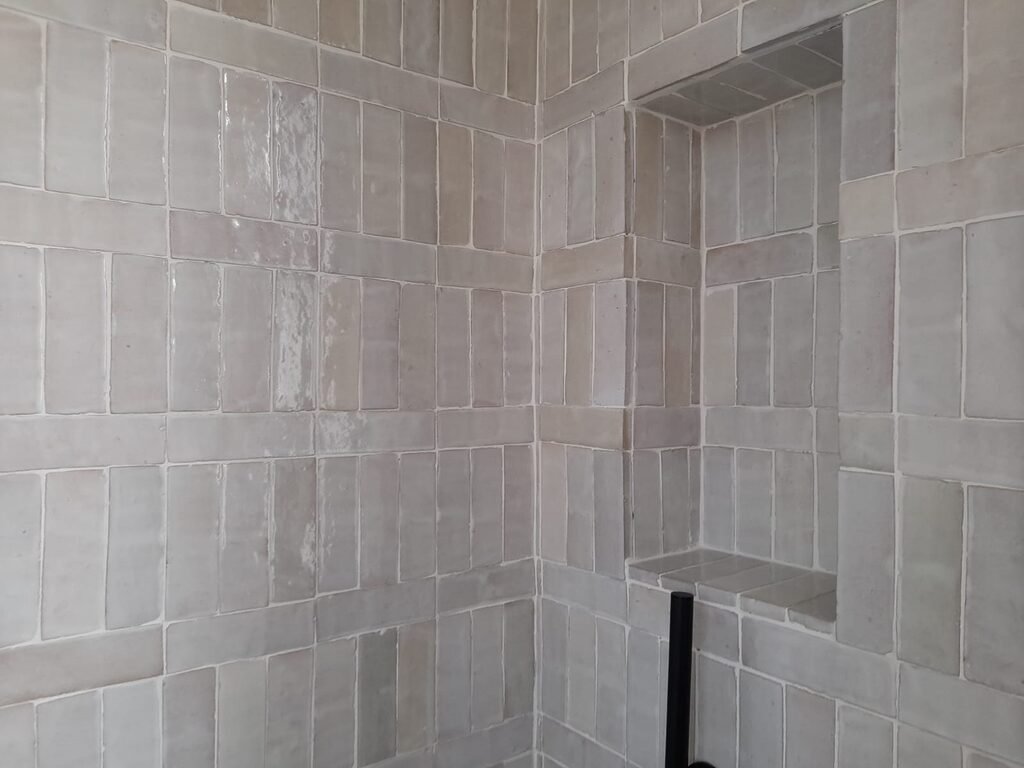
Bathrooms and showers
This is its natural habitat. On shower walls it can be laid without any problem if the substrate has a waterproofing membrane or waterproofing mortar: zellige is not waterproof in itself, and any water that gets in through the joints must meet a barrier behind it. On the shower floor, it is best avoided: wet glossy glaze is slippery, and the Spanish Building Code (CTE DB-SUA 1) requires slip resistance class 3 in showers.

Kitchens
The splashback between the worktop and the wall cabinets is the most rewarding use: a small surface, raking light that brings out the glaze and easy cleaning. The glaze stands up to grease and splashes; what needs protecting is the grout, which is best treated with a water repellent. Next to a gas hob or a stove there is no problem either: it is ceramic fired at high temperature.
Floors
In Morocco, floor zellige has always been combined with marble or terracotta, as in the photo at the top of this article. In a home it works in bathrooms, bedrooms and areas with moderate foot traffic: the tested piece achieves abrasion resistance class 3, enough for residential use but not for a shop or an entrance straight from the street. Choose thicker pieces (1.8 cm Bejemat or 15×15 Mjeddij, 1.6 cm thick), apply a water repellent after grouting and accept that the gloss will soften with use. For heavy traffic, cement tiles or terrazzo are a better option.
Outdoors, courtyards and fountains
Zellige was born in courtyards and fountains, and in Morocco it still clads them in green and white mosaics. But it is porous: its water absorption is 15.7 %, and water that freezes inside the pores breaks the piece from within. In climates like that of Seville, where frost is rare, it can be used on façades, low walls, benches and fountains; in areas with hard frosts, we do not recommend it. Always with a waterproofed substrate, exterior-grade adhesive and grout, and a water repellent that is regularly renewed. The sun does not affect it: the glaze does not fade. You will find more ideas in our article on zellige in outdoor decoration.


Our article Real zellige projects: bathrooms, kitchens, staircases and courtyards brings together finished projects, with the format and colour used in each one.
How is zellige laid, step by step?
Zellige is laid with a flexible cement-based adhesive on a flat, waterproofed substrate, piece by piece, without spacers and with a minimal joint, and then grouted with a fine grout in a tone close to the glaze. It is slower than laying a calibrated tile: you have to mix shades, make up for differences in size and clean as you go.
- Prepare the substrate. Flat, clean, dry and, in showers, kitchens and outdoors, waterproofed. Any unevenness in the substrate adds to that of the pieces.
- Open several boxes and mix the pieces so that the variations in tone are spread out and do not form patches.
- Dry-lay one square metre. Decide on the laying pattern (butt-jointed, half bond, herringbone, vertical) and how to make up for differences in size.
- Spread a flexible cement-based adhesive (class C2 S1 in wet areas) and comb it with a notched trowel. For 1.8 cm thick pieces or outdoors, use back-buttering (double spreading): on the substrate and on the back of the piece.
- Lay by hand, without spacers. A 1 to 2 mm joint, or butt-jointed if you want the traditional look. Adjust each piece by looking at the whole surface, not at the individual piece.
- Clean off any adhesive that squeezes out with a sponge and plenty of water before it hardens; once dry on the glaze, it is hard to remove and scratches.
- Cut with a water-cooled diamond blade. On exposed corners, mitre the cut; smooth the edges with a diamond file.
- Grout after 24 hours with a fine cement-based grout in a tone similar to the glaze. With light zellige and dark grout, protect the surface with a sealer first: the pigment gets into the crazing and into the pores of the edges.
- Clean and protect. Remove grout residue with a damp sponge, finish with a dry cloth and, after a few days, apply a water repellent in wet areas and outdoors.
There is a whole article on grout, secrets of grout for zellige: which colour to choose, cement-based or epoxy, and how to keep it from staining the glaze. It is what changes the final result the most. With metallic zellige, also follow the instructions given above.
How do you clean and maintain zellige?
Zellige is cleaned like any glazed tile: water, neutral soap and a soft cloth or sponge. What needs attention is the grout and the water repellent in wet areas, not the tile itself.
- Routine cleaning: warm water with neutral soap; dry with a cloth to avoid limescale marks on the gloss.
- Avoid: abrasive scourers, concentrated bleach, acid descalers and powder cleaners; they dull the glaze and attack cement-based grout.
- Crazing: the network of hairline cracks in the glaze is normal in zellige, not a defect; in kitchens, a sealer protects it from grease stains.
- Water repellent: renew it when water stops beading on the joints in showers, on worktops and outdoors.
- Breakages or loose pieces: they are replaced piece by piece; keep a spare box from the same order so that the shade matches.
If stains, chipped glaze or loose pieces appear, our article zellige damage: causes and solutions explains where they come from and how to fix them.
Frequently asked questions about zellige tiles
Is zellige ceramic?
Yes. Zellige is ceramic in the strict sense: moulded, fired and glazed clay, tested to the ceramic tile standards (the UNE-EN ISO 10545 series). What sets it apart from an industrial tile is not the material but the process: it is moulded, glazed and cut by hand, piece by piece. It should not be confused with cement tile, which is pressed cement that is never fired.
Can zellige be used on floors?
In homes, yes, with some conditions: areas of moderate foot traffic, thicker pieces, a water repellent after grouting, and accepting that the gloss will soften with use. Our tested zellige has abrasion resistance class 3, suitable for residential use but not for commercial premises or entrances straight from the street. On shower floors and floors that get wet, the glossy glaze is slippery: another material is a better choice.
Is zellige suitable for outdoors or for a swimming pool?
On façades, low walls, benches and fountains in climates without hard frosts, yes, with a waterproofed substrate, exterior-grade adhesive and grout, and a water repellent. Its water absorption is 15.7 %, so where there is frost, water frozen in the pores can crack it. For swimming pools we do not recommend it without consulting us first: permanent immersion and pool chemicals call for a material with very low absorption.
Why do zellige pieces arrive in different shades and sizes?
Because each piece is glazed and fired in traditional kilns and cut by hand. Within the same colour there are lighter and darker pieces, pieces with more or less sheen and pieces of slightly different size. This is neither a defect nor grounds for a complaint: it is what sets zellige apart from industrial ceramics. For an even overall result, mix pieces from several boxes as you lay them.
What joint and grout does zellige need?
A minimal joint of 1 to 2 mm, or butt-jointed if you want the traditional look; never spacers, because the sizes vary. The grout should be cement-based and fine, in a tone close to the glaze: a very dark grout on light zellige gets into the crazing and looks dirty. If there is strong contrast, seal before grouting, and remove the residue with a damp sponge without letting it dry.
How much does handmade zellige cost?
It depends on the format, the colour and the type of piece. Small formats (5×5, 3×3 and mosaic pieces) multiply the units per square metre and the laying hours, and carved zellige or mosaic plates are quoted separately. Request a quote from the workshop with the measurements and format of your project, and ask about zellige in stock.
If you are considering zellige for a bathroom, a kitchen or a courtyard, choose the format and colour in the zellige tile catalogue and ask for physical samples: the true shade can only be judged in the hand. At our showroom in Seville you can see formats and colours by appointment.