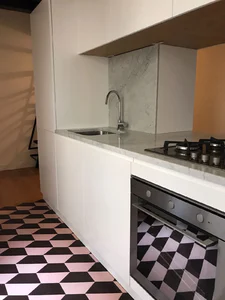
The most popular cement tile patterns are the chequerboard, geometric designs, floral and Modernista motifs, Mudéjar-inspired designs, the bordered tile rug, hexagons and herringbone laid with rectangular tiles. The right pattern for each project depends on the size of the room, the light it gets and the effect you are after: making it feel larger, making it look longer or marking out a particular area.
What is a cement tile pattern, and how is it different from the layout?
A cement tile floor combines two different patterns: the design each tile carries and the way the tiles are laid on the floor. The first is decided in the workshop; the second, on site.
The design is formed with the divider, a metal template that separates the colours in the face layer: each cell is filled with its pigment mixed with white cement and marble powder, the divider is lifted out, the base layers are added and the tile is pressed. There is no firing: the tile sets and cures for weeks, as we explain in how cement tiles are made.
Depending on the design, the motif fits on a single tile (a centred flower or star) or is completed by four rotated tiles: the 2×2 module, the most common. That repeat module tells you how many tiles you need to see the whole design, and it determines the setting-out.
The layout is how the tiles are arranged: in a straight grid, turned 45° (on the diagonal), staggered or in herringbone. With plain or two-colour tiles, the layout creates the pattern; with patterned tiles, it has to respect the orientation of the design.

What are the most popular cement tile patterns?
Eight families come up in most projects, each with its own tile format and the rooms it suits best.
Chequerboard: the two-colour classic
The chequerboard alternates plain tiles in two colours, almost always in the 20×20 cm square. In black and white it is the most recognisable version and the one that ages best; in white with burgundy, green or blue it has a more retro feel. It is laid in a straight grid, or turned 45° to make the room look wider. A real example: this bathroom with a black and white cement tile floor (Mod. 123).
Geometric: diamonds, cubes and stars
These combine triangles, diamonds and squares in two or three colours. The most common are the three-tone cube (which gives a 3D effect), the diamond and the eight- or sixteen-pointed star. In soft shades they can cover an entire living room; in strong contrast they work better in small areas or as a rug.

Floral: the pattern that never dates
A flower centred on the tile, with corner motifs that link up with the neighbouring tiles, is the most recognisable design of the classic cement tile, almost always in two or three colours on a light ground. It is the usual floor in the bathrooms and kitchens of old houses, and one of the most frequent choices when renovating flats and country homes.

Modernista and Art Nouveau
Descended from late nineteenth-century Art Nouveau: curving lines, leaves and stems, often in rugs with a matching border. They are a frequent request when renovating flats from the early twentieth century.
Mudéjar: strapwork and eight-pointed stars
They reproduce the strapwork, crosses and stars of the al-Andalus tradition, almost always on a four-tile module and in green, ochre, blue and black. They add visual texture and suit courtyards, entrance halls and bohemian or eclectic projects.

Tile rug with a border
A cement tile rug is a field of patterned tiles framed by a perimeter border with its corner pieces and surrounded by plain tiles. It is the traditional way of flooring living and dining rooms, and today it is used to mark out an area (the table, the bath, the terrace of a commercial space) without covering the whole floor in pattern. There are more examples in our guide to cement tile rugs.


Hexagonal
The hexagonal tile, plain or patterned, forms a continuous honeycomb that only needs cutting at the edges. In a single colour it gives a sober, contemporary floor; with two or three colours you can draw cubes, stripes or gradients.
Herringbone and other layouts with rectangular tiles
Herringbone is laid with plain rectangular tiles set at 90° to one another; chevron, with tiles cut at 45° that form a continuous V. Both bring movement to corridors and entrances and make the room look longer in the direction the tiles run.
Which tile format does each pattern need?
The chequerboard and the classic designs are usually done in the 20×20 cm square, herringbone needs rectangular tiles and the honeycomb, hexagons. The table lists the formats made in our Seville workshop, with weight and units per square metre: what you need to work out your order.
| Pattern | Format (ref.) | Size | Weight per tile | Units per m² |
|---|---|---|---|---|
| Chequerboard, floral, Modernista, Mudéjar | Square (H03) | 20×20×1.5 cm | 1.30 kg | 25 |
| Small-tile chequerboard | Square (H04 / H06) | 15×15×1.5 / 10×10×1.5 cm | 0.79 / 0.35 kg | 45 / 100 |
| Herringbone and chevron | Rectangular (H13 / H12 / H11) | 20×10×1.5 / 25×10×1.6 / 30×15×1.6 cm | 0.62 / 0.86 / 1.45 kg | 50 / 40 / 23 |
| Hexagonal honeycomb | Hexagonal (H23 / H22 / H21) | 11.5×10×1.5 / 23×20×1.5 / 30×20×1.7 cm | 0.35 / 1.16 / 1.62 kg | 116 / 29 / 21 |
| Octagon (with a square tile insert) | Octagonal (H31) | 20×20×1.5 cm | 1.14 kg | 25 |
| Diamonds and lozenges | Diamond (H71) | 28×16.5×1.6 cm | 0.72 kg | 44 |
| Arabic-style shapes: Chakar / Laghaz / Labrys | H61 / H41 / H51 | 20×17×1.5 / 20×17×1.5 / 30×20×1.5 cm | 0.58 / 0.62 / 1.35 kg | 50 / 50 / 25 |
| Tile insert between plain tiles or terracotta | Tile insert (H07) | 7×7×1.5 cm | 0.25 kg | 205 |
The units per m² give you the order: a 20×20 cm chequerboard over 12 m² takes 300 tiles, 150 of each colour, plus wastage for cuts. The full table, including skirting, is on our cement tile formats page. The Arabic-style shapes create a pattern through their outline alone, with no design on the face: the Chakar cement tile is the clearest example.
How do you choose a pattern for the size and light of the room?
A rule of thumb: the smaller and darker the room, the lighter the ground and the simpler the design; the larger and brighter the room, the more contrast and large motifs it can take.
- Size. In small rooms, a single-tile design or a chequerboard turned 45°; in large ones, 2×2 modules, large motifs and rugs.
- Light. With little natural light, a light ground and mid-tones; with plenty of light, intense shades and black hold up well.
- Use. Entrances, kitchens and commercial spaces benefit from mid-tones and small motifs, which disguise wear; in bedrooms, soft designs.
- Surrounding colours. Neutral walls and furniture call for a floor that takes centre stage; a room that is already colourful, a simple pattern. The cement tile colour chart brings together 49 references, from MC1 to MC49, to match the design to the rest of the room.
- The effect you want. To make it look bigger: a diagonal layout, light shades and grout in the colour of the ground. To make it look longer: rectangular tiles or herringbone running lengthways; laid widthways, they make it look wider. To draw the eye: a contrasting rug.
Which pattern works best in each room?
In kitchens and bathrooms, the chequerboard and florals rule; in corridors and entrances, herringbone and borders; in living rooms, the rug; in courtyards and on terraces, large geometric patterns that mark out areas and paths.
Kitchen
A 20×20 cm chequerboard in black and white or white and burgundy with plain-fronted units, so that nothing competes with the floor; or a plain floor with a perimeter border, which concentrates the pattern at the edges and leaves the work zone uncluttered.

Bathroom
Florals and geometrics in blues, greys and whites, or a rug under the freestanding bath surrounded by plain tiles. In the shower, a matt finish and a water-repellent treatment.
Corridor and entrance
Herringbone in 20×10 cm tiles or a chequerboard on the diagonal make the most of the length of the space; a border following the walls brings order to the corridor and neatly resolves the junctions with the doors. These are high-traffic areas: mid-tones are better than pure whites.
Living and dining room
A cement tile rug under the table or the sofa, with a plain surround: it is the classic solution and the one that sits best with wood flooring in the rest of the house. Large Modernista and floral designs come into their own here, with plenty of light.
Courtyard, terrace and balcony
Outdoors, large geometric patterns that mark out areas (the table, the path, the edge of the pool) work well: terracotta tones with a geometric design add warmth; blues and greens in florals or arabesques, freshness. The cement tile floor has to be treated with a water-repellent and sealed, and its slip resistance checked against the requirements of DB-SUA 1 of the Spanish Building Code (CTE). In our tests, 20×20 cm hydraulic terrazzo reached a PTV of 59.5 in wet conditions at 20 °C: class 3, the class the CTE requires for outdoor areas, swimming pools and showers (test report no. 4718). That figure applies to that material, not to every model: ask the workshop for the test report on the one you plan to lay. The full reports are on our laboratory tests page.

How do you combine patterns with borders, plain tiles and other materials?
The rule is a single focal point: if the floor is patterned, keep walls and furniture plain; if the floor is plain or a chequerboard, the pattern can move up the wall in zellige or metro tiles, in a colour taken from the floor. Do not use more than three colours per design, and repeat at least one across tiles that touch.
- Pattern + plain. A plain band one or two rows wide separates the rug from the rest and takes up the cuts; matching cement tile skirting completes the composition.
- Cement tile + wood. A rug or chequerboard in the wet area and wood flooring elsewhere, with a straight junction between the two.
What texture does a cement tile have?
The surface of a cement tile is smooth, matt and mineral to the touch: it has no glaze, and the colour is in the pigmented cement layer itself. With a water-repellent treatment or a sealer it can take on a slight satin sheen, but it is never glossy like glazed ceramic.
The slight variations in shade between tiles and the clouding in the pigment are inherent in the handmade process and are part of the texture of the pattern: once laid, the matt surface absorbs light and softens the contrast. In matt or gloss finish on cement tiles we compare the two; for showers and outdoor areas it is worth considering microtextures on cement tiles, which add grip without making the surface rough.
How do you plan the pattern, and how much extra material should you order?
Plan the pattern on a scale drawing before you order: define the module, the starting point and the direction of the design, and add wastage for cuts, which increases with diagonal and herringbone layouts.
- Measure the room and draw it to scale, with doors, windows and fitted furniture.
- Choose the module (one tile or 2×2) and check how many complete modules fit; if they do not work out whole, adjust with a plain band around the perimeter.
- Mark the starting point from the centre or from the door, so that the cut tiles fall along the least visible edges.
- Fix the orientation of the design: directional motifs and herringbone change their effect depending on which way they run.
- Work out the number of tiles with the units per m² in the table and add wastage: around 5–10 % for a straight grid, 10–15 % on the diagonal and 15–25 % for herringbone or chevron, approximate figures that are worth confirming with the workshop.
- Ask for samples of each colour before finalising the order: the shade in your hand is never the one on the screen, and it varies slightly between batches.
Frequently asked questions about cement tile patterns
Can cement tiles be laid in herringbone?
Yes. It is done with plain rectangular tiles of 20×10, 25×10 or 30×15 cm laid at 90° to one another. For chevron, with its continuous V, the tiles are cut at 45° with a water-cooled blade, which increases wastage. It is the layout that brings the most movement to corridors and entrances.
How many tiles make up the complete design?
It depends on the repeat module. Some designs fit on a single tile; most of the classics are completed by four rotated tiles (2×2), and compositions with a border and corners need several different references. Ask to see the motif laid out with at least four tiles before you decide.
Which pattern makes a small room look bigger?
A light ground with a simple design, or a 20×20 cm chequerboard turned 45°, with grout in the colour of the ground. Small, high-contrast motifs make a room shrink; so does a dark border hard against the wall. If you want pattern, confine it to a central rug and leave the perimeter plain.
Can two patterns be mixed in the same room?
Yes, if they share a format and colour palette and are separated by a plain band or a border. The usual approach is a patterned field with plain tiles around it, or two designs from the same family in different areas. Three patterns in one room start to look busy.
Are cement tiles handmade?
Yes. Each tile is filled by hand in the divider, one colour at a time, then pressed and cured without firing. That is why there are slight variations in shade and line from tile to tile; they are part of the pattern’s character and set a genuine encaustic cement tile apart from a ceramic imitation.
Can I change the colours of a pattern?
Yes, within the colour chart: the colour is decided when you place the order, and the chart runs from MC1 to MC49. The same pattern in blue and white, in green and ochre or in grey takes on a completely different character. Which combinations each design allows, and the lead times and minimums for a custom colour or design, should be checked with the workshop.
Shortlist two or three patterns, look at each with four tiles side by side and compare them in the room’s real light. All the designs, formats and colours are in the cement tile catalogue; ask the workshop for samples before you decide.