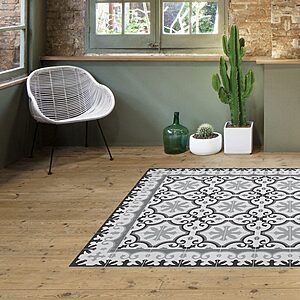
Decorating a bathroom with cement tiles means letting the pigmented cement floor take centre stage and keeping everything else understated: plain walls in white or soft shades, simple sanitaryware and wood or neutral ceramic tiles. In a cement tile bathroom, large or small, the tiles can go on the floor, in the shower and on the walls, provided they are treated with a water-repellent and sealed before first use.
What follows is based on more than twenty real customer bathrooms, from Asturias to Switzerland, fitted with our cement tile designs; all the photos come from those projects.

Why do cement tiles work so well in the bathroom?
Because the bathroom is usually the smallest room in the house and leaves little space for decorative objects, the floor plays a bigger part there than in any other room. A well-chosen pattern decorates the room on its own; everything else can stay white.
A cement tile is made of cement, sand, marble powder and pigments, cold-pressed in a mould with a metal template (the divider) that keeps the colours apart, and cured without firing. It is porous, which is why it is treated with a water-repellent and sealed; once treated, it easily withstands the wear and moisture of everyday bathroom cleaning.
We put our tiles through laboratory tests: cement tiles are assessed as concrete paving tiles under UNE-EN 1339, the Spanish version of EN 1339 (test report no. 9102, 200 × 200 × 15 mm format). Hydraulic terrazzo in the 20 × 20 cm format, also pressed without firing, showed a water absorption of 5.9–6.2 % (UNE-EN 13748-1) and a wet slip resistance of 59.5 PTV, class 3 under the Spanish Building Code, CTE DB-SUA (test report no. 4718). The full reports are on our laboratory tests page.

Where should cement tiles go in the bathroom: floor, shower or wall?
A full floor is the most common option and the one that ages best; in the shower and behind the washbasin, the same tile can go on the wall, and half-height tiling with a border is the classic solution. The only firm rule: don’t cover the floor and every wall in pattern, because the bathroom ends up looking too busy.
| Bathroom area | What works | Real example |
|---|---|---|
| Full floor | A single design, two or three colours, matching skirting | Mod. 125-A in black and white (Asturias); Victorian-style Mod. 219 (Valencia) |
| Cement tile rug | A pattern framed with plain tiles (Mod. 100) or neutral ceramic | Mod. 211 surrounded by black ceramic (Alicante); three Mod. 276 rugs with a plain border (France) |
| Shower wall | Plain tiles or the floor design, minimal joints and sealing | Plain Mod. MC40 (Alicante); grey Mod. 100 (Italy) |
| Washbasin wall | A small pattern or hexagonal tiles, as a splashback | Mod. 224 in green, yellow and sky blue; hexagonal Mod. 604 in white and turquoise (both in France) |
| Half-height tiling with a border | Plain tiles finished with a cement tile border and skirting | Off-white Mod. 100 and a Mod. 59 border with a Mod. 167 floor |
Full floor or cement tile rug
With a simple floor plan, a full floor in a single design is the cleanest option, finished with plain cement tile skirting. If the bathroom is long and narrow or already has another floor covering, a cement tile rug marks out the washbasin or bath area: in Alicante, a Mod. 211 rug (a floral design by Maria Starling) was framed with black ceramic tiles; in France, two bathrooms and the adjoining corridor have three Mod. 276 rugs in white on MC44 navy blue, edged with a plain border in the same blue.


Shower and washbasin wall
On a bathroom wall, cement tiles are laid in the same way as on the floor, but it is best to limit them to one section of wall. In Alicante, the Mod. 139-A floor (white, red and MC40 greenish grey) has a border and skirting in MC40, and the shower wall was tiled in plain MC40: the same colour, without drawing attention away from the floor. In France, the shower and the wall behind the washbasin were clad in Mod. 224 in green, yellow and sky blue, with the tiles rotated to create a pattern of their own.


Half-height tiling, borders and skirting
This is the traditional bathroom formula: plain tiles up to half height, a cement tile border to finish them off and a painted wall above. In one classic bathroom, the Mod. 167 floor (MC3 off-white and MC48 grey) was paired with plain Mod. 100 on the wall and the Mod. 59 border, designed by Yela Álvarez, in the same two colours.

Which colours and patterns should you choose for a bathroom with a cement tile floor?
White, black and greys suit any style; blues are the bathroom colour par excellence; soft shades (pink, green, mustard) call for cream or off-white walls. The more colours the tile has, the more neutral everything else should be. Our cement tile colour chart has 49 shades (MC1 to MC49) for colouring any design.
Black and white: the classic that never fails
Mod. 125-A (MC1 and MC49), with diamonds in a chequerboard layout, features in classic bathrooms in Asturias and in other traditional-style ones; Mod. 219, with its Victorian feel, achieves the same chequered effect with a single tile in Valencia; and Mod. 111-D (white, grey and black), with its cube pattern, was the solution for the shower room in Ourense. In another bathroom, the special Laghaz format laid in MC49 black shows that contrast also works with a shape other than the square.

Blues: freshness and a seaside feel
White and blue is the combination that comes up most often in the bathrooms in this guide. Mod. 111-E (white and two blues) has a geometric pattern with a three-dimensional effect: ZaHu Estudio used it in Zaragoza, and another customer in a small bathroom in A Coruña. Mod. 181 (white and navy blue) features in a bathroom in Catalonia, and Mod. 139 (off-white, indigo and navy) in a vintage one in the Axarquía region, with plain tiles in the same shades. With wood and white sanitaryware, blue brings a seaside feel.


Soft shades and multicolour
The MC29 pink on off-white of Mod. 189, the pink and aubergine of Mod. 137 with salmon walls in Italy, and the turquoise and dark green of Mod. 133 in Zaragoza show that colour need not be loud. If the design has four or five colours, like Mod. 104, the rest of the bathroom should be neutral so that the floor is the only focal point.

How do you decorate a small bathroom with cement tiles?
In a small bathroom, cement tiles stand out even more than in a large one, as long as you choose a single pattern on a light ground with two or three colours and keep everything else plain. The usual mistake is to put pattern on both the floor and the wall and add a dark vanity unit: the room feels cramped.
- A white or off-white ground (MC1 or MC3) and a fine-lined geometric design.
- Cement tiles on the floor or on a single wall, never both.
- Plain white walls, white sanitaryware and a light wood or wall-hung vanity unit.
- Joints of 1 to 2 mm and light, unpigmented grout, so that the pattern is not broken up.
- The 20 × 20 cm format or small hexagons; on shower floors, 10 × 10 or 15 × 15 cm.
Several of the bathrooms our customers have sent us are small: Mod. 111-E in A Coruña, whose 3D pattern adds depth; Mod. 135-A in Baden (Switzerland), a design that can be overpowering in large rooms but here works well with the wooden vanity unit; Mod. 109 on the wall of a tiny bathroom in Bilbao; and the hexagonal Mod. 604 in white and turquoise on the washbasin wall of a bathroom in France.


Which cement tile format works best in a bathroom?
The 20 × 20 cm square is the benchmark: 25 tiles per m², 1.5 cm thick, 1.30 kg per tile and the widest choice of designs. The hexagon changes the pattern without changing the material, and small formats adapt better to shower floors and to bathrooms with lots of cuts. All the sizes are on the cement tile formats page.
| Format | Ref. | Size | Weight per tile | Units per m² | Recommended bathroom use |
|---|---|---|---|---|---|
| Square | H03 | 20 × 20 × 1.5 cm | 1.30 kg | 25 | Full floors, rugs, walls |
| Square | H04 | 15 × 15 × 1.5 cm | 0.79 kg | 45 | Small bathrooms, shower floors |
| Square | H06 | 10 × 10 × 1.5 cm | 0.35 kg | 100 | Shower floors laid to a fall, washbasin walls |
| Rectangular | H13 | 20 × 10 × 1.5 cm | 0.62 kg | 50 | Metro-style walls, borders |
| Hexagonal | H22 | 23 × 20 × 1.5 cm | 1.16 kg | 29 | Honeycomb-pattern floors |
| Hexagonal | H23 | 11.5 × 10 × 1.5 cm | 0.35 kg | 116 | Small bathrooms and showers |
| Laghaz | H41 | 20 × 17 × 1.5 cm | 0.62 kg | 50 | Floors with a distinctive outline |
| Plain skirting | HR01 | 20 × 10 × 1.5 cm | 0.66 kg | 5 per linear metre | Edging for full floors |
We are getting more and more requests for hexagonal tiles in bathrooms: Mod. 600 in two greys (MC47 and MC48) in a minimalist bathroom on Spain’s Levante coast, in white and MC36 blue with wood in Cádiz, and, on off-white, in mustard in one bathroom and in navy blue in another, in a project by Orthosis Architetti in Italy; Mod. 604 can be laid in three different ways with the same tile. Among the special formats, the Chakar (20 × 17 cm, 50 tiles per m²) creates a different pattern from a single tile.


How are cement tiles laid and protected in a bathroom renovation?
In the same way as any other floor tile, with three differences: flexible cement-based adhesive applied by back-buttering, minimal joints, and a water-repellent and sealer treatment before and after grouting. Without that treatment the tiles are stained by grout and water; with it, bathroom moisture is not a problem.
- Substrate. A level, clean and dry screed; in the shower, waterproofing and a fall towards the drain before laying.
- Setting-out. Plan the pattern from the centre line of the bathroom; if there is a rug, mark out the border first; mix tiles from several boxes.
- Adhesive. Flexible tile adhesive, white for light-coloured designs so that it does not show through; back-butter and bed each tile by hand, without tapping the face.
- Joints. 1 to 2 mm; wipe off any cement residue straight away with a sponge and water, because once dry it leaves marks.
- First treatment. Once the adhesive is dry, apply a water-repellent to the clean surface to close the pores before grouting.
- Grout. Fine, unpigmented cement-based grout (white or cement grey): tinted grout can stain the tile permanently. Remove the excess immediately with a damp cloth.
- Finish. Sealer or wax, then allow the curing time specified by the manufacturer before the bathroom gets wet.
The full process is in our guide to laying cement tiles, and aftercare in our article on cement tile floor maintenance. For your building schedule: stock designs are shipped with no production lead time; custom designs are made to order and their lead time is measured in weeks, so check it with the workshop before you fix dates.
Can cement tiles be combined with zellige, wood or ceramic in the bathroom?
Yes, and it is the combination that comes up most often in the bathrooms in this guide: cement tiles on the floor and another material on the walls in wet areas. In France, the Mod. 189 floor (off-white and MC29 pink, designed by Yela Álvarez) sits alongside a shower in 10 × 10 cm Mjeddij zellige in ZC1 white and ZC33 grey: the change of material sets the shower apart without breaking up the brightness, and the irregular sheen of the zellige contrasts with the matt cement. The 15 × 5 cm Bejemat gives the same effect in a metro format; there are more pointers in our article on how to combine cement tiles and zellige.
With wood, cement tiles gain warmth (Switzerland, Cádiz, A Coruña). With ceramic, the safest choice is white metro tiles (France, Mod. 276) or a dark plain slab framing the rug (Alicante, Mod. 211). And in a rustic bathroom in Italy, Mod. 288 in white and grey sits alongside stone, whitewashed walls and weathered wood, with plain grey tiles in the shower.


Frequently asked questions about cement tile bathrooms
Can cement tiles be laid on a shower floor?
Yes, with waterproofing under the mortar, a fall towards the drain, a small format (10 × 10 or 15 × 15 cm) to follow the slope without awkward cuts, and full sealing. Constant water and limescale mean resealing more often than in the rest of the bathroom. There are examples in our article on cement tile showers.
Are cement tile floors slippery when wet?
Generally less so than a glossy glazed tile: the surface is matt and unglazed. In our tests, 20 × 20 cm hydraulic terrazzo reached 59.5 PTV in wet conditions, class 3, the highest under the CTE. For a specific design intended for a shower, ask us for the relevant test report, and avoid gloss-finish waxes in wet areas, as they can reduce grip.
Do cement tiles stain from bathroom moisture?
Untreated, yes: the material is porous and absorbs water, soap and limescale. Treated with a water-repellent and sealed, the surface repels water and stains can be cleaned off with neutral soap. Limescale marks are prevented by drying splashes, never with limescale remover, which is acidic and attacks the cement.
Can cement tiles go on bathroom walls?
Yes, using the same tile as the floor or plain tiles. A 20 × 20 cm tile weighs 1.30 kg, about 32.5 kg per m², so the substrate must be sound and the adhesive a flexible C2 cement-based type. The bathrooms in Bilbao (Mod. 109), Alicante (MC40 in the shower) and Italy (grey Mod. 100) are real examples.
Which cement tile colours make a small bathroom look bigger?
A white or off-white ground with a single design in grey, black or blue, and walls painted the same white: cool colours make the walls recede and a light ground reflects the light. The small bathrooms in A Coruña (Mod. 111-E), Baden (Mod. 135-A) and France (Mod. 604) follow that approach.
How do you clean a cement tile bathroom floor?
With water and neutral soap, a well-wrung mop and no puddles left behind. No bleach, ammonia, vinegar, limescale remover or abrasives: acids attack the cement and strip the seal. Depending on use, it is worth renewing the sealer or wax from time to time to keep the floor protected.
If you are already sure of the style, see which designs are available now in our catalogue of cement tiles in stock and ask us for a sample so you can see it in your bathroom’s light. For custom designs or questions about laying, email us at contacto@demosaica.com or call +34 954 21 21 24.