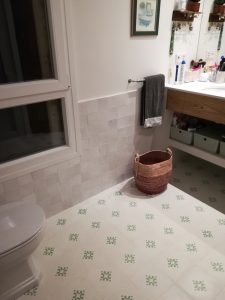
What looks like damage in zellige falls into two groups. Some of it is part of the material — crazing in the glaze, irregular edges, variation in tone between pieces — and is neither a fault nor something to repair. The rest really is damage — hollow-sounding pieces, cracks that run through the clay body, open joints or persistent stains — and it comes from the installation, from poorly managed water or from zellige maintenance carried out with the wrong products.
What counts as real damage, and what is simply the character of handmade zellige?
Real damage affects the bond of the piece, the watertightness of the tiled surface or the clay body itself. Everything else is the mark of the process: zellige is shaped by hand, dried, fired in a traditional kiln, glazed, fired again and cut piece by piece. That artisanal zellige-making process is what makes every piece unique in colour, shape and size.
Part of the material, not something to repair:
- Crazing: a network of very fine cracks in the glaze that does not continue into the clay body.
- Variation in tone and sheen within the same reference and from one firing to the next.
- Wavy edges, rounded corners and small nicks left by hand cutting.
- Pinholes, craters and bubbles in the glaze, more visible in dark colours.
- Differences of a few millimetres in size and thickness between pieces of the same format.
Real damage that needs action:
- A piece that sounds hollow when you tap it with your knuckle: it has not bonded to the substrate.
- A crack that runs through both glaze and clay body, with its two sides out of line.
- Glaze chipped away down to the bare clay in an area that gets wet every day.
- A joint that is open, powdery or crumbles when you run a finger along it.
- A stain that will not come off with warm water and neutral soap and keeps getting worse.
Installation guides in the trade take it as a given that between 15 % and 20 % of pieces arrive with some imperfection from the first group. That is not defective material: it is the margin that lets the tiler choose piece by piece. We explain how to make the most of that irregularity in our article on irregular zellige and the aesthetic value of its imperfection.

Why does zellige glaze craze?
Because the glaze and the clay body do not contract by the same amount as they cool after firing. The glaze, being more rigid, gives way and forms a network of microcracks that stays on the surface and does not reach the ceramic body beneath. It is the same phenomenon you see on old earthenware and, in zellige, it is a sought-after finish, known as crackle glaze.
It does not weaken the piece: it simply gives grease and strong pigments — coffee, turmeric, red wine — more surface to cling to if they are left to dry on it. Over the years this builds up into a patina that darkens the crackle pattern, and the way to prevent it is to clean spills while they are fresh, not to scrub harder later.
A structural crack is a different matter: it goes through the glaze and the clay body, you can feel it with a fingernail and it usually runs in a line across several pieces in a row. In that case the problem is not in the piece; it is underneath.
What causes each type of damage, and how is it fixed?
The eight cases that come up most often, with their likely cause and the solution:
| Symptom | Most likely cause | What to do |
|---|---|---|
| A network of fine cracks in the glaze only | Crazing: glaze and clay body expand differently | Not damage: pH-neutral cleaning and joints treated with a water-repellent |
| The piece sounds hollow when tapped | Not enough adhesive, or laid without back-buttering | Remove the piece, clean up the bed and re-lay it with flexible adhesive |
| A crack running through glaze and clay body | Movement in the substrate or a missing movement joint | Replace the piece and check the substrate before tiling again |
| Chipped corners and edges | Knocks during building work, or pieces cut dry | Cut with a water-cooled diamond blade and protect the tiled surface while work is in progress |
| A whitish haze on the glaze | Grout residue that has dried on the piece | An acid-free cement residue remover; never hydrochloric acid |
| Darkened, mouldy or powdery joint | Poor ventilation or an unsealed joint | Rake out and redo the joint, ventilate and apply a water-repellent for joints |
| Persistent stain on unglazed zellige | Porosity of exposed, unprotected clay | Deep cleaning and a water-repellent for porous ceramics |
| Pieces popping off outdoors after winter | Water held in the pores that freezes and expands | Replace the piece, redo the joint and fix the ponding before the cold comes back |
Six of the eight are decided during installation, not in use.
How do you replace a broken or loose zellige tile?
Without taking down the whole tiled surface, one piece at a time, in this order:
- Tap the surrounding pieces with your knuckle: if several in a row sound hollow, the problem lies in the bed.
- Rake out the joint all around the piece with a grout rake or a multi-tool until all four edges are free.
- Break the damaged piece from the centre outwards, so that you do not drag the neighbouring pieces with it.
- Clean up the bed: remove the old adhesive and leave the substrate flat and free of dust.
- Set the new piece in flexible cement-based adhesive, with adhesive on its back as well (back-buttering), to make up for the irregular thickness of zellige.
- Press it level by hand, not with a mallet: the face must sit flush even if the back is uneven.
- Let the adhesive set for the time its manufacturer states — usually between 24 and 48 hours — then grout with the same grout as the rest of the surface and wipe off the excess with a damp sponge while it is still fresh.
The critical point is not technical but a matter of colour: two pieces of the same model fired in different batches rarely match, so it is worth keeping spares from the original box. You will find more detail on grout mixes in our guide to grout for zellige.
How do you clean zellige without damaging the glaze?
With warm water, neutral soap and a soft cloth. Nothing else. The glaze is vitreous and needs no special product; it is the cement joints and the edges of the pieces, which are exposed, that suffer from harsh cleaning.
Routine in kitchens and bathrooms:
- Wipe up splashes of grease, oil and coffee while they are still fresh.
- Wash with diluted neutral soap and rinse with clean water.
- Dry with a cloth: that is what prevents limescale in the shower and on the wall behind the taps.
- Once a year, check the joints and reapply the water-repellent wherever it has worn off.
What zellige should never come into contact with:
- Hydrochloric (muriatic) acid and builders’ descalers: they eat away the cement joint and leave the edge of the piece exposed.
- Regular use of acid limescale removers on the joints.
- Metal scourers, steel wool and abrasive powder cleaners: they scratch the gloss of the glaze irreversibly.
- Pressurised steam on fresh or deteriorated joints.
- Neat bleach as an everyday cleaner: it whitens mould, but breaks down the joint in the medium term.
One honest caveat: in our test reports, chemical resistance was tested on terracotta, not on zellige. Without that figure measured on the glaze, our advice stays on the cautious side: pH-neutral products and a test first on an inconspicuous area.
Does zellige need sealing or a water-repellent?
The glazed face does not: the glaze is already the barrier. What is worth protecting is the cement joint and any unglazed or cut piece, because there the clay is exposed and absorbs water. How well the tiled surface ages depends on that distinction.
| Measured property | Value | Method |
|---|---|---|
| Water absorption of glazed zellige, 10 × 10 cm | 15.7 % (mean coefficient) | UNE-EN ISO 10545-3 |
| Abrasion resistance of zellige | Visible defects at 750 revolutions: class 3 | UNE-EN ISO 10545-7 |
| Absorption of terracotta, 15 × 5 cm (for reference) | 16.9 % | UNE-EN ISO 10545-3 |
| Porcelain stoneware (market benchmark) | Below 0.5 % | — |
The figure is recorded in test report no. 9103, from a sample of 100 × 100 × 12 mm pieces taken on 28 May 2024, and there is a second report, no. 15847, for the 5 × 15 cm format. Both are signed by Elabora, a laboratory listed in the register of the Junta de Andalucía (the Andalusian regional government) under number AND-L-155; the full PDFs are on our laboratory test reports page.
That 15.7 % explains how the material behaves: the ceramic body soaks up water, the glaze does not. As long as water cannot find a way in — sound joints, protected edges, a waterproofed substrate in showers — the tiled surface holds up.
How does zellige maintenance change with the climate: heat, humidity and frost?
Glazed zellige is not harmed by sun or dry air; it suffers from sudden changes in temperature and from water that stays trapped in the pores. With that in mind, maintenance changes little from one climate to another.
| Situation | Real risk | Precaution |
|---|---|---|
| Heat and direct sun | Thermal shock next to gas rings and hobs; the glaze copes well with UV radiation | Do not rest scorching-hot pans against the tiles or cool an overheated surface with water |
| Humid environment | Mould, which appears in the joint and hardly ever on the glaze | Ventilate daily, dry the shower and keep the water-repellent on the joints up to date |
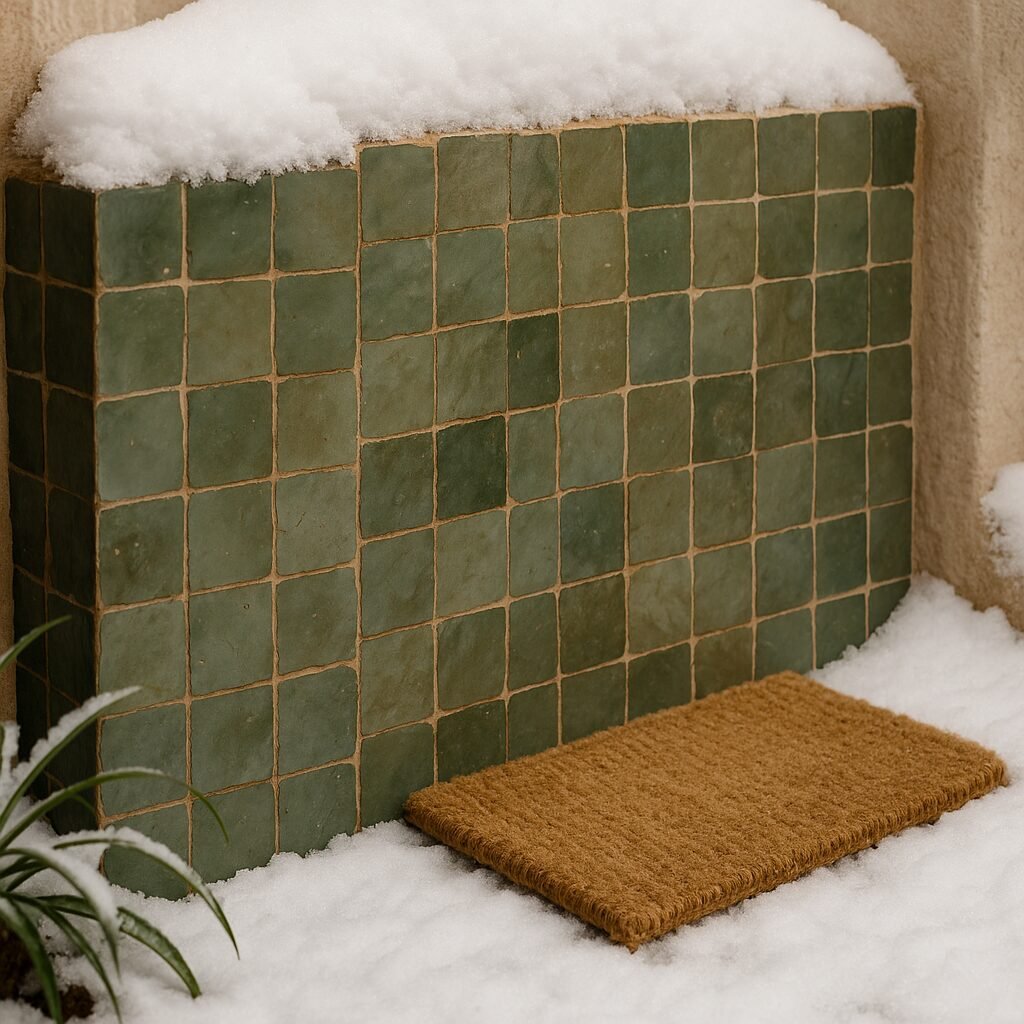
| Frost | Water held in the pores freezes, expands and spalls the piece from within | Waterproof joints, exterior-grade adhesive and falls that drain water away without ponding |
Three points worth noting. Heat itself is not the problem — zellige is fired at temperatures far above anything a kitchen reaches — sudden contrast is:zellige on fireplaces and stoves works well as long as it is not in direct contact with the flame. If mould appears, look at the joint before the piece: the glaze is not porous, the grout is. And outdoors, frost resistance does not depend on the individual piece but on keeping water away from the clay, as we explain in our guide to outdoor zellige.
Which installation mistakes cause the most damage?
Most of the problems that end in a repair are decided before grouting. The most common ones:
- A substrate that is not level or not waterproofed. In showers and tiled shower trays, the waterproofing membrane always goes underneath: zellige is not the waterproofing.
- Rigid adhesive, or the wrong amount of it. Thickness varies from piece to piece; without back-buttering, voids are left behind, and voids are what lead to loose pieces and to breakage on impact.
- Cutting dry. A water-cooled diamond blade leaves a clean edge; cut dry, the glaze chips.
- Letting grout dry on the piece. While fresh, it wipes off with a sponge; once dry, it calls for products the joint will not thank you for.
- Forgetting movement joints on large surfaces, where zellige meets other materials and on floors with underfloor heating.
- Ordering only just enough material. With no margin, the tiler cannot reject pieces and ends up laying the worst ones.
- Using it for high-traffic flooring. With visible defects at 750 revolutions in the abrasion test, it is above all a material for walls and for floors with moderate use.
How much extra material to order
Allowing for waste is prevention, pure and simple. With 10 × 10 cm Mjeddij, 100 pieces go into a square metre; with a 15 × 5 cm Bejemat, 134. An extra 15 % on 6 m² gives you between 90 and 120 spare pieces to choose from while laying and to keep in reserve. The pieces per square metre for each reference are listed in the zellige formats table.
Frequently asked questions about zellige maintenance
Is crazing in zellige a manufacturing defect?
No. It is the network of microcracks that forms in the glaze as it cools, because the glaze and the clay body contract at different rates. It stays on the surface, does not go through the piece and does not affect its strength. In handmade zellige it is considered part of the finish, just like the variation in tone.
Can zellige be laid on floors?
Yes, in areas with moderate foot traffic and with a sufficiently wide joint. The abrasion test puts it in class 3, with visible defects at 750 revolutions, so it is not the material for commercial premises. What is more, the pendulum test needs a sliding area of 124 × 76 mm: small pieces have to be tested on a sample that has already been laid.
Which products should I never use to clean zellige?
Hydrochloric acid and acid descalers, acid limescale removers used regularly, metal scourers and powder cleaners. Acids dissolve the cement joint and leave the edge of the clay exposed; abrasives scratch the glaze irreversibly. Warm water and neutral soap are all you need for everyday cleaning.
Does glazed zellige need a water-repellent?
Not on the visible face, because the glaze is already waterproof. The water-repellent goes on the cement joint and on unglazed or cut pieces, where the clay is exposed. In showers and on worktops, it is worth checking it once a year.
Can zellige withstand frost?
It depends on the installation as a whole, not on the piece. With a mean absorption of 15.7 % under UNE-EN ISO 10545-3 (the Spanish edition of EN ISO 10545-3), the clay takes in water; if that water freezes inside, it spalls the glaze. With waterproof joints, exterior-grade adhesive, a stable substrate and good drainage, the tiled surface will get through the winter.
Can I replace a broken piece years later and still match the colour?
Colour and sheen vary from one firing to the next, so an exact match can never be guaranteed. The practical answer is to keep spares from the original box; if there are none left, find the closest reference and start replacing in the least visible area. Send us photos and the format, and we will tell you what the options are.
If you are diagnosing a tiled surface, photograph the damaged area, measure a whole piece and note the colour: with those three details we can tell you whether it is damage or the character of the material, and which replacement will work. See which references are available in zellige in stock or browse the full range of handmade zellige tiles.