Yes, cement tiles can be used to floor a high-traffic commercial space: they are made of pressed cement mortar, with the pattern running solid through the face layer, so foot traffic wears it down but does not erase it. On the other hand, they are porous, and there are three things worth sorting out before you buy: the slip resistance required by the Spanish Building Code (CTE), sealing and the cleaning routine.
Can cement tiles stand up to heavy foot traffic in a commercial space?
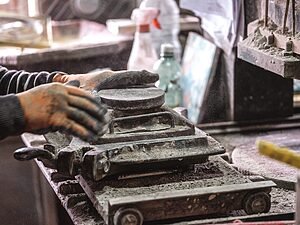
They can, if they are specified properly. They are cold-pressed and left to set rather than fired, and their visible face — the face layer — is pigmented through its full thickness with cement, marble powder and oxides.
That changes everything. A decorated porcelain tile carries its pattern in a glaze a few tenths of a millimetre thick: when the glaze wears through at the entrance, the body shows and the tile is left marked. On a cement tile, wear evens out the sheen, but the design is still there.
The limitations, in plain terms:
- They are porous. Our hydraulic terrazzo returned an absorption of between 5.9 % and 6.2 %. Without a water-repellent, they pick up wine, grease and coffee stains.
- They get harder over the months: the delicate moment is the fit-out and the first clean, not year five.
- Slip resistance depends on the finish, not on the material: ask for the Rd value of the finish you are actually going to lay.
- They have the tolerances of a pressed product: variation in shade and calibre between batches, which is evened out by mixing boxes during laying.
What do laboratory tests show about cement tiles?
We have had them done and we publish them. Each report is signed by Elabora, a laboratory listed in the register of the Junta de Andalucía (the Andalusian regional government) under number AND-L-155, and gives the sampling date and the standard method used.
| Product tested | Test | Result | Standard and report |
|---|---|---|---|
| Hydraulic terrazzo 200 × 200 × 18 mm | Slip resistance (pendulum, wet, at 20 °C) | PTV 59.5 — class 3 | UNE 41901:2017 EX · report no. 4718 |
| Hydraulic terrazzo 200 × 200 × 18 mm | Water absorption | 5.9 – 6.2 % | UNE-EN 13748-1 · report no. 4718 |
| Glazed zellige 100 × 100 × 12 mm | Water absorption | 15.7 % | UNE-EN ISO 10545-3 · report no. 9103 |
| Porcelain stoneware (market benchmark) | Water absorption | ≤ 0.5 % | UNE-EN 14411, group BIa |
Class 3 for the hydraulic terrazzo is the top of the scale: what the CTE requires outdoors, in swimming pools and in showers. The pendulum needs an area of 124 × 76 mm, so small tiles are tested on a sample that has already been laid.
The cement tile has its own report, no. 9102 (200 × 200 × 15 mm, UNE-EN 1339:2004); the published slip resistance figure is the one for the hydraulic terrazzo, from the same family of concrete tiles. You can download the full laboratory test reports and cite them by number in a project description.
Why are PEI ratings and AC classes no use for assessing cement tiles?
Because they are scales for other materials, and using them is the most common specification mistake in commercial projects.
- PEI measures abrasion of the glaze on a glazed ceramic tile. A cement tile has no glaze.
- AC1–AC6 (EN 13329) and use classes 31 to 34 belong to laminate and vinyl flooring.
Cement tiles and terrazzo are concrete tiles: UNE-EN 1339 (the Spanish edition of EN 1339) and, for terrazzo, UNE-EN 13748-1/2, which measure bending strength, absorption, abrasion resistance and slip resistance. Zellige and terracotta, on the other hand, are ceramic: UNE-EN ISO 10545 and UNE-EN 14411. Asking for ceramic marking on a cement tile leads to comparing figures that cannot be compared, one of the common mistakes when specifying cement tiles.
What slip resistance class does the CTE require in commercial premises?
The one that matches each area, not a single class for the whole floor. Basic Document DB-SUA 1 applies to Commercial, Public Assembly and Public Residential uses, among others, and divides floors into four classes according to their pendulum Rd value.
| Rd value (PTV) | Class | Where the CTE requires it | In commercial premises |
|---|---|---|---|
| Rd ≤ 15 | Class 0 | Meets no requirement | Ruled out |
| 15 < Rd ≤ 35 | Class 1 | Dry indoor areas with a slope of less than 6 % | Main room and dining area |
| 35 < Rd ≤ 45 | Class 2 | Dry indoor areas with a slope or stairs, and wet indoor areas with no slope | Street entrance, toilets, steps |
| Rd > 45 | Class 3 | Wet indoor areas with a slope or stairs, outdoor areas, swimming pools and showers | Terrace, pavement seating, kitchen with water on the floor |
A bar brings together three or four different requirements: the entrance from the street, which gets wet when it rains; the main room; the bar counter; and the kitchen. Asking for the Rd value of each finish saves you from improvising the entrance the day before opening.
Which format and thickness suit each area of the premises?
Under heavy traffic, thickness and tile size are what count: fewer joints and more mass per tile. Catalogue formats, with weight and units per square metre for ordering:
| Shape | Ref. | Size | Weight | Units | Where it fits |
|---|---|---|---|---|---|
| Square | H02 | 25 × 25 × 1.8 cm | 2.30 kg/pc | 16 pcs/m² | Constant foot traffic |
| Square | H03 | 20 × 20 × 1.5 cm | 1.30 kg/pc | 25 pcs/m² | Classic stock format |
| Rectangular | H11 | 30 × 15 × 1.6 cm | 1.45 kg/pc | 23 pcs/m² | Herringbone and chequerboards |
| Hexagonal | H21 | 30 × 20 × 1.7 cm | 1.62 kg/pc | 21 pcs/m² | Bar areas and transitions |
| Chakar | H61 | 20 × 17 × 1.5 cm | 0.58 kg/pc | 50 pcs/m² | Rugs and bar fronts |
| Plain skirting | HR01 | 20 × 10 × 1.5 cm | 0.66 kg/pc | 5 pcs/linear m | Protects walls from the mop |
Geometry helps: the Chakar cement tile or the hexagon softens the transition to polished concrete without a metal trim in the middle of the walkway, which is almost always the first piece to come loose. The full list of cement tile formats gives sizes and weights.
Zoning instead of tiling the whole premises
A commercial space does not need cement tiles from wall to wall. Save the material for what counts: a rug at the entrance, the front of the bar counter, a band leading to the toilets. Everywhere else, a seamless floor in the same shade: you concentrate the investment where it shows and reduce the area to be maintained.
How do you lay and protect a cement tile floor before opening?
It is a matter of sequence more than technique: the floor forgives little on site and almost anything afterwards. This is the order you should not change:
- A dry, flat, clean screed. Adhesive does not correct unevenness, and residual moisture causes efflorescence.
- A dry lay-out, mixing boxes to spread the variation in shade.
- Cementitious adhesive, back-buttered on large tiles, with a minimal joint and a movement joint around the perimeter.
- Grout in the right colour. A grey grout dulls a black and white chequerboard; a dark one makes it pop.
- Acid-free cleaning of residue. Acid descalers attack the cement in the face layer: the most common irreversible mistake.
- Full drying before treatment. Sealing a floor with water still inside it traps the moisture and causes stains.
- Water-repellent and finish to suit the use of each area, and physical protection until opening.
With a fixed opening date, drying and treatment are items on the schedule, not a last-minute finishing touch; the details are in our guide to laying cement tiles.
How much maintenance does a cement tile floor need with hundreds of footsteps a day?
Not much, but it has to be regular and with the right product: a dry mop every day to pick up grit — which is what scratches — and washing with neutral soap. No bleach, ammonia or acids, and no pressurised steam on the joints.
- Renew the treatment zone by zone. The entrance and the walkway along the bar lose their protection before the back of the room.
- Act fast with wine, oil and coffee. On a porous cement mortar, reaction time is the difference between a stain and a near miss.
- Keep spare tiles from the same batch. Tiles can be replaced one at a time without touching the rest of the floor.
- Count on re-polishing. The tile is solid all the way through: when the busiest area looks tired, it can be refinished in situ.
The full routine is in the article on cement tile floor maintenance and care.
Which commercial spaces have Demosaica cement tiles?
Bars, restaurants, patisseries, delicatessens, holiday apartments, offices and a corporate headquarters, each with its own design and colours.
Hospitality: bar counters, dining rooms and patchwork

For La Infanta, in the centre of Seville, we designed two versions based on Model 130: a floral pattern in near-pastel tones with a bright red, framed with borders 19-A and 19-B to form a rug.

At Lobo López they handled the walkway along the bar with a hexagonal patchwork — plain Mod. 603, Mod. 604 in custom colours and Mod. 604-A from stock — set in polished concrete almost identical to MC48: it stands out without upstaging the walls.

Cement tile patchwork is what we recommend when a project cannot settle on one pattern: the designs are picked at random from the stock catalogue and are not repeated in any other premises. That is how the bar at Cantara Westfield in London and several surfaces in a restaurant in Slovakia were done; Café Carusel in Helsinki chose the opposite, a single design: 135-A in black and white.


In a traditional Spanish bar, 3 × 3 rugs of Mod. 122 in white and red, bordered with plain Mod. 100 in red and with corners in Mod. 182. In another, with Mod. 129 in blues, the cement tile skirting stands up to the bucket and mop.
Retail: patisseries, delicatessens and shop windows

The Camelia Bakery patisserie, in an outlet shopping centre, has its entire floor in stock Mod. 104-B (20 × 20 × 1.5 cm, 1.30 kg): a light floral that does not overwhelm a small space. The Lihasöber delicatessen in Estonia chose the opposite: plain Mod. 100 in two blues. A tea room in Versailles went for Mod. 126-B in white and dusky pink, and a furniture shop framed its shop window with Mod. 124.

Offices, apartments and corporate headquarters

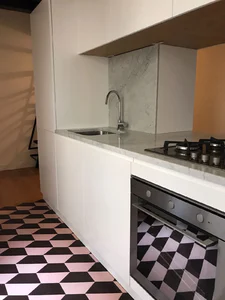
Holiday apartments are heavy traffic in its purest form: suitcases, daily cleaning and zero tolerance for damage. Sevilla Center Apartments did all of theirs with chequerboards of the plain design, and the Borras S.L. office in Ceuta chose two shades that recall roasted coffee and cocoa.


In offices and co-working spaces the material comes into its own in communal areas and on walls: a cement tile wall stands up to chairs and trolleys rubbing against it better than paint does. And it is not all about floors: at Restaurante Jaime Alpresa in Seville we combined a black and white cement tile floor with a row in greens and handmade green zellige finished with ZC201 in 10 × 10 cm.
Almost all of them were supplied from the catalogue of cement tiles in stock, with no production lead time; the custom designs — Mod. 604 at Lobo López, Mod. 122 in the traditional bar — needed several weeks in the workshop.
Frequently asked questions about cement tiles for commercial spaces
Which stands up better to heavy foot traffic: cement tiles or porcelain stoneware?
It depends on what you measure. Porcelain wins on absorption (below 0.5 %, against the 5.9–6.2 % we measured on our hydraulic terrazzo) and on surface hardness. Cement tiles win because their pattern is solid: it wears without disappearing, tiles can be replaced one at a time and the floor can be re-polished in situ years later.
Can cement tiles be used in a restaurant kitchen?
It is the most demanding area: grease, constant water and aggressive cleaning. The CTE treats a kitchen as a wet indoor area: it requires class 2 when the floor is essentially flat and class 3 as soon as there is a fall to the drain or steps. Feasible in open kitchens and in the service area, after checking the finish and the cleaning routine with the workshop first.
How much does it cost to lay cement tiles in a commercial space?
It varies with the design (from stock or custom-made), the format, the square metres and the laying, which should be done by a professional used to the material. Grout and treatment have to be added to the cost. Ask for a quote with the measurements and the zoning to get a real figure.
Can a bar counter front be clad in cement tiles?
Yes, and it is one of the uses where they work best: on a vertical surface they suffer no wear from foot traffic, so they can take bolder patterns than on the floor. We have done it at Café Carusel in Helsinki, at Cantara Westfield in London and on bar counters with stock patchwork.
How long does the material take to arrive for a commercial project?
Designs from the stock catalogue are dispatched as soon as the order is confirmed, with no production lead time. Custom designs and colours that are not in stock need several weeks in the workshop. Check the current lead time with us before setting the opening date.
What happens if a tile breaks once the premises are open?
The tile is lifted and replaced without touching the rest of the floor, an advantage over a seamless resin or microcement floor. It is worth keeping spare material from the same batch: because the tiles are pressed by hand, a new batch may differ in shade.
If you are specifying the floor for a commercial space, start with the cement tile catalogue and shortlist two or three designs per area. Write to us with the square metres and the use of each area: we will send you samples and any test reports you need, or show them to you at our Seville showroom, by appointment.