Cement tile, encaustic tile and hydraulic tile are the names under which the same product is sold in English: a piece of pigmented cement mortar, cold-pressed and cured without firing, with the pattern formed by the colours of the material itself. In Spain you will come across several more, from baldosa hidráulica to rachola. The word changes from one market to another; the material and the way it is made stay the same.
Are cement tiles, encaustic tiles and hydraulic tiles the same thing?
In the trade, yes: all three name the same floor tile and are used interchangeably. The difference is one of geography and habit, not technique: “cement tile” prevails in the United States and in most catalogues, “encaustic tile” is widespread in the British market, and “hydraulic tile” is a literal translation of the Spanish name. Strictly speaking, though, an encaustic tile is something else: a fired ceramic tile with its pattern inlaid in coloured clays, the medieval floor tile that the Victorians revived. In Spain, catalogues and project specifications say baldosa hidráulica, while losa and loseta are still very much alive in everyday speech and in much of Latin America.
| Name | Where it is usually used | Nuance |
|---|---|---|
| Cement tile | The United States and the international trade; also common in the UK | The most accurate name in English: it states the material, and the tile is tested as a concrete tile, not as ceramic |
| Encaustic tile / encaustic cement tile | The British market and interiors magazines | Strictly, a fired ceramic tile with inlaid coloured clays, typical of Victorian floors; “encaustic cement tile” removes the ambiguity |
| Hydraulic tile / baldosa hidráulica | The standard term in Spain, in catalogues and projects; in English, in Spanish makers’ catalogues | The most precise in Spain: it is the term that appears in the standards for concrete tiles. “Hydraulic” refers to the press and the cement, not to water |
| Losa / loseta hidráulica | Losa: everyday speech throughout Spain; loseta: eastern Spain (the Levante), Catalonia and Latin America | On a building site, losa also means a structural concrete slab, which can be confusing; loseta, its diminutive, suggests a small format, 20 × 20 cm or less |
| Rachola | The Valencia region and Catalan-speaking areas | A Hispanicised form of the Catalan rajola (tile); also used for other kinds of tile |
| Mosaico hidráulico | Andalusia and Latin America | Stresses that the pattern is built up tile by tile; it is the historical name of the trade |
There is a historical reason why the name varies: the tile was born in France in the mid-nineteenth century and spread around the Mediterranean, the Middle East and the Americas under the local name of each market. You can follow that journey in the history of the cement tile.
What is a cement tile made of?
Cement mortar, aggregate and mineral pigments, cold-pressed and cured with water. It is not fired: it sets. That is what separates it from any ceramic tile, and it explains its matt appearance and stone-like feel.
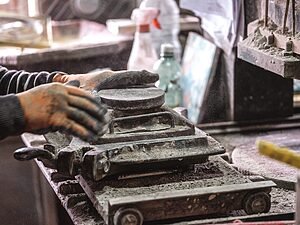
The tile is made in two layers. The top one, a few millimetres thick, is the wear layer: it contains white cement, marble powder and the pigments that form the pattern, poured by hand into a divider—the metal template that keeps each colour apart. Underneath goes the layer of grey mortar that gives the tile its body and strength. The two layers are then pressed together and the tile is left to cure.
The most important practical consequence is that the pattern is formed by the material itself, not printed or glazed onto the surface: the design is as thick as the wear layer and does not disappear with use or with polishing. The whole process, step by step, is in our guide to how cement tiles are made.

What are the technical properties of a cement tile?
It is a concrete tile, and as such it is tested to UNE-EN 1339, the Spanish edition of the European standard EN 1339, not to the ceramic standards. Mixing up the two frameworks leads to comparing figures that cannot be compared: expecting a cement tile to be classified like porcelain stoneware makes no sense, because neither the material nor the test method is the same.
At Demosaica we publish the full laboratory test reports, issued by Elabora (no. AND-L-155 in the Register of Testing Laboratories of the Junta de Andalucía, the Andalusian regional government), with their number, date and the method applied. These are the reference figures for the material:
| Property | Measured value | Product and standard |
|---|---|---|
| Slip resistance (Rd, pendulum) | PTV 59.5 wet → class 3 | Hydraulic terrazzo 20 × 20 cm · UNE 41901:2017 EX · report no. 4718 |
| Water absorption | 5.9 – 6.2 % | Hydraulic terrazzo 20 × 20 cm · UNE-EN 13748-1 |
| Cement tile format tested | 200 × 200 × 15 mm | Cement tile · UNE-EN 1339:2004 · report no. 9102 |
Class 3 is the top of the scale in the Spanish Building Code (CTE), in its Basic Document DB-SUA 1, and the class it requires for outdoor areas, swimming pools and showers. It was measured on hydraulic terrazzo, the material closest to the cement tile in our range; the full report for the cement tile can be downloaded from the laboratory tests page. If you have to justify a specification item to the architect supervising the works, cite the report by its number rather than a generic value.
What sizes and formats are available?
The classic format is the 20 × 20 cm square, but the tile is made in squares from 10 to 25 cm, rectangles, hexagons, octagons and several interlocking shapes. Weight and the number of tiles per square metre affect both the budget and the calculation of materials:
| Format | Ref. | Size | Weight per tile | Tiles per m² |
|---|---|---|---|---|
| Square | H02 | 25 × 25 × 1.8 cm | 2.30 kg | 16 |
| Square (classic) | H03 | 20 × 20 × 1.5 cm | 1.30 kg | 25 |
| Square | H06 | 10 × 10 × 1.5 cm | 0.35 kg | 100 |
| Rectangular | H11 | 30 × 15 × 1.6 cm | 1.45 kg | 23 |
| Hexagonal | H22 | 23 × 20 × 1.5 cm | 1.16 kg | 29 |
| Tile insert | H07 | 7 × 7 × 1.5 cm | 0.25 kg | 205 |
The full table, with every format and its reference, is on our cement tile formats page. Any pattern in the catalogue can be ordered in the colours of the MC1–MC49 colour chart, which is what makes it possible to adapt an old design to a present-day palette.
What are the real advantages over other floor coverings?
- The pattern does not wear off. It runs through the body of the wear layer; it is not printed. A floor from 1920 can be brought back by polishing it: the same design reappears, sharper than before.
- It can be repaired tile by tile. Because it is laid with a minimal joint, a broken tile can be replaced without lifting the rest of the floor.
- Custom designs without an industrial mould. The divider is made by hand, so an old pattern can be reproduced or a new one created without the minimum runs of industrial ceramics.
- It is cool and stable. Cement mortar has thermal inertia: it keeps rooms cool in summer and is suitable for underfloor heating.
- Relatively light. A square metre in the 20 × 20 cm format weighs about 32 kg, which is manageable in renovation work without structural reinforcement.
And two limitations worth knowing before you decide: it is a porous material, so it needs a water-repellent from day one, and it is supplied unpolished, with the tolerances of a handmade product. Neither is a defect, but both change the way it is laid and maintained.
Where can it be laid and what maintenance does it need?
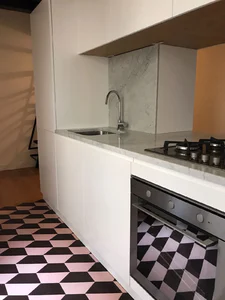
Indoors and outdoors, on floors and walls. In homes it works in every room, kitchens and bathrooms included; outdoors, on patios, terraces and porches, always with the right fall and the right water-repellent. In high-traffic areas, it is worth weighing up the format and the sealing rather than ruling the material out.

Maintenance is simple but has its own rules: no acids, no bleach, just water and neutral soap, and periodic reapplication of the water- and oil-repellent. The details are in our guide to cement tile floor maintenance and care, and the specific requirements for outdoor use in our article on cement tiles for patios and terraces. For installation—setting-out, back-buttering, grouting and sealing—see our guide to laying cement tiles.
Frequently asked questions about encaustic and cement tiles
Is an encaustic tile the same as a cement tile?
In many shops, yes; strictly speaking, no. A true encaustic tile is fired ceramic, with its pattern inlaid in coloured clays, and the word itself means “burnt in”. The British market also uses the name for cement tiles, which is why many makers write “encaustic cement tile” to be precise. The cement tile is also sold as a hydraulic tile, and that adjective has nothing to do with water in use: it comes from the hydraulic press and the hydraulic cement it is made with.
Why are they called hydraulic if they are not waterproof?
Because of the process, not because of how they behave with water. They are compacted in a hydraulic press and set with hydraulic cement, the kind that hardens on contact with water. In fact the material is porous—it absorbs water—which is why it is always treated with a water-repellent after laying.
What is the difference between cement tiles and terrazzo?
Both are concrete tiles, but terrazzo has exposed marble aggregate and its pattern comes from the grain itself, whereas in a cement tile the design is composed by hand with pigments. You can compare the two materials on our terrazzo page.
Can cement tiles be used outdoors?
Yes, on two conditions: the drainage has to be well designed so that water does not collect, and the water-repellent has to be applied in several coats and renewed over time. In climates with frequent frosts, the freeze-thaw cycle needs to be taken into account, because water held in the pores breaks the tile when it freezes.
How many tiles do I need per square metre?
It depends on the format: 25 tiles for the classic 20 × 20 cm, 16 for the 25 × 25 cm and 100 for the 10 × 10 cm. On top of that you need to add an allowance for cutting waste, larger if the tiles are laid diagonally or with a perimeter border.
Are handmade cement tiles still made today?
Yes. They are still made one at a time, with a divider and a press, just as they were a century ago. In our Seville workshop we reproduce historical patterns and create new designs; you can see the models available for immediate delivery among our cement tiles in stock.
If you are now clear about the material, the next step is to choose the pattern and colour: our hydraulic tiles catalogue has every model, and from there you can order physical samples to see them in the light of your own home before you decide.