The history of the cement tile begins around 1850 in the south of France. It is a pigmented cement tile made cold: a face layer of white cement, marble powder and mineral pigments over a base of cement and sand, compacted in a press and hardened by hydration, with no kiln. It is a concrete paving unit, not a ceramic, and its name comes from that setting with water — hence “hydraulic tile”.
A Barcelona factory presented it at the Paris Universal Exhibition of 1867, it entered thousands of Spanish homes with Modernisme, it vanished from new construction in the 1960s and today it is made by hand again. At Demosaica we still make it that way, piece by piece, in our workshop in Seville; the models, formats and colours are in the hydraulic tiles catalogue. If you want to know where what you are about to walk on comes from, read on.
Why is it called a hydraulic tile?
It is called hydraulic because the cement it is made from is a hydraulic binder: it sets and hardens by reacting with water, not with fire. The hydraulic press used today to compact each piece reinforces the name, but it is not its origin; the first presses of the nineteenth century were operated by hand.
That is the fundamental difference from glazed tile, stoneware or terracotta. A ceramic tile is fired in a kiln; a hydraulic tile comes out of the press still soft, goes through a water bath and cures in a humid environment until the cement reaches its hardness, a process that takes around 28 days.
That is why it is tested to the standard for concrete paving units, UNE-EN 1339, and not to the ceramic standards; on our laboratory testing page we sum it up in four words: it is not fired, it sets. And since it carries no glaze, the colour is not a surface film but a layer several millimetres thick, which is what makes it possible to polish a hundred-year-old cement floor and bring it back.
Where and when does the history of the cement tile begin?
In Viviers, in the French department of Ardèche, in the early 1850s; in Spain it became known in 1867 through a Barcelona factory. It is not a Spanish invention, although it was in Catalonia that it became both an industry and an art.
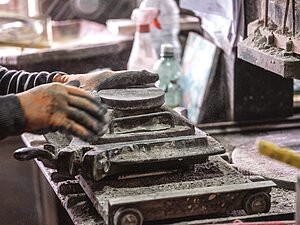
There, alongside the Lafarge cement works, the public works contractor Étienne Larmande found that hydraulic lime mixed with calcined clay, sand and water produced an artificial stone without firing, and patented the process in 1851. With it he made the first compressed cement tiles, the carreaux de ciment. To inlay multi-coloured designs into the surface, the local locksmith Auguste Lachave made him the first dividing moulds: the direct ancestor of the divider we still use in the workshop.
The first references in Spain date from 1857, and the date always cited is 1867: at the Paris Universal Exhibition, the Barcelona firm Garret, Rivet y Cía presented a tile consolidated by pressing, without fire, as an alternative to marble. It was a modern, clean material, far cheaper than stone, and for the first time it put a decorated floor within reach of the middle class.
| Year | Milestone | Where |
|---|---|---|
| 1851 | Étienne Larmande patents artificial stone made of hydraulic lime without firing and makes the first compressed cement tiles | Viviers, Ardèche (France) |
| 1857 | First documented references to hydraulic mosaic in Spain | Catalonia |
| 1867 | Garret, Rivet y Cía presents at the Universal Exhibition a tile consolidated by pressing, without firing | Paris / Barcelona |
| 1873 | The M. C. Butsems mosaic factory is founded, known for its artificial stone | Barcelona |
| 1886 | Escofet, Fortuny y Cía is born, the factory with the greatest presence in Modernista buildings | Barcelona |
| 1904 | Gaudí designs his hexagonal paving with Escofet for Casa Batlló; it ends up laid in Casa Milà | Barcelona |
| 1900–1930 | Hydraulic mosaic workshops across Spain; in 1927 the dynasty of the loseteros begins in Lora del Río | Spain / province of Seville |
| 1960–1970 | Terrazzo and stoneware displace hydraulic tile in new construction | Spain |
| 1997 | Barcelona paves the pavements of Passeig de Gràcia with a reissue of Gaudí’s panot | Barcelona |
| From 2000 | Restoration of old floors and the return of handmade production, for export as well | Spain and Europe |
How was it made in the nineteenth century, and how is it made today?
The same way. The process established in the nineteenth century is, step by step, the one we follow in our workshop; the only real difference is that the press is no longer operated by hand. We tell it in detail in our article on how hydraulic tiles are made; in short, every piece goes through six steps:
- The metal mould is cleaned and assembled: frame, base and the divider, a grid of brass or iron partitions that reproduces the design.
- The corresponding coloured paste — white cement, marble powder and mineral pigments — is poured into each cell of the divider. This is the face layer, some 4 or 5 mm thick.
- The divider is removed and a dry layer of cement and fine sand is sprinkled on, absorbing the excess water from the colour.
- The mould is filled with the base layer of grey cement and sand, which gives the tile body and strength.
- The piece is pressed and removed from the mould.
- It is cured: a water bath and a rest in a humid environment until the cement hardens. Counting the drying, the tile takes about a month to be ready to lay.
From that come the features that identify it: a thick colour layer, a grey, rough reverse, no glaze, and a total thickness of between 15 and 25 mm. In the nineteenth century formats were made from 10×10 up to 40×40 cm, but 20×20 was by far the most common and remains the catalogue reference: our H03 format measures 20×20×1.5 cm, weighs 1.30 kg and works out at 25 pieces per square metre.
Why did the cement tile triumph with Modernisme?
Because it arrived at exactly the right moment. Between 1880 and 1930 cities were growing, the bourgeoisie was building and wanted decorated floors, and hydraulic mosaic gave colour and pattern at a price far below marble or Nolla ceramic mosaic. The factories were in the city itself and every house could choose its design, border and colours: the floor stopped being a neutral background and became the fixed rug of each room.
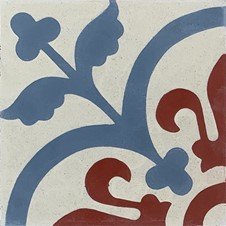
Barcelona concentrated the phenomenon. Alongside Garret Rivet and Butsems came Escofet, Fortuny y Cía, founded in 1886 and the most present in Modernista buildings. These factories commissioned their designs from architects and artists such as Alexandre de Riquer, Lluís Domènech i Montaner and Josep Puig i Cadafalch. The geometric, floral and plant motifs of those catalogues are what we recognise today as “hydraulic pattern“.
Gaudí’s paving, the most famous cement tile of all
The best example of that meeting between art and factory is Gaudí’s panot. Antoni Gaudí designed it in 1904 together with Escofet for Casa Batlló: a hexagonal piece in relief with three marine motifs — a starfish, an ammonite and a strand of seaweed — that are only completed when several pieces are laid together. It was never installed at Casa Batlló and ended up paving the service quarters of Casa Milà. Since 1997 a reissue has covered the pavements of Passeig de Gràcia: if you have walked through Barcelona, you have trodden on it without knowing.
Hydraulic paving in Seville and Andalusia
Andalusia went through the same process a few years later. In Seville, the entrance halls, courtyards and drawing rooms of houses built in the first decades of the twentieth century were laid with hydraulic mosaic, often beneath skirtings of Triana glazed tile, and a good many of those floors are still there. The province had factories of its own: in Lora del Río, José Hernández Gamero founded the town’s first mosaic factory in 1927 and gave rise to the dynasty of the loseteros, now in its third generation.
Why did the cement tile fall out of use?
Because from the 1960s onwards it stopped being profitable. Terrazzo, stoneware and later porcelain were produced on a production line, laid faster and needed neither a month of curing nor a craftsman filling dividers by hand. The mass construction of the boom years called for square metres, not designs.
Hydraulic tile held on in housing well into the 1970s, with ever simpler motifs and fewer colours, and then disappeared from new construction. For decades it was covered over with floating parquet, carpet or ceramic, and many dividers and catalogues were lost when the factories closed. What turns up today when a laminate floor is lifted in an old flat is usually just that: an intact hydraulic floor that nobody wanted to see for forty years.
How has the cement tile come back?
It came back through the door of restoration. From the 2000s, and strongly over the past decade, architects and interior designers began to recover the original floors of nineteenth-century apartments, village houses and listed buildings and to treat them as heritage. From there to making new pieces to complete what was missing, and then to designing whole floors with the same system, was a single step.
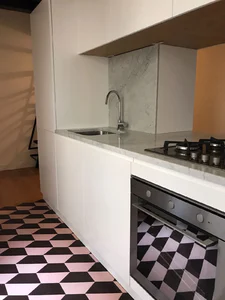
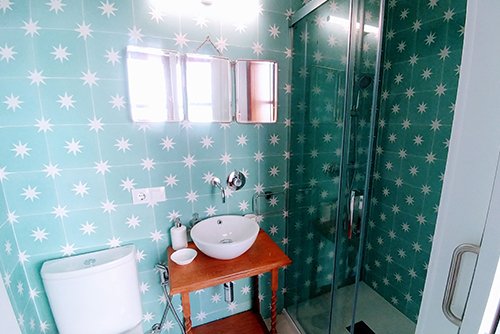
Today the cement tile is made just as it was in 1900, but it is used differently: hydraulic rugs framed by plain paving, bathroom and kitchen walls, staircases, terraces and courtyards, and formats that never appeared in the old catalogues, such as hexagons, matching skirtings or special pieces like our Chakar hydraulic tile. The colour chart has grown to 49 shades, from MC1 to MC49, and quality is no longer assumed, it is measured: our 20×20 cm hydraulic tile was tested in 2024 to UNE-EN 1339 and the report (no. 9102) is published.
| Format | Reference | Dimensions | Weight per piece | Units per m² |
|---|---|---|---|---|
| Square 10×10 | H06 | 10 × 10 × 1.5 cm | 0.35 kg | 100 |
| Square 15×15 | H04 | 15 × 15 × 1.5 cm | 0.79 kg | 45 |
| Square 20×20, the historic standard | H03 | 20 × 20 × 1.5 cm | 1.30 kg | 25 |
| Square 25×25 | H02 | 25 × 25 × 1.8 cm | 2.30 kg | 16 |
| Hexagonal | H22 | 23 × 20 × 1.5 cm | 1.16 kg | 29 |
| Plain skirting | HR01 | 20 × 10 × 1.5 cm | 0.66 kg | 5 per linear metre |
The full table, with rectangles, octagons and the rest of the special pieces, is in our hydraulic tile formats.

Cement tile, hydraulic mosaic, encaustic tile: are they the same thing?
Yes. Cement tile, hydraulic tile, encaustic cement tile, hydraulic mosaic and hydraulic floor all name the same material: a pigmented cement tile, pressed and cured without firing. What changes is the point of view — the loose piece, the laid whole, the technical term or the colloquial one — and the region where it is spoken.
- Cement tile and encaustic cement tile: the usual names in English. “Encaustic” is borrowed from the medieval inlaid ceramic tile, which shares the idea of a design inlaid rather than printed, though the material is entirely different.
- Hydraulic mosaic (mosaico hidráulico): the nineteenth-century factory name and the one most used in Catalonia and Valencia. It is not a mosaic of tesserae; it is called that because each tile forms the design with its neighbours.
- Rajola hidràulica or rachola: the same piece in Catalan and in the speech of Aragon; rajoles hidràuliques antigues is how an old floor is searched for in Catalan.
- Losa or loseta hidráulica: popular variants across much of Spain; in the province of Seville, loseta gave its name to the loseteros of Lora del Río.
- Hydraulic paving (pavimento hidráulico): the technical term, the one used in project specifications, restoration records and heritage catalogues.
- And abroad: carreaux de ciment in France, Zementfliesen in Germany, cementine in Italy, piso hidráulico or mosaico de pasta in Latin America, ladrilho hidráulico in Brazil.
And what is not a cement tile, even if it is sometimes sold as one: Nolla mosaic, small tesserae of fired stoneware born in Meliana (Valencia) in the same period, and “hydraulic-effect” porcelain stoneware, which prints the design onto a fired ceramic. Terrazzo is a close relative, also pressed cement without firing, but with visible marble aggregate and a polished surface, with no design layer.
How can you tell whether a cement floor is old?
An original hydraulic floor is recognised by four signs: the colour layer is several millimetres thick and can be seen on the edge of a broken piece; the reverse is grey, porous, unglazed cement; the format is almost always 20×20 cm with a minimal joint; and the designs and colours match the catalogues of their period, with perimeter borders and floral or geometric motifs in earths, ochres, English red, greys and black. The wear in the traffic areas, which lightens the tone without erasing the design, confirms that it is cement and not printed ceramic.
If you think you have one, do not lift it without thinking twice: it almost always pays to clean it, seal it and complete the broken pieces with reproductions.
Frequently asked questions about the history of the cement tile
Who invented the cement tile?
Étienne Larmande, a public works contractor from Viviers (Ardèche, France), who in 1851 patented an artificial stone of hydraulic lime without firing and used it to make the first compressed cement tiles; the moulds for the designs were made by the local locksmith Auguste Lachave. In Spain it was made known by the Barcelona firm Garret, Rivet y Cía at the Paris Universal Exhibition of 1867.
What year did the cement tile reach Spain?
The first references date from 1857, ten years before the 1867 presentation in Paris. In the 1870s and 1880s the great Barcelona factories were founded (Butsems in 1873, Escofet in 1886) and from there it spread to Valencia, Andalusia and the rest of the peninsula, peaking between 1900 and 1930.
What is the difference between a cement tile and hydraulic mosaic?
None in the material: they are the same pigmented cement tile, pressed and cured with water. “Hydraulic mosaic” is the name the nineteenth-century factories sold it under and the one most used in Catalonia and Valencia; “tile” names the piece, and “paving” or “hydraulic floor” the laid whole. Not to be confused with Nolla mosaic, which is fired ceramic.
Is the cement tile a ceramic?
No. It is a concrete tile: cement, sand, marble powder and pigments that harden by hydration, with no kiln. That is why it is tested to UNE-EN 1339 for concrete paving units and not to the ceramic standards, and why its colour is a thick layer rather than a glaze. It is also the reason it needs a sealer after laying.
Are cement tiles still made by hand?
Yes. At Demosaica we make every piece in our workshop in Seville with the same system as in the nineteenth century: metal divider, pigmented coloured paste, cement base layer, press and curing with water, without firing. We work with catalogue designs, with models held in stock and with bespoke designs; if you want to reproduce an old pattern, ask the workshop.
How long does a hydraulic floor last?
More than a century: across Spain there are floors laid between 1890 and 1930 still in use. Because the design is a layer several millimetres thick, it takes successive polishings and wear does not erase it. What ruins it is not time but rising damp, cleaning acids and the lack of sealing; with a sealer and neutral cleaning, a new hydraulic floor should last as long as the house.
If you want to walk on this history in your own home, start with the concrete: look at the designs available in hydraulic tiles in stock, ask for a sample of the model and colour that suit you and tell us about the project; in the workshop we will help you choose format, colours and skirting.