Antique cement tiles are pressed, unfired slabs of pigmented cement, made between the mid-19th century and the 1960s or 1970s. You can recognise them by their matt, unglazed surface, by the colour layer several millimetres thick that shows at the edge and by their grey cement back. Here we explain how to identify them, what they are worth, how to restore them and when it pays to reproduce them.
What counts as an antique cement tile?
An antique tile is one made in the days of the historic cement tile factories: from the mid-19th century until terrazzo and ceramic stoneware took over in the 1960s and 1970s. Anything made after that is a new tile, even if it reproduces a pattern from 1900.
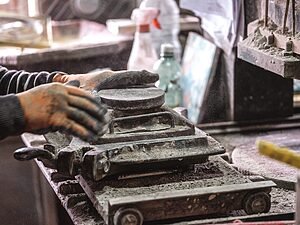
The technique has not changed: a layer of white cement, marble powder and pigments is poured into a mould fitted with a brass divider that keeps the colours apart, compacted in a hydraulic press—hence the name “hydraulic tile”—and left to set without ever going into a kiln. It is the same process we follow in our workshop in Seville; its story is told in the history of the cement tile.
In Spain the tile goes by different names depending on the region: mosaico hidráulico or suelo hidráulico (hydraulic mosaic, hydraulic floor), losetas or racholas (in Catalan, rajoles hidràuliques antigues). People who search for azulejos hidráulicos antiguos are after these same tiles, even though an azulejo is, strictly speaking, a glazed and fired ceramic wall tile. And “hydraulic” does not mean waterproof: the tile is porous and has to be sealed.
How can you tell if a cement tile floor is antique?
To identify an antique cement tile floor, look at the edge, the back and the wear: the colour runs several millimetres into the tile, the back is grey cement with sand in it and the pattern is more worn where people walk. Ceramic imitations fail all three tests. This is the checklist we use with a tile or a photo:
- Matt, unglazed surface. Fine cement to the touch, slightly absorbent, never glassy.
- The colour has depth. At the edge the coloured layer usually runs 3 to 5 mm deep; on a “cement-look” ceramic tile the pattern is a print a few tenths of a millimetre thick.
- Grey cement back. Rough, with visible sand and sometimes the maker’s mark. A smooth back of ceramic biscuit rules it out.
- Uneven thickness. Antique tiles are around 2 cm thick or more, compared with 1.5–1.8 cm for today’s tiles, and vary by one or two millimetres from one to the next.
- Colour bleed. When the divider is lifted, one colour creeps slightly into the next; on an imitation the line is perfect, or the flaw repeats identically.
- Selective wear. The pattern fades in front of doorways and survives under the furniture; a printed aged effect looks equally worn on every tile.
- Water drop and joints. Water darkens the surface and soaks in slowly. These floors were also laid tight, with 1–2 mm joints, on a bed of lime or cement mortar.
No single sign is enough on its own: a tile made today meets the first four. What gives an antique away is the combination, and above all genuine wear.
Dating a cement tile floor by decade
Patterns followed fashion, so they offer a clue to the date. With one caveat: factories kept reissuing their catalogues for decades, so the table narrows the date down rather than proving it.
| Period | Typical motifs | Colours | Context |
|---|---|---|---|
| 1860–1895 | Greek key borders, meanders, rosettes, faux marble | Ochres, red oxide, black, grey | First factories; thick tiles |
| 1895–1915 | Stylised flowers, curving stems, hexagons | Greens, blues, pinks, soft yellows | Modernisme (Art Nouveau): the golden age |
| 1915–1936 | Pure geometry, cubes, zigzags, chequerboards | Black, white, grey and red in contrast | Noucentisme and Art Deco |
| 1940–1960 | Simplified patterns, chequered designs, marbling | Muted greys and tans | Post-war: low-cost production |
| 1960–1975 | Single colour, marbling, outdoor panot paving | Greys and tans | Decline: terrazzo and stoneware arrive |
How much is an antique cement tile floor worth?
It depends on four factors: condition, pattern, quantity and whether the floor is still in place. There is no benchmark price for antique cement tile floors, and a complete floor in situ is worth more than the same tiles once lifted: taking them up breaks some of them, and the composition of rug, border and field is lost.
- Condition. What counts is how much colour layer is left, not the dirt: under a crust of old wax there may be three millimetres of pattern still intact.
- Pattern. Common designs are plentiful on the reclamation market; the sought-after ones are architect-designed patterns, tile rugs with borders and corners, and rare colours.
- Quantity. A small lot will do for a tile rug, a tabletop or a splashback; paving a room takes enough square metres plus a margin for breakages.
- Laid or lifted. Reclamation dealers sell lots, cleaned of mortar, by the square metre. In a historic building the floor also has heritage value, and in protected old town centres municipal regulations may require it to be kept.
Restore or replace an antique cement tile floor?
Restore the floor if it is well bonded, dry and still has its colour layer. Replace or reproduce it if there is unresolved rising damp, more broken tiles than you can find replacements for, or if the pattern has disappeared in the main walkways. Most often the answer lies in between: restore what is there and make up the rest with new tiles.
Restoration is worthwhile when the tiles sound solid, nothing is bulging, the missing tiles are concentrated in a few spots and the dirt is only on the surface: wax, varnish or vinyl adhesive that lets the colour show through when you clean a corner.
Reproducing or replacing is the better option when:
- The floor sounds hollow over large areas or moves underfoot: the mortar has come loose and polishing would break the tiles.
- There is efflorescence, dark staining or tiles that are crumbling: water is rising by capillary action, and that has to be solved before the floor.
- The building work requires it to be lifted to run services, add insulation or fit underfloor heating, or there are more tiles missing than can be salvaged. A floor can be lifted and relaid by levering under the base, but some of the tiles will break.
And before you demolish anything, look at what lies underneath: in Seville, intact cement tile floors are still turning up under terrazzo and vinyl.
How to restore antique cement tiles step by step
The right order is assessment, acid-free cleaning, stripping, repair, grouting, polishing only if needed and a breathable seal once the floor is dry. Changing that order—sealing before cleaning, polishing loose tiles—is what ruins floors that had been fine for a hundred years.
- Assessment. Photograph the layout—rug, border, corners and field—before touching anything. Tap each tile in turn to find the hollow ones, measure the moisture and count the missing tiles.
- Deep clean. Warm water, pH-neutral soap or a mild alkaline cleaner, a bristle brush and several rinses. No muriatic acid, vinegar, limescale remover or concentrated bleach: acid burns the colour layer and bleach dulls the pigments.
- Stripping. These floors build up oxidised wax, varnish and, if they were ever covered with vinyl or carpet, adhesive. All of it comes off with an acid-free stripper. The haze left by recent building work calls for a post-construction cleaner suitable for cement tiles.
- Repair. Hollow tiles are lifted by cutting through the joint with a thin disc, their backs are cleaned and they are re-bedded with flexible tile adhesive. Broken ones are replaced with spares or with new tiles in the same pattern, making up the difference in thickness with the bedding mortar.
- Fine grouting. A fine cement grout in a shade close to the background colour, wiping off the excess before it hardens. If the tile is very open-pored, apply a coat of sealer first.
- Polishing, only if needed. Wet, with progressively finer abrasives, when the surface is uneven. Every pass removes colour: do not polish if less than 2 mm is left at the edge, if there are loose tiles or if you want to keep the patina.
- Drying and sealing. Leave the floor to dry for 24–48 hours and apply a breathable water- or oil-repellent impregnator that soaks into the pores without forming a film; finish with natural wax and renew it every 6–12 months. You will find the products in our guides to cement tile floor maintenance and tile treatment.
Mistakes that ruin an antique cement tile floor
- Muriatic acid, vinegar or limescale remover: acid eats into the cement and leaves the pattern dull and stained for good.
- Film-forming varnishes and resins on a damp floor: they turn white and peel off.
- Dry sanding with a floor sander or an angle grinder: circular scratches and lost colour.
- Crystallising the floor as if it were marble, or sealing it while damp: whitish clouding that is almost impossible to reverse.
Can antique patterns be reproduced with new tiles?
Yes. Any antique cement tile pattern can be made again with the same technique: it is drawn to scale, the brass divider for the mould is built and the tiles are pressed one at a time. In our workshop we start from an original tile—even a broken one—or, if there is none, from photos taken straight on in natural light, the exact dimensions and the associated pieces: border, corner and plain field tile.
The colours come from our chart of 49 shades, MC1 to MC49. You can ask for samples before ordering the full quantity; lead times and minimum orders depend on the pattern and the area, so check them with the workshop. The process is explained in our guide to custom tiles, from idea to bespoke design.
These are the formats used to reproduce an antique floor; the 20 × 20 cm square has been the most common in every period:
| Format | Ref. | Dimensions | Weight | Units per m² |
|---|---|---|---|---|
| Square | H03 | 20 × 20 × 1.5 cm | 1.30 kg | 25 |
| Square | H02 | 25 × 25 × 1.8 cm | 2.30 kg | 16 |
| Square | H04 | 15 × 15 × 1.5 cm | 0.79 kg | 45 |
| Octagonal | H31 | 20 × 20 × 1.5 cm | 1.14 kg | 25 |
| Insert tile | H07 | 7 × 7 × 1.5 cm | 0.25 kg | 205 |
| Hexagonal | H22 | 23 × 20 × 1.5 cm | 1.16 kg | 29 |
| Rectangular | H13 | 20 × 10 × 1.5 cm | 0.62 kg | 50 |
| Skirting | HR11 | 20 × 10 × 1.5 cm | 0.64 kg | 5 per linear metre |
The less common formats—Laghaz, Labrys, Diamante or the star and cross of the Chakar cement tile—are in our special cement tiles section.

Reclaimed antique tiles, new tiles or a ceramic imitation?
Reclaimed tiles bring patina and authenticity, but they come in fixed lots, with uneven thicknesses and no spares. A new cement tile with an antique pattern is the same material made with the same technique, with uniform dimensions and spare tiles available. A “cement-look” ceramic tile is a print on stoneware.
| Criterion | Reclaimed cement tile | New cement tile | Ceramic imitation |
|---|---|---|---|
| Material | Pressed cement, unfired | Pressed cement, unfired | Fired stoneware with a printed pattern |
| Availability | Whatever came out of the demolition | Catalogue, stock and made-to-measure patterns | Industrial, unlimited |
| Surface | Matt with patina; colour with depth | Matt; colour several millimetres deep | Glazed; the pattern is a surface film |
| Thickness | Over 2 cm; irregular | 1.5–1.8 cm; uniform | Thin and rectified |
| Spares | Only if the lot includes them | Borders, corners, skirtings and spares | Depends on the manufacturer’s series |
| Best for | Heritage restoration | Renovations with an antique pattern and spares | Zero maintenance |
One more argument for new tiles on a professionally supervised project: they can be tested. A cement tile is a concrete tile and is tested to UNE-EN 1339, the Spanish version of EN 1339, not as a ceramic. Our 200 × 200 × 15 mm tile is covered by test report no. 9102 (sample taken on 28/05/2024), issued by Elabora, a laboratory listed in the register of the Regional Government of Andalusia under number AND-L-155; you can download it from our laboratory tests page. A tile from 1910 comes with no such paperwork.
What is the difference between antique, vintage and retro tiles?
Antique means an original tile from the historic factories; vintage, a new tile that reproduces a classic pattern; retro, a new design inspired by the 1950s to the 1970s. Someone searching for “vintage cement tiles” hardly ever wants a reclaimed tile from 1920: they want new tiles with an antique pattern, uniform and with spares available.
Four layouts work best for recreating an antique floor: a black-and-white chequerboard, eight-pointed stars with a border, octagons with insert tiles, and Art Nouveau floral rugs. You will find them in the cement tile catalogue, with some of the models available from stock. And “1970s tiles” are hardly ever cement tiles: by that decade terrazzo was already being laid, and it is the period-correct material for restoring a floor from those years, as we explain in our article on hydraulic terrazzo, its history and modern applications.

Frequently asked questions about antique cement tiles
How do you clean antique cement tiles without damaging them?
With warm water, pH-neutral soap or a mild alkaline cleaner, a bristle brush and several rinses. Waxes, varnishes or adhesives call for an acid-free stripper, tested first in a corner. Never use muriatic acid, vinegar, limescale remover or concentrated bleach: acid burns the colour layer and bleach dulls the pigments.
Can antique cement tiles be polished?
Yes, if they still show more than 2 mm of colour at the edge, are well bonded and the floor is level. Polishing is done wet with progressively finer abrasives, and every pass uses up colour: it is a finite resource. Do not polish if there are hollow tiles or active damp, or when the patina is precisely what you want to keep.
Where can you buy antique cement tiles?
Original tiles are bought from reclamation yards and architectural salvage dealers, who sell cleaned lots by the square metre, or from private owners who lift them during a renovation. If you need enough square metres, spares and matching borders, the alternative is new tiles in the same pattern.
How long does a restored antique cement tile floor last?
Decades. The floors being restored today have been in use for between 60 and 130 years, and restoration does not weaken the tiles: it cleans and protects them. How long it lasts depends on how much colour layer is left, on a breathable seal renewed every few years and on dealing with any damp rising from the ground beneath.
What other kinds of antique tiles are there besides cement tiles?
Several live side by side in Spanish homes: fired clay or terracotta, porous and unglazed; glazed ceramic tiles on dados and splashbacks; Nolla mosaic, made of very small stoneware pieces fired at high temperature; terrazzo, which is cement with marble aggregate; and stone. Each material is cleaned and sealed differently.
If you have an antique cement tile floor, take three photos of it in natural light—an overall view, a close-up of the pattern and the edge of a broken tile—and send them to us from the contact page: we will tell you whether it is worth restoring, whether we can reproduce the pattern or which model in our catalogue comes closest.