An eco-friendly tile is one with the lowest cumulative impact over its whole life cycle: extraction of raw materials, manufacturing energy, transport, laying, use and end of life. When comparing eco-friendly tiles, two factors outweigh any label: whether or not the tile goes through a kiln, and how many decades it lasts once laid before it has to be replaced.
At Demosaica we make cement tiles in our workshop in Seville and also work with handmade, kiln-fired zellige and terracotta, so we know both sides: what pressing without firing saves, and what it costs to bring zellige over from Morocco. Below are the numbers, tests documented in laboratory reports, and the figures that do not favour our own material.
What makes a tile truly eco-friendly?
Not the label, but the sum of seven measurable factors. Any honest comparison of eco-friendly tiles has to look at all of them, because a material wins on some and loses on others.
- Raw materials: what they are, where they come from and what proportion is recycled.
- Manufacturing energy: whether it is fired or not, at what temperature and with what fuel.
- Water: consumption, sludge settling and recirculation in the workshop.
- Transport: kilometres travelled multiplied by the kilos in each square metre.
- Laying: adhesives, grouts, sealers and the waste produced by cutting.
- Use phase: how often the floor needs treating and what volatile organic compounds (VOCs) it releases into the home.
- Durability and end of life: decades of service, tile-by-tile repair and what happens to the material when it is taken up.
The rule of thumb: the most eco-friendly decision is the one that avoids a second round of building work in fifteen years’ time.
Why are cement tiles not fired, and how much energy does that save?
Because they harden as the cement sets, not by sintering in a kiln. That difference removes at a stroke the biggest energy cost in making a ceramic floor.
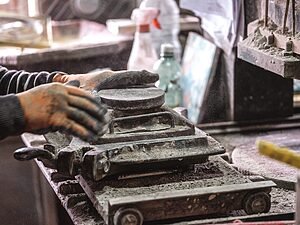
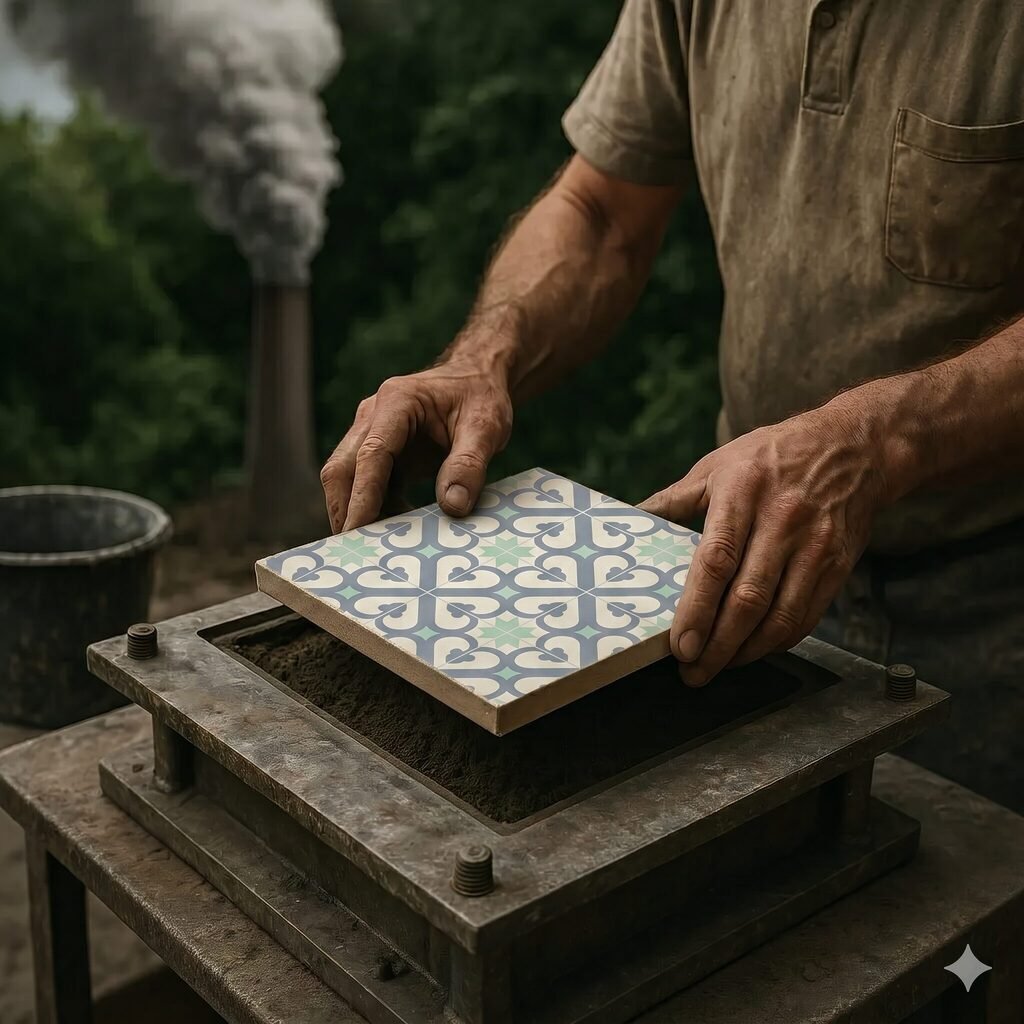
The process: mineral pigments mixed with cement and marble powder are poured into a brass divider, covered with dry mortar and pressed under several tonnes, and the tile then cures in water and dries in the shade for weeks. Energy use is concentrated in the press, the mixer and the water pumps: there is no kiln, no firing fuel and no process chimney. The details are in our article on how cement tiles are made, step by step.
For context: life-cycle assessments of the Spanish ceramic sector put the manufacture of a ceramic tile at between 30 and 40 kWh per square metre, and around 90 % of that energy is thermal, that is, drying and firing. For porcelain stoneware, kiln temperatures exceed 1,100 °C. That cost does not exist in the cement tile process.
What is the weak point of cement tiles? The cement
The binder. Portland cement emits CO₂ twice: during the calcination of limestone, through a chemical reaction, and through the fuel burned in the clinker kiln. The cement industry is estimated to generate around 7 % of global CO₂ emissions, and no cement tile manufacturer stands outside that chain.
What does lighten that load in handmade cement tile production:
- Blended cements (pozzolans, limestone filler, fly ash) that reduce the clinker content while maintaining performance.
- Optimised thickness: our tiles range from 1.5 to 1.8 cm; making them thicker than necessary means spending cement for no gain.
- Locally sourced aggregates, silica sand and marble powder, with fewer kilometres per tonne.
- Closed water circuits: sludge settling, reuse of the clarified water and controlled handling of the pigment-laden fines.
- Recovering rejects: tiles with minor flaws go into patchwork-style layouts or less demanding areas.
None of these measures makes cement carbon-neutral: a cement tile carries the footprint of its binder from day one and makes up for it with decades of service.
Is zellige eco-friendly if it is fired in a kiln?
It is fired, yes, and that should be said plainly. The advantage of handmade Moroccan zellige lies not in avoiding the kiln but in clay dug next to the workshop, a lower firing temperature than industrial porcelain and kilns fuelled with wood and plant waste such as olive stones. That fuel is renewable biomass, but burning it is not clean: it gives off particulates.
In return, the process generates very little waste: each piece is moulded, glazed and cut by hand, and its irregularity—which on an industrial line would be grounds for rejection—is precisely the product. The same goes for terracotta: variation in tone is part of the material.
The other key figure is porosity. In testing, 10 × 10 cm glazed zellige gave a mean water absorption coefficient of 15.7 % and 15 × 5 cm terracotta 16.9 %, compared with 5.9–6.2 % for hydraulic terrazzo and less than 0.5 % for porcelain stoneware. Porosity like this calls for a water-repellent treatment, and the impregnator is a chemical input that is repeated throughout the life of the floor: choosing a water-based, low-VOC product matters as much as the kiln.
Which flooring has the lowest environmental impact? A comparison
No flooring is impact-free. On manufacturing energy and repairability, pressed mineral floors and those fired at low temperatures come off better than porcelain and vinyl.
| Flooring | How it hardens | Water absorption | Repairable tile by tile? | End of life |
|---|---|---|---|---|
| Cement tile and hydraulic terrazzo | Pressed and set, no kiln | 5.9–6.2 % (terrazzo, report 4718) | Yes, tile by tile | Inert, can be crushed into aggregate |
| Glazed zellige | Shaped by hand and fired with biomass | 15.7 % (report 9103) | Yes | Inert, highly reusable |
| Terracotta / fired clay | Shaped and fired at around 900–1,000 °C | 16.9 % (report 7539) | Yes | Inert, reusable |
| Porcelain stoneware | Pressed and fired above 1,100 °C | Less than 0.5 % | Yes, although large rectified formats make it harder | Inert, recyclable as aggregate |
| Vinyl flooring (PVC) | PVC extrusion (petrochemical) | Non-absorbent | Plank by plank; usually replaced entirely | Plastic waste that is difficult to recycle |
| Wood flooring | Sawn, dried and varnished | Not applicable | Yes: sanding and revarnishing | Biodegradable or recoverable |
With one caveat that hardly anyone mentions: the ceramic industry has improved a great deal. It incorporates between 5 % and 30 % recycled material into the tile body, and a good many plants operate with zero discharge. Its problem is still the kiln, not the raw material. If you are weighing tiles against a synthetic floor, see the comparison between cement tiles and vinyl flooring.
Weight travels too: kilos per square metre
Transport is calculated in kilos, not square metres. With our formats, a 20 × 20 cm cement tile floor weighs about 32.5 kg/m², while a 10 × 10 cm zellige wall comes to 16 kg/m²: half as much. That is why zellige travels from Morocco at a lower cost per square metre than you might think.
| Material and format | Ref. | Dimensions | Weight per piece | Pieces/m² | Weight per m² |
|---|---|---|---|---|---|
| Square cement tile | H02 | 25 × 25 × 1.8 cm | 2.30 kg | 16 | 36.8 kg |
| Square cement tile | H03 | 20 × 20 × 1.5 cm | 1.30 kg | 25 | 32.5 kg |
| Zellige Mjeddij | ZS02 | 10 × 10 × 1 cm | 0.16 kg | 100 | 16.0 kg |
| Zellige Bejemat | ZS15 | 15 × 5 × 1.5 cm | 0.18 kg | 134 | 24.1 kg |
The weight of each reference is in the table of formats, weights and units per m². A model such as the Chakar cement tile (H61, 20 × 17 cm and 0.58 kg per piece) covers a square metre with 50 pieces and less than 30 kg of material.
How much weight does durability carry in the environmental balance?
More than any other factor. A floor that lasts eighty years spreads its footprint over eighty years; one that is replaced every fifteen multiplies it by five and adds the rubble and building work of each replacement.
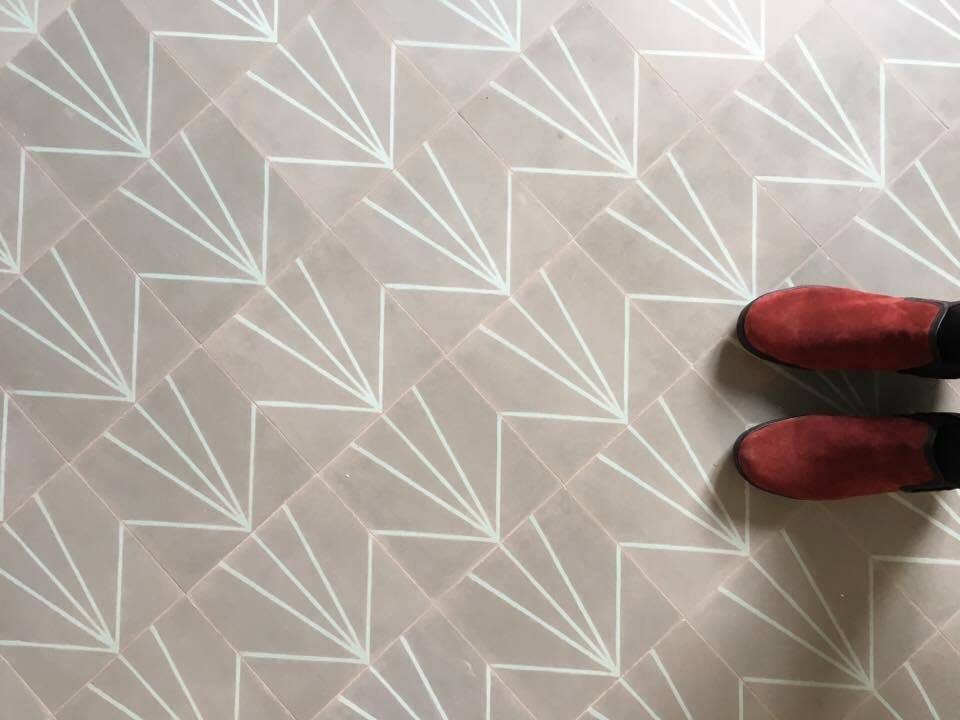
Cement tiles are salvaged from old houses, cleaned and relaid: it is common to see floors from the early 20th century still in service after polishing. If a tile breaks, you replace that tile, not the room; and if the colour has lost intensity, light sanding and a treatment restore the face.
Something similar happens with wall tiles: reusing reclaimed zellige means putting together entire wall panels from salvaged pieces. And at the end of the road, cement tiles, terracotta and zellige are inert waste: they are crushed and come back as aggregate, with no leachates or plastics to separate.
How can you reduce the impact of laying and maintenance?
A good part of the footprint is decided after the tile has been made. The steps that save the most:
- Measure carefully and order everything at once. A second delivery doubles the transport and may come from a different batch.
- Match format and thickness to the use. Small formats leave fewer offcuts in irregular rooms; extra thickness only makes sense where there is heavy foot traffic.
- Prepare the substrate properly. A flat, fully cured screed prevents breakages and rework that end up as discarded tiles.
- Choose the grout to suit the colour of the tile. Grouting that is too dark or poorly cleaned off calls for aggressive stripping that attacks the face.
- Use a water-based impregnator. It seals the pores without loading the indoor air with solvents; reapply only when water stops beading.
- Clean with neutral soap. No acids, bleach, ammonia or steam: cement tile floor maintenance comes down to water, neutral soap and little else.
- Keep some spares. Half a box in the storeroom lets you replace tiles in twenty years’ time without hunting for an impossible shade.
How can you tell a sustainable manufacturer from greenwashing?
By asking for documents, not adjectives. Four questions show whether there is anything verifiable behind the talk:
- Does it have an Environmental Product Declaration (EPD)? It is a Type III ecolabel under ISO 14025 and EN 15804, with specific rules for ceramic tiles in EN 17160. It covers the full life cycle, is verified by a third party and expires after five years.
- Does it have a certified environmental management system? ISO 14001 does not measure the product: it measures how consumption and waste are managed at the plant.
- Are there signed laboratory test reports? A report with a number, sampling date, standard test method and the signature of the laboratory director is worth more than ten pages of storytelling.
- Where do the raw materials come from and how many kilometres do they travel? Anyone who knows will answer with names and distances.
We publish the full reports, not a summary. They are issued by Elabora, a laboratory listed in the Register of Testing Laboratories of the Junta de Andalucía (the Andalusian regional government) under number AND-L-155, and they can be downloaded from the laboratory tests page to cite in a project specification.
| Product tested | Report no. | Format | Reference standard | Key result |
|---|---|---|---|---|
| Cement tile | 9102 | 200 × 200 × 15 mm | UNE-EN 1339:2004 | Concrete paving unit, not ceramic |
| Hydraulic terrazzo | 4718 | 200 × 200 × 18 mm | UNE-EN 1339 and UNE-EN 13748-1/2 | Rd 59.5 (CTE class 3); absorption 5.9–6.2 % |
| Glazed zellige | 9103 | 100 × 100 × 12 mm | UNE-EN ISO 10545 | Absorption 15.7 %; abrasion class 3 |
| Terracotta | 7539 | 150 × 50 × 15 mm | UNE-EN ISO 10545 | Absorption 16.9 %; flexural strength 8.7–10.3 N/mm² |
A note to avoid misleading comparisons: cement tiles and terrazzo are concrete paving units (UNE-EN 1339, the Spanish edition of EN 1339), while zellige and terracotta are ceramics (UNE-EN ISO 10545). Asking a cement tile for a ceramic classification, or vice versa, means comparing figures that cannot be compared.
Frequently asked questions about eco-friendly tiles
What exactly is an eco-friendly tile?
A tile whose impact is low across its whole life cycle: natural or recycled raw materials, little manufacturing energy, short or efficient transport, maintenance without harsh products, a long service life and an inert end of life. There is no single certification that confers that title; it is demonstrated with process data and tests.
Are cement tiles more eco-friendly than porcelain stoneware?
In the manufacturing phase, yes: they never go into a kiln, and that is where the bulk of a ceramic tile’s energy consumption lies. On raw materials, porcelain has the edge, because cement has a high footprint and the ceramic body can take up to 30 % recycled content. Once durability and repairability are added in, the balance tips towards cement tiles.
Is zellige sustainable if it travels from Morocco?
Transport counts, but it weighs less than people assume: a square metre of 10 × 10 cm zellige comes to 16 kg, half as much as a cement tile floor. On the other side of the scale are local clay, biomass firing, hand glazing and practically no manufacturing waste. It is an honest material, as long as it is not compared with a product made ten kilometres away.
Can old cement tiles be reused or recycled?
Yes. They are salvaged from demolition and renovation work, carefully cleaned on the back, polished and relaid. Those that arrive broken or badly worn are crushed and reused as aggregate on building sites. It is the most effective route of all: reusing an existing tile consumes no new cement or energy.
Which document proves that a tile is sustainable?
The Environmental Product Declaration (EPD), verified by a third party under ISO 14025 and EN 15804, with specific rules for ceramics in EN 17160 and valid for five years. The plant’s ISO 14001 certificate and the product’s test reports, issued by a laboratory listed in the relevant official register, are useful complements.
Do tiles give off harmful substances indoors?
The mineral tile itself does not: neither cement tiles nor fired clay nor zellige release VOCs once set or fired. The risk lies in what is applied on top or underneath: solvent-based adhesives, sealers, waxes and varnishes. Choosing water-based, low-VOC products keeps the indoor air in your home clean.
The next step is to get your hands on the material: request samples and compare them in natural light, because mineral colour behaves differently from a digital print. If you need technical data sheets, test reports or exact weights for a project specification, write to us at our workshop in Seville.