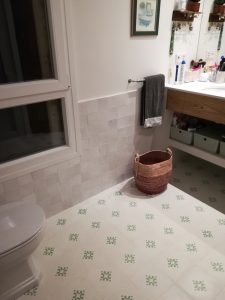
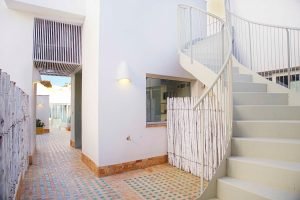
Outdoor zellige works, but not on every surface or in every climate. It is a glazed ceramic with a porous body: it performs well on vertical surfaces, fountains, benches and the fronts of barbecues or planters in mild climates, and it is a poor choice for floors that take foot traffic or for areas with frequent frosts. Getting it right depends on the substrate, the joints and the drainage.
Can zellige be used outdoors, and on which surfaces?
Yes, as long as the piece is used vertically or on surfaces with little foot traffic, and water does not pool on it. A handmade zellige tile is hand-moulded clay, fired and glazed: the glazed face is waterproof, but the biscuit underneath and the joints are not. Everything else follows from that.
| Outdoor surface | Handmade zellige? | Why |
|---|---|---|
| Vertical wall in a courtyard, porch or niche | Yes | Water runs off and does not pool |
| Exposed façade in a mild climate | Yes, on a waterproofed substrate | The sun does not affect it; water getting in through the joints does |
| Fountain, reflecting pool or ornamental basin | Yes, waterproofing first | Zellige is a cladding, not waterproofing |
| Front of a barbecue, bench, planter or built-in table | Yes | Vertical or only used occasionally, never walked on |
| Stair risers, dados and borders | Yes | Not walked on: colour from just a few square metres |
| Courtyard floor, path, stair tread or ramp | No | Abrasion class 3, and no Rd value can be measured on a loose piece |
| Submerged pool basin or waterline | No | High absorption, chlorine or salt, and filling cycles |
| Horizontal surface in a frost-prone area | Only under cover | Water in the pores breaks the piece when it freezes |
The courtyard floor is the case that causes the most headaches
Can it go on a courtyard floor? The honest answer is no.A piece of zellige, between 1 and 1.8 cm thick, undulating and with a thin glaze, is not designed to be walked on outdoors. For paving, hydraulic terrazzo, which reached slip resistance class 3 in our test, or terracotta makes more sense. Besides, the contrast between a matt floor and a glazed wall looks better.

What do the tests on zellige say about how it performs outdoors?
The figure that matters most is water absorption: a mean coefficient of 15.7 % for our 10×10 cm glazed zellige, measured to UNE-EN ISO 10545-3 (the Spanish edition of EN ISO 10545-3) and recorded in test report no. 9103, from a sample taken on 28 May 2024. That makes it a porous-bodied ceramic: its absorption is well above the 10 % that marks the highest absorption group in UNE-EN 14411, and that limits how it can be used outdoors.
| Material | Mean absorption (E) | Method | What it means outdoors |
|---|---|---|---|
| Glazed zellige 10×10 cm | 15.7 % | UNE-EN ISO 10545-3 (report 9103) | Porous body: vertical yes, horizontal no |
| Terracotta 15×5 cm | 16.9 % | UNE-EN ISO 10545-3 (report 7539) | Porous: always needs a water-repellent |
| Hydraulic terrazzo 20×20 cm | 5.9 – 6.2 % | UNE-EN 13748-1 (report 4718) | Concrete tile, suitable for paving |
| Porcelain stoneware (market benchmark) | < 0.5 % | UNE-EN ISO 10545-3 | A benchmark for comparison, not handmade |
Two more figures. The first is abrasion: in the UNE-EN ISO 10545-7 test, visible defects appear at 750 revolutions, which is class 3. Enough for a wall or a bench; not enough for a walkway with sand and street shoes.
The second is a limitation of the method. The friction pendulum test in the Spanish standard UNE 41901:2017 EX, which gives the Rd value required by the Spanish Building Code (CTE DB-SUA 1), needs a sliding area of 124×76 mm: small pieces have to be tested on a sample that has already been laid. That is why you will not see a certified class 3 for a loose piece of zellige, and why hydraulic terrazzo with a wet PTV of 59.5 is easier to justify to the architect or site supervisor. You can download the full test reports.
None of the reports we publish includes a frost resistance test (UNE-EN ISO 10545-12). What has been measured is absorption, and at 15.7 % the conclusion is the one in the next section.
Can zellige withstand frost?
With that level of absorption, zellige should not be assumed to be frost-resistant. Water that gets in through the joints or the crazing lodges in the pores, expands as it freezes and breaks the piece from within. In practice, there are three scenarios:
- The Mediterranean coast and southern Spain, where frost is rare: zellige holds up well on vertical surfaces. This is its natural climate, the same as that of the Maghreb.
- Inland Spain and mountain areas, with freeze–thaw cycles: only under cover, in porches and covered galleries, and never on horizontal surfaces.
- Any climate where water collects: a parapet without a drip or a planter without drainage brings the problem on sooner, even where it does not freeze.
Most outdoor damage does not come from the tile but from water getting in behind it: a substrate that has not been waterproofed, an open joint or a badly detailed capping. We go through these in our guide to zellige damage.
Where does zellige look good in a courtyard, on a terrace or in a garden?
On anything vertical or decorative, or in contact with water that is kept under control. The Alhambra and the Hassan II Mosque in Casablanca show the way: zellige goes where it is seen up close, not where people walk.
Walls, murals and blocks of colour
Cladding a section of wall in a single colour is the most rewarding option: the irregular sheen of the glaze changes with the light and gives depth to a flat wall. On large areas, an elongated format such as the 15×5 cm Bejemat works better, laid in a stretcher bond or herringbone; on small areas, a two-tone mural.
Fountains, reflecting pools and ornamental basins
This is the most photogenic use and the one that demands the most care. Zellige is a cladding, not a waterproofing layer: watertightness comes from the substrate, with its membrane or waterproofing mortar, applied before the first piece is fixed. Done well, the result looks like the zellige and terracotta fountain we documented in Morocco. With hard water, limescale will need removing often.
Benches, planters and barbecues
Barbecue sides, bench backs, planter fronts and stair risers are vertical or only used occasionally: zellige territory. It withstands heat, wipes clean with a damp cloth and only takes a few square metres.

Outdoor showers, spas and wet areas
In a poolside shower, a hammam or a covered spa, zellige offers what no industrial material can reproduce: each piece has a different tone and relief, and the surface as a whole shimmers instead of reading as flat. Cement tile, matt and uniform, goes on the floor; zellige goes on the wall. Before tiling, waterproof the substrate and sort out the fall and the drain.

Can you clad a façade with zellige?
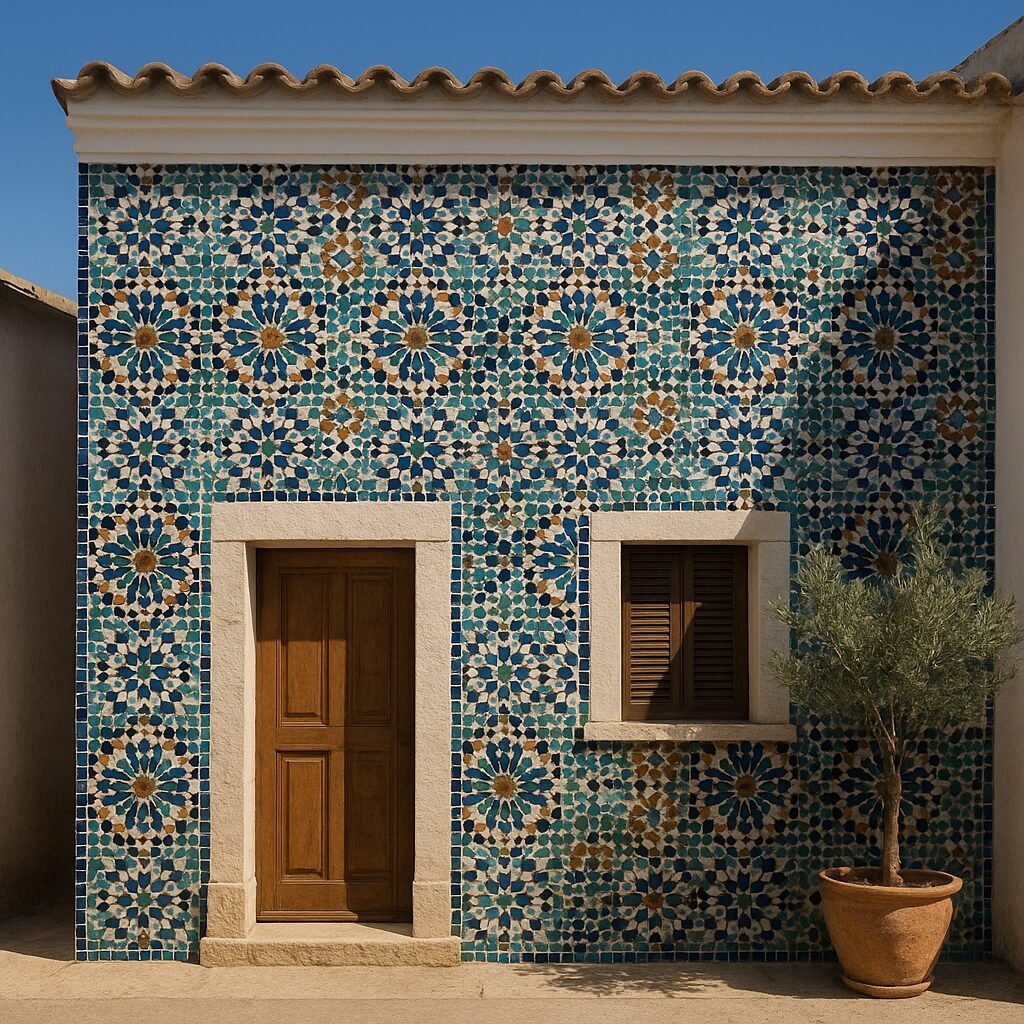
Yes, and it is one of the oldest uses of the material, but it is more demanding than it looks. Ceramic glaze is not degraded by sunlight or ultraviolet rays: the colour holds up outdoors without changing. The problem is water and movement in the substrate. What to sort out before the scaffolding goes up:
- A stable, clean substrate: a flat, plumb render, fully cured and free of dust. Nothing bonded to old paint will last.
- Prior waterproofing of the wall in areas exposed to driving rain.
- Cappings with a drip on parapets, cornices and wall tops, so that water cannot get in at the top edge.
- Perimeter and intermediate movement joints, following the Spanish standard UNE 138002 and the adhesive manufacturer’s instructions: a south-facing wall expands more than you might think.
- Colour in measured doses: a dado, window surrounds or a band under the eaves rather than a whole wall.
Combined with wood, stone or lime render, it gives the Mediterranean look of a coastal village without covering the whole house. If you are also working on the paving, lay the floor first and tile the walls afterwards.
How do you install zellige outdoors, step by step?
Like any outdoor tiling, with two additional requirements: a flexible adhesive and a proper joint. This is the order of work.
- Prepare the substrate: a flat render or bedding mortar, cured and clean, with the falls checked wherever water could collect.
- Waterproof the surface if it will be in contact with water — fountains, showers, reflecting pools — or exposed to driving rain.
- Mix the boxes: open several at once and alternate pieces, because each one differs in tone and size. That way the wall does not end up patchy.
- Use a flexible cement-based adhesive, type C2 with deformability class S1 or S2 to UNE-EN 12004, with back-buttering (double spreading) on thick or very exposed pieces.
- Leave a joint: outdoors, zellige is never butt-jointed. A joint of 1 to 3 mm absorbs thermal movement and stops pieces from popping off.
- Plan the movement joints, perimeter and intermediate, and respect any existing structural joints.
- Grout with an improved cement-based grout, or epoxy in areas permanently in contact with water. Colour changes everything: we cover it in our guide to grout for zellige.
- Apply a water-repellent to the joints and edges once everything has cured. The glaze does not need it; the joints and any exposed biscuit do.
Costly mistakes: laying on a damp or frozen substrate, grouting before the adhesive has set, using film-forming sealers that turn yellow and forgetting the drip on the coping.
Which zellige format should you choose, and how many pieces go into a square metre?
Outdoors, the bigger the piece, the less joint there is and the fewer ways in for water. That is why rectangular Bejemat pieces work better on walls and façades than small mosaics, which we keep for murals, borders and details.
| Format | Ref. | Size | Weight | Pieces / m² |
|---|---|---|---|---|
| Bejemat | ZS11 | 30 × 10 × 1.8 cm | 1 kg/piece | 34 |
| Bejemat | ZS12 | 20 × 10 × 1.8 cm | 0.6 kg/piece | 50 |
| Bejemat | ZS13 | 15 × 7.5 × 1.8 cm | 0.37 kg/piece | 89 |
| Bejemat | ZS15 | 15 × 5 × 1.5 cm | 0.18 kg/piece | 134 |
| Mjeddij | ZS01 | 15 × 15 × 1.6 cm | 0.3 kg/piece | 45 |
| Mjeddij | ZS02 | 10 × 10 × 1 cm | 0.16 kg/piece | 100 |
| Chakar | ZS31 | 12 × 11 × 1 cm | 0.13 kg/piece | 135 |
| Darj | ZS51 | 10 × 10 × 1 cm | 0.08 kg/piece | 200 |
| Kora 8 | ZS81 | 10 × 10 × 1.5 cm | 0.24 kg/piece | 100 |
The edges are cut by hand, so sizes vary from one piece to another: that is part of the material, not a defect. The full list is on our zellige formats page, and it is worth allowing a margin of spare pieces: finding a replacement in the same tone years later is almost impossible.
How do you maintain zellige outdoors?
It takes little effort, but it takes consistency. Water and neutral soap with a cloth or a soft sponge are enough; avoid abrasive cleaners, metal scourers and strong acids, which scratch or dull the glaze.
- Check the joints once a year, before winter: an open joint is a doorway for water.
- Renew the water-repellent on joints and edges as the manufacturer recommends.
- Remove limescale from fountains as soon as it appears, without chlorine-based descalers.
- Watch out for salt and fertilisers: in tiled planters they cause efflorescence in the joints.
Handmade zellige or zellige-effect porcelain?
It depends on where it is going. For outdoor paving, porcelain has its place: absorption below 0.5 % and a certified slip class. What it cannot reproduce is the irregularity of a handmade tile or the way its glaze reflects the light.
That is why a mixed solution works better in a courtyard: paving suitable for outdoor use — terrazzo, cement tile or terracotta — and zellige on vertical surfaces, the fountain and borders, as in these real zellige projects.

Frequently asked questions about outdoor zellige
Is zellige frost-resistant?
It is best not to assume so. Our 10×10 cm glazed zellige has a mean absorption of 15.7 % (test report no. 9103, UNE-EN ISO 10545-3), and water held in the pores breaks the piece when it freezes. In areas with frequent frosts, use it only under cover and on vertical surfaces.
Can zellige be used on a courtyard or terrace floor?
We do not recommend it. The piece shows abrasion defects at 750 revolutions, class 3 under UNE-EN ISO 10545-7, and its size means that the Rd value the Spanish Building Code (CTE DB-SUA 1) requires outdoors cannot be measured on a loose piece. For paving, hydraulic terrazzo, cement tile or terracotta is a better choice.
Can zellige be used to clad a fountain or a swimming pool?
For a fountain or a decorative reflecting pool, yes, as long as the substrate is waterproofed first: zellige is a cladding, not a waterproofing layer. For the submerged basin of a swimming pool or the waterline, it is not the right material: high absorption, chlorine or salt, and cycles of filling and emptying.
How many pieces of zellige do I need per square metre?
It depends on the format: 34 pieces per square metre with the 30×10 cm Bejemat, 100 with the 10×10 cm Mjeddij, 134 with the 15×5 cm Bejemat and 200 with the 10×10 cm Darj. The formats table gives the coverage and weight of each one.
Does zellige fade in the sun?
No. Ceramic glaze is stable under solar radiation and ultraviolet rays, so the colour lasts for years. What does change is the patina: the gloss softens and fine crazing appears, which is part of the character of the material.
Does zellige need sealing or a water-repellent outdoors?
The glazed face does not, but the joints and exposed edges do. A water-repellent is applied once the adhesive and grout have cured, and renewed as the manufacturer recommends. Avoid film-forming sealers: they turn yellow in the sun and are hard to remove.
If you are working on a courtyard, a façade or a fountain, first decide which surface gets zellige and which gets paving, and only then the colour. You can see what is currently available in zellige in stock and ask for samples to judge them in the light of your own courtyard.