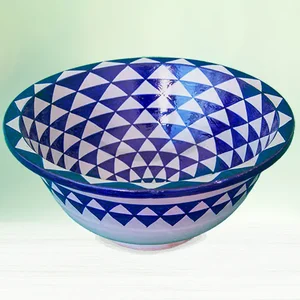
Hand-painted tiles are glazed ceramic pieces whose design is applied with a brush, one colour at a time, onto the raw glaze before the final firing. That is why no two are alike: the brushwork, the shade and the sheen vary slightly from one piece to the next. They are used for dados, kitchen splashbacks, bathrooms, fountains and courtyards, and they lend themselves to bespoke designs.
What is the difference between a hand-painted tile and a printed one?
On a hand-painted tile, the colour is applied with a brush to the glazed piece, which is then fired; a printed tile reproduces a photograph of the design using digital printing or industrial screen printing. From a metre away they look alike. Up close, they do not.
The signs that tell them apart, without relying on the label:
- Exact repetition. In a box of factory-made tiles, the motif repeats identically. On a hand-painted tile, each flower is closed off in its own way and every line has its own rhythm.
- Brush loading. Against the light and to the touch, you can make out the thickness of the glaze: areas where the colour builds up and others where the brush has dragged less pigment.
- Outlines. Cuerda seca leaves a dark, matt line between the colours; on a printed tile the outline is clean and uniform.
- Edges and back. A handmade piece shows its porous biscuit, and the glaze stops irregularly at the edges.
- Shade variation. The intensity of the blue or green changes from one firing to the next. It is not a defect: it is proof that the glaze has been applied by hand.
How is a tile painted by hand?
The design is applied to the glaze while it is still unfired, and it is the kiln that fixes it: the pigment fuses with the glaze and ends up protected under a layer of glass. This is the journey a piece goes through:
- Biscuit. The clay is shaped, dried and given a first firing that leaves it porous and stable.
- Glazing. It is coated with the base glaze, usually white, which will form the background of the design.
- Transferring the motif. The design is transferred to the piece with a perforated template and charcoal — good old-fashioned pouncing — or drawn freehand.
- Painting. The metal oxides are applied with a brush, one colour at a time: cobalt gives the blues, copper and chromium the greens, and manganese the browns and blacks.
- Firing. A second firing at around 1,000 °C. The oxides, dull and earthy when they go in, come out of the kiln in their final colours.
- Sorting. Pieces with chipped glaze are discarded and the rest are grouped by shade.
Cuerda seca
The outline of the design is drawn with a greasy mixture loaded with manganese oxide. That line repels the glaze and acts as a dam: it stops the colours running into one another during firing. When it comes out of the kiln it is matt and dark, like the leading of a stained-glass window, but on a perfectly flat surface.
Cuenca or arista
Here the dam is not painted but stamped: a mould is pressed into the still-soft clay and leaves a relief that physically separates the colours. The technique became widespread in the fifteenth and sixteenth centuries in Seville, Toledo and Muel, and displaced cuerda seca because it allowed much faster production. That tradition lives on in Andalusian tilework, as we explain in our article on Sevillian tiles.
Freehand painting on glaze
No outline and no relief: the brush rests on the raw glaze, which soaks up the pigment like blotting paper. There is no room for correction, which is why the painter’s hand shows so clearly. It is the technique used for ceramic murals.
What size is a hand-painted tile, how much does it weigh and how many make a square metre?
The catalogue format is 10 × 10 cm, which means 100 pieces per square metre; according to the product data sheets, the tile can also be ordered in 15 × 15 cm. The weight varies with the amount of glaze and the thickness of the biscuit: among the 10 × 10 cm models published, values range from 0.24 to 0.52 kg per piece.

| Piece | Reference | Dimensions | Weight per piece | Pieces per m² |
|---|---|---|---|---|
| Hand-painted tile Mod. Gamonal | AP31-07 | 10 × 10 cm | 0.52 kg | 100 |
| Hand-painted tile Mod. Alquife | AP21-01 | 10 × 10 cm | 0.24 kg | 100 |
| Zellige Mjeddij | ZS02 | 10 × 10 × 1 cm | 0.16 kg | 100 |
| Zellige Mjeddij | ZS01 | 15 × 15 × 1.6 cm | 0.30 kg | 45 |
| Cement tile | H06 | 10 × 10 × 1.5 cm | 0.35 kg | 100 |
| Cement tile insert | H07 | 7 × 7 × 1.5 cm | 0.25 kg | 205 |
To work out your order, multiply the square metres by the number of pieces per square metre and add the usual allowance for cuts and breakages on site, between 5% and 10%. With hand-painted tiles that margin matters more: any later top-up will come from a different firing and will not match in shade.
Can hand-painted tiles be used in a courtyard or on a façade?
Yes: on vertical surfaces and on a stable substrate, it is a traditional use — courtyard dados, fountains and street signs have been finished this way for centuries. The glaze seals the visible face and protects it from water and sun; the precautions concern the back and the edges, which are still porous biscuit.
Handmade ceramics absorb a fair amount of water. In the test reports on our materials, 10 × 10 cm glazed zellige gave a mean absorption coefficient of 15.7% and 15 × 5 cm terracotta 16.9%, measured to UNE-EN ISO 10545-3 (the Spanish edition of EN ISO 10545-3), compared with porcelain stoneware, which does not exceed 0.5%. You can consult the full documents in our laboratory test reports. We have no specific test for the hand-painted tile, but the order of magnitude is that of a porous glazed ceramic: in areas with frost, use an adhesive suitable for exterior use and leave no voids under the tile where water could collect and freeze.
For outdoor floors, the answer is different. The Spanish Building Code (CTE) requires, in its Basic Document DB-SUA 1, a slip resistance class according to the use of the area, and a glossy glazed tile is not a non-slip floor covering:
| Rd value (PTV) | Class | Where it is required |
|---|---|---|
| Rd ≤ 15 | Class 0 | Not valid anywhere: the CTE requires at least class 1 |
| 15 < Rd ≤ 35 | Class 1 | Dry indoor areas with a slope of less than 6% |
| 35 < Rd ≤ 45 | Class 2 | Dry indoor areas with a slope of 6% or more and stairs; wet indoor areas (entrances, bathrooms, kitchens) with a slope of less than 6% |
| Rd > 45 | Class 3 | Wet indoor areas with a slope of 6% or more and stairs; outdoor areas, swimming pools and showers |
Our 20 × 20 cm hydraulic terrazzo achieved a PTV of 59.5 in the wet test — class 3 — according to test report no. 4718. That is the sensible approach for a courtyard: a tested material for the floor, and the painted tile kept for the dado, the fountain or the bench, where nobody walks.
How did the country house courtyard turn out with Mod. Gamonal?
From Cáceres, we were sent photos of a clay-brick fountain finished with our hand-painted tile Mod. Gamonal (AP31-07), from the Toledo collection, in the courtyard of a country house. It is exactly the approach described above: the tile goes on a vertical surface over brickwork, and the floor is done in another material.

Gamonal has a floral pattern in greens and whites, and that is precisely why it works in this courtyard: the green of the glaze picks up the green of the plants, and the white ground gives back the light that the exposed brick soaks up. With a more contrasting model, the whole thing would have competed with the plants instead of complementing them.
Our thanks to Mrs Concepción, who sent us the photos of the finished project. If you are working on a similar restoration, we set out the criteria for this kind of project in our guide on how to choose tiles for country house renovations.
What collections of hand-painted tiles are there?
The catalogue includes more than sixty models across several series named after villages, plus a single-colour range. They all share the 10 × 10 cm format, so they can be mixed in the same order without any setting-out problems.
- Granada collection (AP21). All in blue and white, the classic palette of Andalusian tilework, with models such as Alquife, Barcinas, Albuñol, Órgiva, Monachil and Trevélez.
- Toledo collection (AP31). Polychrome, with greens, ochres and honey tones, in models such as Gamonal, Torrijos, Mora, Oropesa, Ajofrín and Illescas.
- AP41 series. Six models named after towns in Mallorca: Petra, Escorca, Algaida, Manacor, Pollensa and Capdepera.
- Monocolor (AP01) and plain tiles. Single-colour pieces to act as a background, a frame or a resting point between the decorated models.
Because they are glazed, they are suitable for wet areas, kitchens and bathrooms included. The full range is on our hand-painted tiles, washbasins and roof tiles page.
How do you combine several models in a patchwork?
A patchwork alternates different models in the same format to build up a tapestry with no apparent repeat. It works very well with hand-painted tiles because the variation in shade between pieces, which in a uniform layout reads as a defect, becomes the whole point here.

These are the rules that work best when putting one together:
- A single format. Mixing models is easy; mixing sizes means replanning the joints and cutting decorated pieces.
- A bridging colour. Choose a shade that appears in every model, even if only in the background. Without it, the whole thing looks like a box of odds and ends.
- Plain pieces as breathing space. Slipping in single-colour tiles, one in every four or five, calms the pattern and brings down the cost per square metre.
- A dry run on the floor. Lay the pieces out before you mix any adhesive and photograph them: once they are on the wall, there is no going back.
- Well-defined areas. It looks its best on a kitchen splashback, a worktop, a table or a plant pot; across a whole bathroom it soon becomes tiresome.

The same idea can be carried over to the floor with other materials; in our article on patchwork tiles we go through the combinations that work best. If the painted tiles run up the wall, the usual choice for the floor below is a cement tile with a quiet pattern that does not compete with them.

How are they installed and maintained?
They are installed like any conventional ceramic tile, with two precautions that come with a handmade product: the dimensions are not exact to the millimetre, and the shade varies from box to box.
- Check that the substrate is flat, clean and dry: there is no thickness here to make up for a wall that is out of true.
- Open all the boxes and mix them before you start. Laying box by box leaves patches of different shades on the finished wall.
- Dry-lay the whole surface and mark out the courses. If it is a patchwork, photograph the layout.
- Apply a cement-based adhesive with a notched trowel, suited to the substrate and, outdoors, rated for exterior use.
- Bed each piece with a slight twist, without knocking the glazed edge, and leave a joint of 1.5 to 3 mm: it absorbs the dimensional variation of handmade tiles.
- Grout once the adhesive has set and wipe off the residue with a damp sponge before it hardens: once dry, it scratches the glaze.
- Clean off the final haze with a neutral product. The colour of the grout changes the result completely: we cover this in our article on which grout to choose for the colour of your tiles.
Maintenance is simple: the glaze is a layer of glass.
- Water and neutral soap. No acid cleaners, hydrochloric acid or descalers: they attack the grout and can dull the glazes.
- No wire wool or scouring powders: they scratch the glaze and take away its shine.
- The face needs no water-repellent, unlike unglazed terracotta.
- Keep a small surplus from your order for future replacements.
Frequently asked questions about hand-painted tiles
How much does a hand-painted tile cost?
It depends on the model, the number of colours, the format and whether it is a catalogue design or an exclusive one: a single-colour piece and a polychrome motif that needs several passes of the brush do not cost the same. Send us the square metres, the model and the format, and we will prepare a quote with lead times.
Can they be laid on floors?
As a decorative detail indoors, in areas with little foot traffic, yes; as a continuous floor, no. The glossy glaze scratches underfoot and is not a material tested for slip resistance. For the floor, choose a cement tile or a terrazzo, which reaches class 3 in our tests.
Can I order my own design?
It is a product that lends itself to that, because the motif is applied piece by piece: signs, numbers, borders or designs for a specific project. The sensible approach is to start from a sketch and approve a sample before the order goes ahead. We explain how a bespoke design is approached in our article on custom tiles; check terms, lead times and minimum quantities with the workshop.
Why are the pieces not all identical?
Because the design is painted piece by piece and the glaze behaves differently in each firing, depending on where the piece sits in the kiln. Differences in shade, line thickness and size, within a margin of a few millimetres, are inherent to the product and are evened out by mixing boxes before laying.
Do they hold up on a façade or an outdoor fountain?
On vertical surfaces and properly fixed, yes: it is a traditional use in courtyards, fountains and signs. The glaze protects the visible face, but the back is still porous ceramic: use an adhesive suitable for exterior use, leave no voids under the tile and take extra care in areas with frost.
How do they differ from zellige?
Zellige is Moroccan clay, glazed and cut by hand piece by piece, with no pattern: its charm lies in the irregular glaze and the uneven sheen. A hand-painted tile carries a motif applied with a brush over white glaze. We explain what zellige mosaic is in a separate article.
If you are planning a courtyard, a kitchen splashback or a fountain, the next step is to see the pieces in person: glaze and brushwork cannot be judged on a screen. Write to us through our contact page with the area and the model you are interested in, and we will confirm formats, lead times and samples.