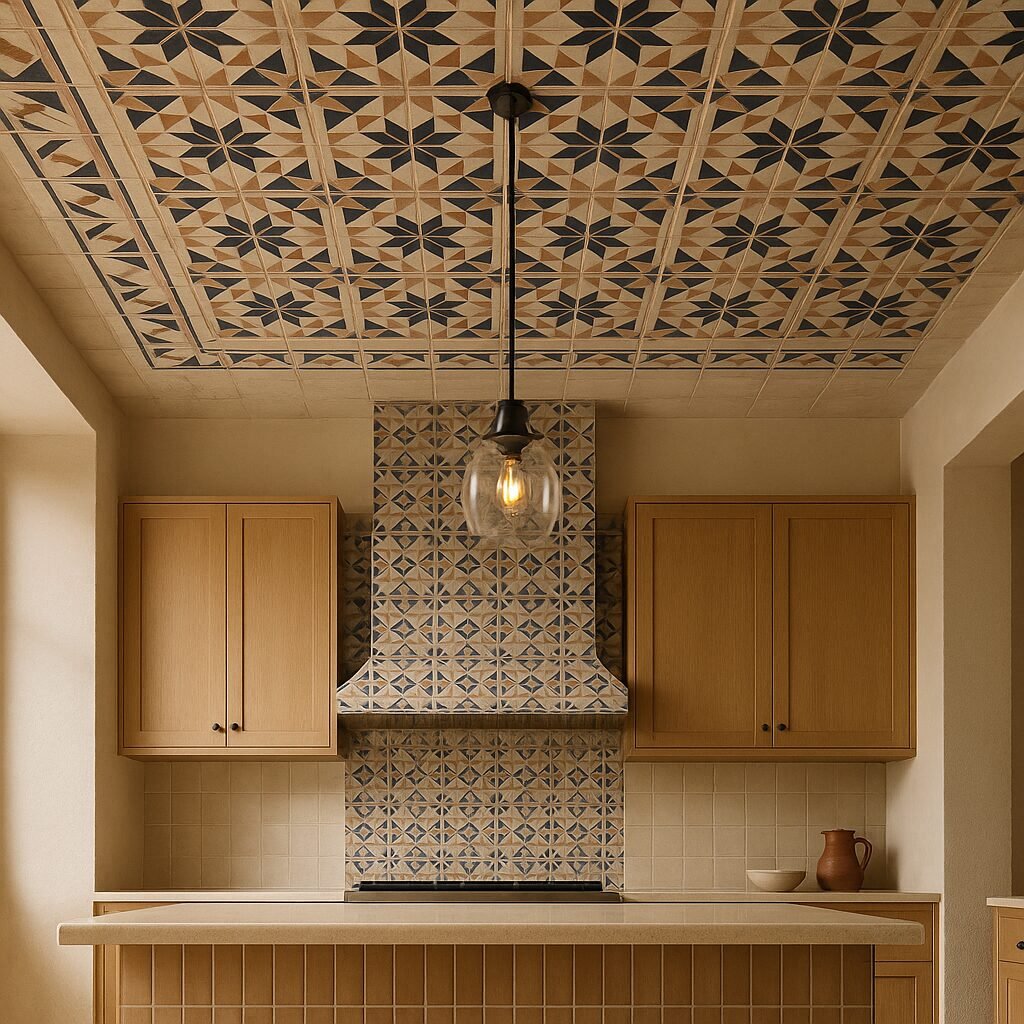
Tiling a ceiling is possible, but only with lightweight tiles, C2 TE S1 cementitious adhesive and back-buttering: weight is the deciding factor. A square metre of cement tiles weighs between 28 and 37 kg and is not a ceiling material; 10 × 10 cm zellige, 1 cm thick, comes in at 16 kg/m² and is fine for small, contained areas. On vertical surfaces, almost the entire catalogue is an option.
What are ceiling tiles, and what is vertical tiling?
The term “ceiling tiles” covers two different things. Suspended ceiling tiles are panels of plaster, mineral fibre, PVC or polystyrene that sit on an exposed grid: light, removable and neither ceramic nor cement.
What concerns us here is something else: tiling a real ceiling — a floor slab, a vault or the ceiling over a shower — by bonding tiles to it with adhesive. It is a decorative decision with structural consequences, which is why it calls for numbers before inspiration.
Vertical features are everything else: feature walls, columns, arches, niches, bar fronts, headboards, stair risers and fireplaces. There, the wall takes the weight, the requirements relax and the whole range of materials opens up.
Can you tile a ceiling?
Yes, as long as the tile is light and the system is designed to work upside down. It is not a question of taste but of adhesion, weight and substrate.
The substrate must be sound and primed: a concrete slab, rendered masonry or cement board. Standard plasterboard and plaster are not designed to carry the hanging weight of a ceramic finish; if the project calls for one, they are replaced with cement board on a properly engineered frame.
There are no shortcuts with the adhesive either. EN 12004 (UNE-EN 12004 in Spain) classifies cement-based tile adhesives with letters that are all-important here: C2 means an improved cementitious adhesive; T, reduced slip (the tile does not slide or drop while the adhesive sets); E, extended open time; and S1 or S2, deformable and highly deformable. For a ceiling, the minimum is C2 TE S1.
That leaves the limit hardly anyone mentions: every adhesive manufacturer states a maximum weight per m² for ceiling application in its technical data sheet, and that figure decides which tile can go up. On a false ceiling or over large areas, the added load must be checked by a qualified professional under DB-SE-AE, the document of the Spanish Building Code (CTE) that covers loads.
How much does a square metre of cement tiles or zellige weigh?
Cement tiles weigh between 28 and 37 kg/m² in the usual formats; zellige 1 cm thick and about 10 cm across, between 14 and 19 kg/m². That difference decides whether a material can go up on a ceiling or stays on the wall. The weights and units come from our format tables:
| Material and reference | Size | Weight per piece | Units/m² | Approx. weight per m² | Use on ceilings |
|---|---|---|---|---|---|
| Cement tile H02 (square) | 25 × 25 × 1.8 cm | 2.30 kg | 16 | 36.8 kg | Not recommended |
| Cement tile H03 (square) | 20 × 20 × 1.5 cm | 1.30 kg | 25 | 32.5 kg | Not recommended |
| Cement tile H31 (octagonal) | 20 × 20 × 1.5 cm | 1.14 kg | 25 | 28.5 kg | Not recommended |
| Zellige ZS11 Bejemat | 30 × 10 × 1.8 cm | 1.00 kg | 34 | 34.0 kg | Not recommended |
| Zellige ZS03 Mjeddij | 5 × 5 × 1 cm | 0.05 kg | 400 | 20.0 kg | With reservations |
| Zellige ZS02 Mjeddij | 10 × 10 × 1 cm | 0.16 kg | 100 | 16.0 kg | Feasible on small areas |
| Zellige ZS51 Darj | 10 × 10 × 1 cm | 0.08 kg | 200 | 16.0 kg | Feasible on small areas |
| Zellige ZS62 Kora 6 | 11 × 9.6 × 1 cm | 0.12 kg | 120 | 14.4 kg | Feasible on small areas |
To put the figures in context: a ceramic wall tile 7 to 9 mm thick comes to around 14–17 kg/m², the order of magnitude that systems designed for ceilings work with. Cement tiles double that figure because they are pressed concrete, 15 to 18 mm thick, that cures rather than ceramic that is fired: their mass is a virtue on a floor and a problem on a ceiling.
Two caveats: not all zellige is light — the 30 × 10 × 1.8 cm Bejemat reaches 34 kg/m², as much as a cement tile — and very small pieces get heavy again as the number of units multiplies, so a 3 × 3 cm Mjeddij adds up to 22.2 kg/m² and the 7 × 7 cm tile insert exceeds 50 kg/m².
Overhead, you are looking at 1 cm thick tiles in formats of around 10 cm, such as the 10 × 10 cm Darj zellige. You will find every reference in our tables of zellige formats with sizes and units per m² and of cement tile formats. On top of those kilos comes the weight of the adhesive and the grout.
How do you tile a ceiling or a vertical surface, step by step?
The procedure is the same on both planes, but on a ceiling no step is optional.
- Check the substrate. Sound, flat and clean. If there is paint or an old finish, remove it or apply a bonding primer.
- Set out from the centre. Mark the axes and push the cuts out to the perimeter, so that cut tiles are not on show.
- Dry-lay and mix boxes. Cement tiles and zellige vary in shade; mixing tiles from different boxes spreads the variation.
- Mix the C2 TE S1 adhesive and respect its open time: adhesive that has gone past it no longer grips, even if it is still soft.
- Always back-butter. Comb the adhesive onto the substrate and spread a thin coat on the back of the tile: on a ceiling, an air pocket ends with the tile coming away.
- Leave a joint. At least 1.5 mm to absorb expansion: butt-jointing is a shortcut that ends in broken tiles.
- Prop while it sets. Spacers, wedges and a board held up on props until the adhesive grabs: class T reduces slip, it does not eliminate it.
- Grout with a suitable product for the colour and joint width, and clean off the haze before it hardens.
- Seal and protect. Water-repellent on porous materials and neutral-cure silicone at junctions and around the edges.
The full sequence is in our guide to laying cement tiles.
Which vertical features are best suited to tiles?
On vertical surfaces, weight stops being the problem: the substrate and the finishing details are what count. These are the five places where tiles work best.
Kitchen walls and splashbacks up to the ceiling
Taking the splashback up to the ceiling on the cooking wall creates a continuous surface that works as a backdrop, especially in raking light. If you would rather not go all the way up, half-height tiling does the same job with less material.
Columns, arches and niches
This is where zellige shows its best side: because the pieces are small, they follow the curve without forced cuts, and their irregular edges break up the light on every face. A shower niche concentrates that jewel-like effect in a very small space.
Headboards and furniture fronts
A tiled headboard is one of the most rewarding applications: a defined area, with no moisture and no foot traffic, where cement tiles can shine without any technical limitation. The same goes for furniture and worktops, which we cover in our article on cement tile furniture.
Stair risers and skirting
Covering stair risers with a geometric pattern is a classic that uses very little material. At the foot of the wall, the plain HR01 cement skirting tile, 20 × 10 × 1.5 cm, weighs 0.66 kg, and 5 of them fit in a linear metre: 3.3 kg per metre. The 20 × 20 cm HR02, with 3 per metre, goes up to 4.2 kg.
Fireplaces and bar fronts
The front of a fireplace or a bar needs a tile with some body and a joint that absorbs expansion from heat, something small formats handle better. We cover this in our article on zellige for fireplaces and stoves.
How do you create a 3D effect on a wall by combining formats?
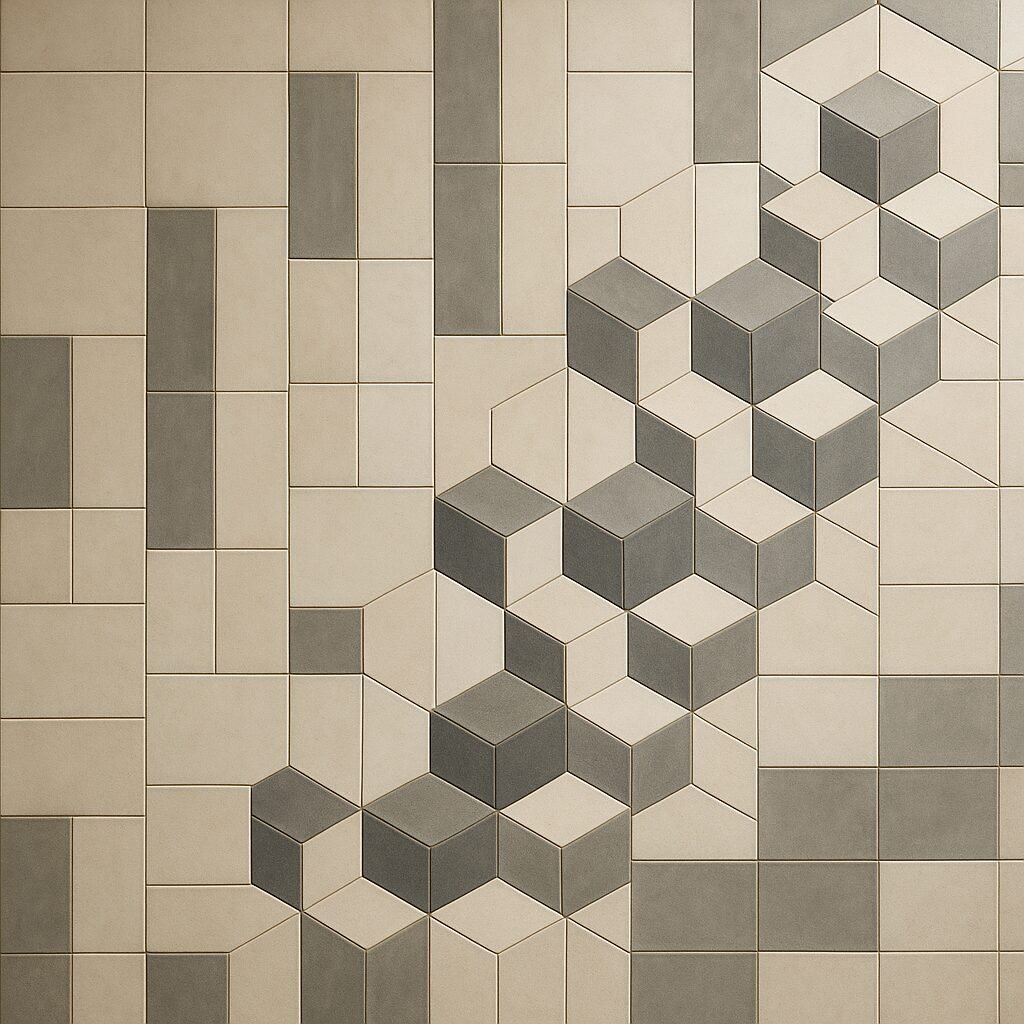
A three-dimensional effect does not need real relief: you can achieve it with flat tiles, three shades and a geometry that the eye reads as a lit face, a face in half-shadow and a face in shadow.
Combine square, rectangular and hexagonal formats
Use a square format over most of the wall and introduce a band of rectangular tiles laid vertically: that change of format and direction is already enough to suggest a different plane within the wall. Mixing hexagons with squares is even more effective, because the hexagon reads as a cube.
The isometric cube in three shades
The isometric cube pattern is built from three rhombuses that form a hexagon. The key is not the design but the colour: a light shade, a mid shade and a dark one. When they are grouped together, the brain reconstructs the volume. Our chart of cement tile colours MC1 to MC49 lets you put these trios together within a single colour range, which is what makes the illusion convincing.
Colour contrast and raking light
Without contrast there is no depth. Combine neutrals — off-whites, greys, sand — with a strong colour, and give the darkest shade to the smallest format: dark tiles seem to recede and light ones to come forward. Side lighting completes the effect, bringing out joints and micro-textures.
Subtle relief and a change of finish
There is no need to cover the wall in relief: it is enough to alternate a slightly textured finish with a smooth one within the same range. The difference in how they reflect the light does the rest.
How do moisture and maintenance affect your choice of material?
On shower ceilings, bathroom ceilings and surfaces exposed to steam, water absorption is what decides: the more porous the material, the more water-repellent it needs. These are the coefficients measured in our tests.
| Product | Average absorption (E) | Test standard | What it means on a wall or ceiling |
|---|---|---|---|
| Hydraulic terrazzo 20 × 20 cm | 5.9 – 6.2 % | UNE-EN 13748-1 | Tighter pores; suitable for wet areas if sealed |
| Glazed zellige 10 × 10 cm | 15.7 % | UNE-EN ISO 10545-3 | The glaze protects the face, but not the edge |
| Terracotta 15 × 5 cm | 16.9 % | UNE-EN ISO 10545-3 | Needs a water-repellent before it goes into use |
| Porcelain stoneware (reference) | less than 0.5 % | UNE-EN ISO 10545-3 | Only as a point of comparison |
The values come from test reports issued by Elabora, a laboratory listed in the Register of Testing Laboratories of the Junta de Andalucía (the Andalusian regional government) under number AND-L-155. We publish the full reports on our laboratory tests page.
It is best not to mix up the standards: cement tiles and terrazzo are concrete tiles — they are not fired, they cure — and are tested to UNE-EN 1339 (the Spanish version of EN 1339), whereas zellige and terracotta are ceramics and fall under the UNE-EN ISO 10545 series.
Slip resistance only matters once the material reaches the floor: if you continue the tiling onto the floor of a shower, the CTE’s Basic Document DB-SUA 1 requires class 3. Our 20 × 20 cm hydraulic terrazzo achieved a PTV of 59.5 in the wet test, which is class 3, according to test report no. 4718.
Common mistakes when tiling a ceiling or a wall
- Thinking that tiles improve the acoustics. It is the other way round: a ceramic or cement surface reflects sound and increases reverberation. If you want sound absorption, the answer is a mineral fibre suspended ceiling, not tiling.
- Tiling over standard plasterboard on a ceiling. It is not a substrate for hanging weight from: you need cement board on a properly engineered frame.
- Choosing a large format overhead. The bigger the tile, the harder it is to get full adhesive contact and the more its weight pulls.
- Not treating zellige or terracotta with a water-repellent in steamy areas. With absorption of 15.7 % and 16.9 %, water gets in through the edges and joints even if the face is glazed.
- Cleaning with acid or pressurised steam. It attacks the grout and opens up the pores: use a pH-neutral cleaner.
Frequently asked questions about tiling a ceiling and vertical features
What is a ceiling tile?
It can mean two different products. On the one hand, suspended ceiling tiles made of plaster, mineral fibre, PVC or polystyrene: light, removable and designed to hide services and absorb noise. On the other, ceramic or cement tiles bonded to the ceiling with adhesive, a decorative solution that means checking weight and substrate.
Can cement tiles be used on a ceiling?
We do not recommend it. Cement tiles weigh between 28 and 37 kg/m² in the usual formats, compared with 14–17 kg/m² for a conventional ceramic wall tile: they are pressed concrete, 15 to 18 mm thick, and upside down that weight works against you. For ceilings, it is better to go for pieces 1 cm thick, such as Mjeddij, Darj or Kora 6 zellige.
Which adhesive is used to tile a ceiling?
A class C2 TE S1 cement-based tile adhesive as a minimum, under EN 12004: C2 means improved performance, T reduced slip so that the tile does not drop while the adhesive sets, E extended open time and S1 deformability. Always back-butter, and check the maximum weight per m² in the technical data sheet.
How much does a square metre of cement tiles weigh?
Between 28 and 37 kg in the usual formats. The 20 × 20 × 1.5 cm H03 weighs 1.30 kg per tile, with 25 tiles per square metre: 32.5 kg/m². The 25 × 25 × 1.8 cm H02 reaches 36.8 kg/m² and the octagonal H31 comes in at 28.5 kg/m². On top of that, you have to add the adhesive and grout.
Can you tile a plasterboard ceiling?
A standard plasterboard sheet on a ceiling is not a suitable substrate for a bonded ceramic finish. The usual solution is to replace it with cement board on a frame sized for the load, prime it and then tile. The added load must be approved by a qualified professional.
Do zellige and terracotta need sealing on vertical surfaces?
Yes. Glazed zellige has an average absorption of 15.7 % and terracotta 16.9 %, measured to UNE-EN ISO 10545-3. Even though the glaze protects the face, the edge and the joint remain porous: in kitchens, bathrooms and steamy areas, a water-repellent is a must.
If you are working on a ceiling, a column or a headboard and want to know which format will hold, write to us with the dimensions and the substrate: you can request samples and book a visit to our showroom in Seville, by appointment, through our contact page.