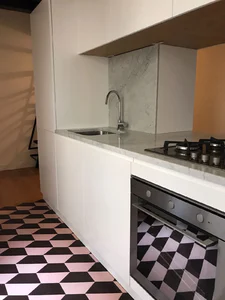
When it comes to where to use cement tiles, the options run from any room in the home—kitchen, bathroom, living room, hallway, bedroom or staircase—to walls, furniture, underfloor heating and high-traffic commercial premises. They also work outdoors and in wet areas, but only under certain conditions: a water-repellent treatment, a waterproofed substrate and caution with frost and with blue and green shades.
This table sums up where cement tiles fit and what each case requires.
| Use | Suitable? | Essential condition |
|---|---|---|
| Dry interiors: living room, hallway, bedroom | Yes | Level, dry substrate; water-repellent before and after grouting |
| Kitchen: floor and splashback | Yes | Anti-stain water-repellent; neutral cleaning products |
| Bathroom and shower floor | Yes | Waterproofed substrate and a small format |
| Walls, headboards and furniture | Yes | Firm substrate: tiling adds 29–37 kg/m² |
| Fireplace: front, sides and hood | Yes | Away from the firebox and the embers |
| Underfloor heating | Yes | Gradual start-up, deformable adhesive, perimeter joint |
| Covered terrace or patio | Yes, with conditions | Water-repellent, fall towards the drain, no blues or greens |
| Exposed outdoor areas with frequent frost | With reservations | Ask us first: porous concrete, and frost takes its toll |
| Submerged surface: fountain, reflecting pool | With reservations | Prior treatment; the shade may change |
| High-traffic commercial premises | Yes | 1.5–1.8 cm thickness and regular resealing |
| Garage with vehicle traffic | We don’t recommend it | Tyres and oil ruin the seal |
What is a cement tile, and why does its make-up decide where it can go?
It is a cold-pressed concrete tile. It is not fired: it is pressed and then left to set. The visible face is a wear layer a few millimetres thick, made of cement, marble powder and mineral pigments; underneath, a mortar base provides thickness and strength. This is how we make our own cement tiles, using brass dividers.
That difference decides where the tile can go. A ceramic glaze is a vitrified barrier; a cement tile is porous exposed concrete that absorbs water and oil unless it is protected. The water-repellent is not an optional extra: it is part of the system.
The standard is different too. Cement tiles and hydraulic terrazzo are tested as concrete paving tiles under UNE-EN 1339, the Spanish version of EN 1339 (and under UNE-EN 13748 in the case of terrazzo), not under the UNE-EN ISO 10545 series for ceramics. Judging them by the ceramic classification means comparing figures that are not comparable.
We publish our data. Test report no. 9102, with the sample taken on 28/05/2024, covers the cement tile, tested on a 200 × 200 × 15 mm piece under UNE-EN 1339:2004; test report no. 4718 covers the 20 × 20 cm hydraulic terrazzo, with an average absorption of 5.9–6.2% under UNE-EN 13748-1. Both are signed by Elabora, a laboratory registered under number AND-L-155, and you can read them in full on our laboratory tests page. Porcelain stoneware, by comparison, stays below 0.5%.

Format and thickness matter too
Thickness is what counts under foot traffic, and weight is what counts on a wall. These are the most widely used formats, with the weight per m² calculated from the weight of each piece.
| Ref. | Shape | Size | Weight/piece | Pcs/m² | Approx. weight/m² |
|---|---|---|---|---|---|
| H02 | Square | 25 × 25 × 1.8 cm | 2.30 kg | 16 | 37 kg |
| H03 | Square | 20 × 20 × 1.5 cm | 1.30 kg | 25 | 33 kg |
| H04 | Square | 15 × 15 × 1.5 cm | 0.79 kg | 45 | 36 kg |
| H06 | Square | 10 × 10 × 1.5 cm | 0.35 kg | 100 | 35 kg |
| H13 | Rectangular | 20 × 10 × 1.5 cm | 0.62 kg | 50 | 31 kg |
| H21 | Hexagonal | 30 × 20 × 1.7 cm | 1.62 kg | 21 | 34 kg |
| H61 | Chakar | 20 × 17 × 1.5 cm | 0.58 kg | 50 | 29 kg |
| HR01 | Skirting | 20 × 10 × 1.5 cm | 0.66 kg | 5 pcs/linear m | 3.3 kg/linear m |
You will find more pieces—octagonal, Labrys, Laghaz, Diamante, tile inserts—in the full table of cement tile formats. Less common shapes, such as the Chakar cement tile, complete the pattern without a border.
Which rooms of the house can you lay cement tiles in?
All of them. Dry interiors are their natural territory: a level substrate, a suitable adhesive, grouted joints and sealing afterwards.
Kitchen
It is the most common use and the most demanding where stains are concerned: the whole floor, the splashback between the worktop and the wall units, the side of the island. If you swap the wall units for open shelves, the tiled wall takes centre stage. Here the water-repellent matters more than anywhere else: oil soaks in faster than water.

Entrance, hallway and living room
More than any other room, the hallway makes the most of the material’s classic device: the rug effect, a patterned panel framed by a border and a plain field, the way 19th-century Modernista floors were laid out. In the living room it marks out the seating area without putting up walls.

Small spaces
In small flats, what works is the opposite of the usual advice: a continuous pattern, light shades, no perimeter border and no change of flooring between rooms. A continuous floor stretches the space; a cut-out panel with a frame chops it up.

Bedrooms, children’s rooms and stairs
The colour chart runs from black and grey to greens, pinks and yellows, with geometric or floral motifs: cement tiles suit a sober bedroom just as well as a child’s room. If the floor or the headboard brings the colour, keep textiles and furniture neutral. On stairs they go on the risers, on the treads or on both, and the pattern climbs flight by flight.

Can cement tiles be used on walls, furniture and fireplaces?
Yes, and it is the use that has grown the most. The key is weight: according to the table above, one square metre adds between 29 and 37 kg before the adhesive. A brick partition or a sound mortar substrate can take that load, but it should be checked on lightweight plasterboard partitions.
- A full kitchen splashback, or just the area behind the hob.
- A headboard: plain, patchwork or a mix of tiles and wood.
- The front of a bar, a kitchen island or a hall cabinet.
- A side table top, edged with a metal trim or wood.
- Fireplace: front, sides and hood.
- A half-height dado in hallways and on stairs.
On fireplaces, one caveat: the tiles clad the front, sides and hood, but they do not go inside the firebox or in contact with the embers. Concrete withstands radiant heat; direct flame is another matter. Details of edges and substrates are in the article on cement tiles on tables, headboards and worktops.


Can cement tiles be laid outdoors?
Yes, but not automatically. We don’t recommend it as a matter of course: it depends on the climate, on sun exposure and on whether the area is covered. On sheltered terraces and patios in mild climates the result is excellent; where there is frost, it has to be assessed case by case.
The two real risks are frost and sun. Water held in the pores expands as it freezes and breaks the tile from the inside, and the absorption measured on hydraulic terrazzo is around 6%. Mineral pigments stand up well to sunlight, but blues and greens are the shades that suffer most and can shift over the years: outdoors, it is best to avoid them.
Steps for preparing a terrace or patio for cement tile paving:
- Check that the screed is sound, even and laid to a fall towards the drain, so that no puddles are left.
- Waterproof the substrate, especially if there is a living space underneath.
- Lay the tiles with a deformable cementitious adhesive, respecting the expansion joints.
- Apply a water- and oil-repellent before grouting, so that the grout does not stick to the pigmented layer.
- Grout with an exterior-grade grout, clean off the residue while it is still fresh and seal again once the tiles are dry; we recommend FILA products.
There is more guidance in the article on cement tiles for patios and terraces. If you are unsure about your climate, write to us before you buy.

Can cement tiles handle showers, bathrooms and submerged surfaces?
Yes in showers and bathrooms, with a waterproofed substrate and tiles treated with a water-repellent; with reservations on submerged surfaces. What counts in wet areas is slip resistance, the only figure that the Spanish Building Code (CTE) requires, in its Basic Document DB-SUA 1. The Rd value is obtained with the friction pendulum test in the Spanish standard UNE 41901:2017 EX and gives four classes:
| Rd value (PTV) | Class | Where it is required |
|---|---|---|
| Rd ≤ 15 | Class 0 | Not valid anywhere: the CTE requires at least class 1 |
| 15 < Rd ≤ 35 | Class 1 | Dry indoor areas with a slope of less than 6% |
| 35 < Rd ≤ 45 | Class 2 | Dry indoor areas with a slope of 6% or more and stairs; wet indoor areas (entrances, bathrooms, kitchens) with a slope of less than 6% |
| Rd > 45 | Class 3 | Wet indoor areas with a slope of 6% or more and stairs; outdoor areas, swimming pools and showers |
Our 20 × 20 cm hydraulic terrazzo achieved a PTV of 59.5 in the wet test at 20 °C, with individual values from 55 to 60. That puts it in class 3: the top of the scale and the class the CTE requires for showers, swimming pools and outdoor areas. It is recorded in test report no. 4718.
An honest caveat: the pendulum needs a sliding area of 124 × 76 mm, so small tiles have to be tested on a laid sample. For a shower floor, 10 × 10 cm or 15 × 15 cm formats are the way to go, as they handle the fall to the drain with fewer cuts; we cover this in the article on showers with cement tiles.
On submerged surfaces—a fountain, a reflecting pool—they can be laid after a water-repellent and anti-mould treatment, but the shade may change with the sun. Here too, rule out blues and greens.


Can cement tiles be laid over underfloor heating?
Yes. A cement tile is a solid piece of concrete 1.5 to 1.8 cm thick, with good conductivity and high thermal inertia: it takes a little longer to warm up than thin porcelain and then holds its temperature for longer. With continuous use, that inertia works in its favour.
Three precautions prevent almost every problem: a gradual start-up of the heating circuit before and after laying, a deformable cementitious adhesive, and respect for the expansion joints and the perimeter joint. Skip any of them and you end up with cracks; they are explained in detail in the article on common mistakes when laying cement tiles over underfloor heating.

Can cement tiles stand up to a high-traffic commercial space?
Yes: it is one of their historic uses, and the entrance halls and shops still in use a century later are the best argument. The advantage over ceramic flooring is that the colour is not in a glaze a few tenths of a millimetre thick but in a wear layer several millimetres deep: a scratched floor can be re-polished in situ.
For heavy traffic, go for the thickest formats (the 1.8 cm H02 or the 1.7 cm hexagonal H21), lay them on a firm substrate and renew the sealing more often than in a home. The criteria are set out in the guide to cement tiles for high-traffic commercial premises.

Where is it best not to use cement tiles?
- Garages and ramps where vehicles turn. Turning wheels and oil spills destroy the seal.
- Exposed outdoor areas with frequent frosts. It is porous concrete—the hydraulic terrazzo we tested absorbs around 6%—and the freeze-thaw cycle breaks it from the inside.
- Industrial kitchens and areas with constant acid spills. Exposed concrete cannot withstand permanent chemical attack.
- Surfaces above living spaces that have not been waterproofed. The problem is not the tile but what lies underneath.
- Projects that call for ceramic marking. If the specification requires UNE-EN 14411, bear in mind that this material is governed by UNE-EN 1339.
- Damp, dirty or uneven substrates. No tile can correct a poor substrate, and this one even less so: its thickness is constant.
Frequently asked questions about where to use cement tiles
Can cement tiles be laid outdoors?
Yes, under certain conditions. On covered terraces and patios in mild climates they work well if the substrate is waterproofed, there is a fall towards the drain and a water-repellent is applied. Where frosts are frequent, it needs to be looked at first: a cement tile is a porous piece of concrete and the freeze-thaw cycle can break it from the inside.
Does the sun fade cement tiles?
The pigments are mineral and run through the body of the wear layer rather than sitting in a surface glaze, so the material stands up well to sunlight. Even so, blues and greens are the shades that suffer most and can shift over the years outdoors or under water.
Are cement tiles slippery when wet?
Less than people think. Our 20 × 20 cm hydraulic terrazzo gave a PTV of 59.5 in the wet test, which means class 3: the highest level, the one the CTE requires for showers, swimming pools and outdoor areas. The matt finish of the cement grips; a badly chosen gloss sealer does not.
Are hydraulic tiles and cement tiles the same thing?
It is the same product under two names. In Spanish, baldosa hidráulica, azulejo hidráulico, mosaico hidráulico, loseta, rachola and solería hidráulica all refer to the same pressed concrete tile, known in English as a cement tile or hydraulic tile. Strictly speaking, it is not an azulejo, because an azulejo is fired, glazed ceramic: this tile is pressed and left to set.
Do cement tiles work in a small flat or bathroom?
Yes, and if they are well planned they usually make the space feel bigger: a single continuous pattern, light shades, and no perimeter border or changes of flooring between rooms. In small bathrooms, the 15 × 15 cm and 10 × 10 cm formats mean fewer cuts and deal better with corners.
Can new cement tiles help restore an old house with its original floor?
Yes. Because we make tiles to order, the original pattern can be reproduced to fill in the missing areas, or a compatible design can be made. We need the format, the thickness and a photo of the tile; with that, the workshop assesses whether it calls for a new divider or can be done with a model from the catalogue.
If you already know where your floor is going and just need the pattern, take a look at the gallery of cement tile projects. And if your surface is one of those that come with conditions, tell us about it before you order: we would rather adjust the format, colour and treatment in good time.