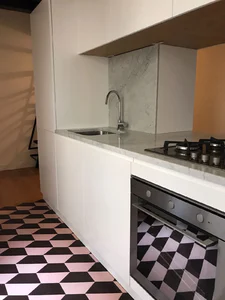
Knowing how to choose cement tiles comes down to five decisions, taken in this order: material, format, colour and pattern, how the room will really be used, and the laying method. A cement tile is a piece of pigmented cement, cold-pressed and never fired, with a colour layer several millimetres thick; that layer is what takes the wear, and it shapes every other decision.
This guide works through those decisions with hard data: the table of formats we make in Seville, the laboratory tests on each material and the mistakes that prove expensive.
What exactly is a cement tile?
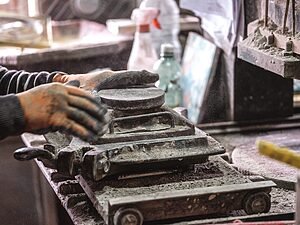
It is a tile of coloured cement that hardens by setting, not by firing. It is made by pouring the pigments, mixed with white cement and marble powder, into a divider—the metal template that keeps each colour apart—then covering them with sand and Portland cement and compacting it all in a hydraulic press.
The technique emerged in the second half of the nineteenth century as a way of making floor tiles without burning firewood, and the method has barely changed since. That explains what matters when you choose one: the pattern is not printed on the surface; it is part of the material itself. The full process is explained in how cement tiles are made.

In Spanish it is also called mosaico hidráulico, suelo hidráulico, pavimento hidráulico, losa or loseta; in English you will also come across encaustic cement tile or hydraulic tile. What it is not, under any circumstances, is ceramic.

Genuine cement tile or porcelain imitation: how to tell them apart
Much of what is sold today as cement tile is in fact porcelain with a printed pattern. It is worth knowing which one you are looking at before you compare prices:
- Thickness: a cement tile is between 1.5 and 1.8 cm thick; decorated porcelain stays at 8–10 mm.
- Colour layer: in a cement tile the pigment goes several millimetres deep; in porcelain it is a print under the glaze.
- Repetition: porcelain repeats a limited number of faces; every cement tile comes out different.
- Edge and back: a cement tile shows grey mortar and a crisp, unglazed edge.
- Absorption: porcelain is below 0.5%; handmade materials are well above that, which is why they are treated with a water-repellent.
Porcelain needs less maintenance; cement tiles give you one-of-a-kind pieces, made-to-measure patterns and a finish that gains patina over the years. You will find the designs in our cement tile catalogue.
Which material is right for you: cement tile, terrazzo, zellige or terracotta?
It depends on where the tile will go and how much water and wear it will have to take. The way to compare them without resorting to adjectives is to look at the test results. These are the figures from our test reports from the Elabora laboratory (no. AND-L-155 in the register of testing laboratories of the Junta de Andalucía, the Andalusian regional government), with porcelain stoneware added at the end purely as a market reference:
| Material and format tested | Reference standard | Result published in the report | Report no. |
|---|---|---|---|
| Cement tile 200 × 200 × 15 mm | UNE-EN 1339 (concrete) | Tested as a concrete tile: it sets, it is not fired | 9102 (28/05/2024) |
| Hydraulic terrazzo 200 × 200 × 18 mm | UNE-EN 1339 · UNE-EN 13748-1/2 | Absorption 5.9–6.2% · slip resistance Rd 59.5 (class 3) | 4718 (22/03/2021) |
| Glazed zellige 100 × 100 × 12 mm | UNE-EN ISO 10545 (ceramics) | Absorption 15.7% · abrasion class 3 (750 revolutions) | 9103 (28/05/2024) |
| Terracotta 150 × 50 × 15 mm | UNE-EN ISO 10545 (ceramics) | Absorption 16.9% · bending strength 8.7–10.3 N/mm² · chemical resistance class A | 7539 (13/05/2022) |
| Porcelain stoneware (market reference) | UNE-EN 14411 | Absorption below 0.5% | — |
Absorption settles more decisions than any other figure: it governs how a tile copes with stains and frost, because water in the pores expands as it freezes and breaks the tile from the inside. A zellige tile at 15.7% and a terracotta tile at 16.9% definitely need a water-repellent; hydraulic terrazzo, at around 6%, behaves differently. The full reports are on our laboratory tests page.
One point that is often overlooked: cement tiles and terrazzo are tested as concrete tiles; zellige and terracotta, as ceramics. Expecting a ceramic classification from a cement tile means comparing figures that are simply not comparable.
Which tile format should you choose for each room?
The format has more effect on the result than the pattern. A rule of thumb: the smaller and more awkwardly shaped the room, the fewer cuts the layout should involve; over large areas, a big format gives continuity and reduces the number of joints. These are the formats we make:
| Type | Ref. | Size | Weight per tile | Tiles per m² |
|---|---|---|---|---|
| Square | H02 | 25 × 25 × 1.8 cm | 2.30 kg | 16 |
| Square | H03 | 20 × 20 × 1.5 cm | 1.30 kg | 25 |
| Square | H04 | 15 × 15 × 1.5 cm | 0.79 kg | 45 |
| Square | H06 | 10 × 10 × 1.5 cm | 0.35 kg | 100 |
| Rectangular | H11 | 30 × 15 × 1.6 cm | 1.45 kg | 23 |
| Rectangular | H13 | 20 × 10 × 1.5 cm | 0.62 kg | 50 |
| Hexagonal | H21 | 30 × 20 × 1.7 cm | 1.62 kg | 21 |
| Hexagonal | H22 | 23 × 20 × 1.5 cm | 1.16 kg | 29 |
| Octagonal | H31 | 20 × 20 × 1.5 cm | 1.14 kg | 25 |
| Laghaz | H41 | 20 × 17 × 1.5 cm | 0.62 kg | 50 |
| Labrys | H51 | 30 × 20 × 1.5 cm | 1.35 kg | 25 |
| Chakar | H61 | 20 × 17 × 1.5 cm | 0.58 kg | 50 |
| Diamante | H71 | 28 × 16.5 × 1.6 cm | 0.72 kg | 44 |
| Tile insert | H07 | 7 × 7 × 1.5 cm | 0.25 kg | 205 |
| Plain skirting | HR01 | 20 × 10 × 1.5 cm | 0.66 kg | 5 pcs / linear metre |
Weight matters: a square metre of 25 × 25 tiles comes to around 37 kg, which has a bearing on transport and on wall cladding. The full list of formats adds the 14 × 14, the 25 × 10, the small hexagon and all the skirting pieces.
Less conventional formats
The 20 × 20 is the most requested, but not always the best:
- Hexagonal: breaks up the grid and creates a continuous honeycomb. It works in bathrooms and entrance halls and lends itself to mixing colours.
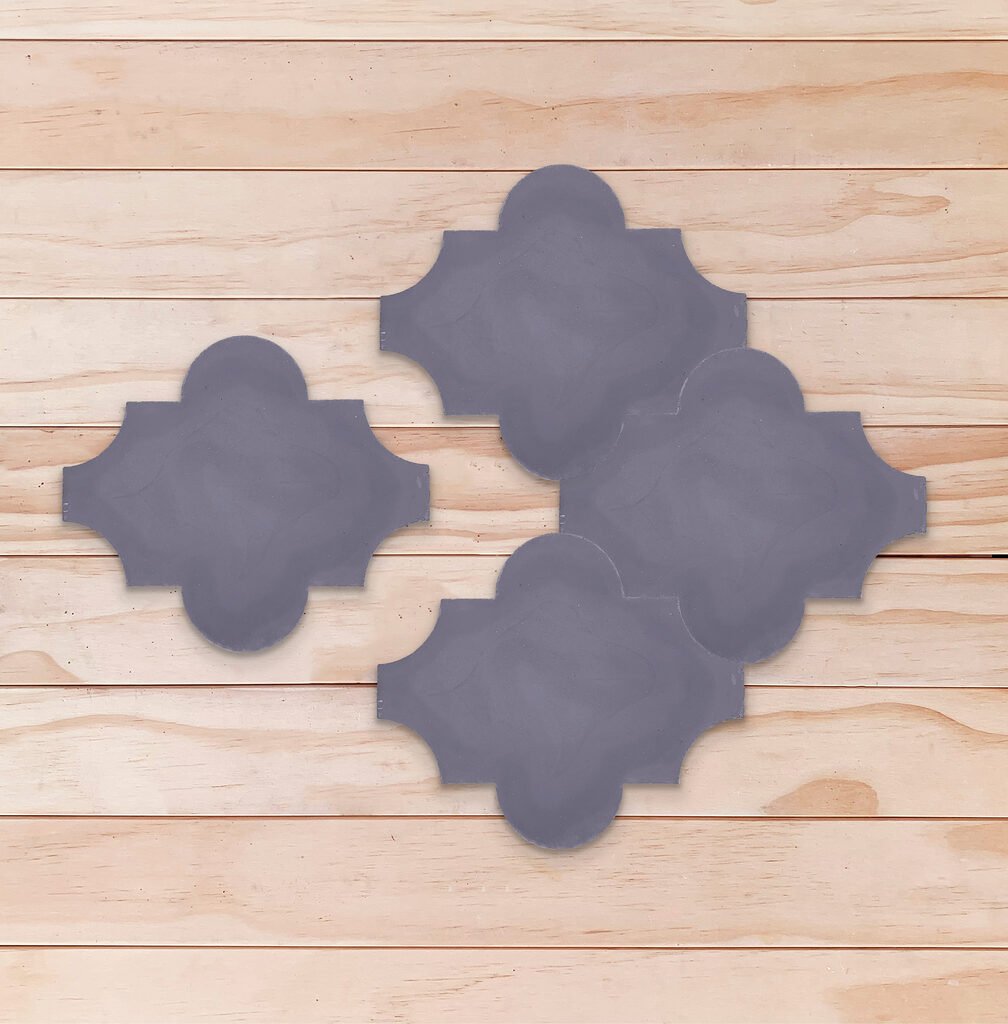
- Laghaz and Chakar: curved outlines that interlock and create a pattern from a single colour. The Chakar cement tile needs no border.
- Diamante and Labrys: create three-dimensional effects depending on how the colours are combined.
- Octagonal: the genuine article has tile inserts at the corners; an octagon simulated within a 20 × 20 tile is not the same thing.
- 7 × 7 tile insert: a small finishing piece, to combine with terracotta or to set into a grid of large tiles.
How do you get the colour and pattern right?
First decide what role the floor will play: backdrop or centrepiece. If it is the centrepiece, the wall tiles and joinery should take a step back; if it is the backdrop, go for a single colour or a low-contrast pattern. Our colour chart has 49 colours, from MC1 to MC49, and any design can be recoloured with them.
A word of warning about single-colour tiles: because the whole tile is one colour, variations in shade show more than on a patterned design. It is not a defect but a consequence of pressing each tile individually; still, it is worth knowing before you order a large expanse of plain tiles.

That is the advantage over a mass-produced floor: you can start from a catalogue design and change its colours, or draw a new pattern and have its divider made. Formats and designs can also be combined in the same floor—a tile rug in the centre, plain tiles around it and a border as the transition—to mark out areas without putting up partition walls.
Before you settle on a colour, look at a physical sample in the light of the room itself and next to the grout you plan to use: a grey joint and a white one change the way the pattern reads.
Can cement tiles go in kitchens, bathrooms, on stairs or outdoors?
Yes, in all four, under different conditions. They are used on floors and as wall cladding, and also on stairs, benches, fountains, headboards and tables; there are more examples in where to use cement tiles.
In kitchens and bathrooms the limiting factor is not wear but stains: grease, oil, cleaning products. The answer is a water-repellent applied before grouting and neutral soap for cleaning, never acids, least of all hydrochloric acid.

On stairs they perform very well: patterned risers and plain or terracotta treads give plenty of impact from very little surface.

Outdoors, the Spanish Building Code (CTE) sets the rules: its Basic Document DB-SUA 1 requires a minimum slip resistance depending on the area. The Rd value is measured with a friction pendulum, as set out in the Spanish standard UNE 41901:2017 EX, and falls into four classes:
| Rd value (PTV) | Class | Where it is required |
|---|---|---|
| Rd ≤ 15 | Class 0 | Not valid anywhere: the CTE requires at least class 1 |
| 15 < Rd ≤ 35 | Class 1 | Dry indoor areas with a slope of less than 6% |
| 35 < Rd ≤ 45 | Class 2 | Dry indoor areas with a slope of 6% or more and stairs; wet indoor areas (entrances, bathrooms, kitchens) with a slope of less than 6% |
| Rd > 45 | Class 3 | Wet indoor areas with a slope of 6% or more and stairs; outdoor areas, swimming pools and showers |
Our 20 × 20 cm hydraulic terrazzo reached a PTV of 59.5 in wet conditions at 20 °C: class 3, the top of the scale, according to test report no. 4718. That figure applies to that product and that format; for any other design, ask for its own test report. Also check that the area does not suffer frequent frosts and that there is a fall and drainage: standing water damages any porous material.
How many tiles should you order, and in what sequence do you decide?
You place the order at the very end. This is the sequence that saves you from redoing your sums:
- Define the use of each area: indoor or outdoor, dry or wet, domestic or public foot traffic. That alone rules out some materials.
- Choose the format and set out the layout on the plan: where the cuts fall and whether there is a border or a tile rug.
- Finalise the design and colours with a physical sample in your hand, seen in the room itself.
- Measure the actual area zone by zone and add up the linear metres of skirting separately.
- Convert to tiles using the tiles-per-m² column: 25 for the 20 × 20, 29 for the hexagon, 205 for the tile insert.
- Add wastage: around 10% for simple layouts, and more with diagonal cuts or irregular rooms.
- Order everything in one go and keep spares: tiles from the same batch keep the same shade and will take care of any future repair.
Production lead times, minimum quantities per design and colour availability are worth confirming with the workshop before you fix dates for the building work.
What should you plan for when it comes to laying and maintenance?
Cement tiles are not laid like porcelain, and that is where many of the problems come from:
- A flat, clean, dry substrate, with the residual moisture in the screed under control.
- A dry lay-out first, mixing tiles from several boxes to spread the variation in shade.
- A minimal joint, but a joint all the same: butt-jointed, the floor cannot absorb movement.
- Water-repellent before grouting: this is the step that prevents the most stains, because it stops the grout from staining the pores.
- Carefully chosen grout: the colour of the joint counts as much as the colour of the tile.
- Acid-free cleaning, with neutral soap, and periodic resealing depending on use.
Each stage is covered in our guide to laying cement tiles; cleaning and protection routines, in how to clean and care for cement tile floors.
Costly mistakes when choosing tiles
- Choosing the pattern before thinking about use, then finding that the material is not up to the job there.
- Ordering the exact area and no more, or topping up the order weeks later from a different batch.
- Grouting a porous material without a water-repellent and then having to rescue the floor.
- Deciding on the colour from a photo on screen instead of a physical sample.
- Forgetting the finishing pieces: skirting, borders and tile inserts are calculated separately.
If you want to add environmental criteria to use, format and colour, the comparison between materials is in the environmental impact of tiles.
Frequently asked questions about how to choose cement tiles
What else is a cement tile called?
In English it is also known as an encaustic cement tile or a hydraulic tile. In Spanish, mosaico hidráulico, suelo hidráulico, pavimento hidráulico, losa and loseta hidráulica are common synonyms, and in some regions rachola is used as a generic term. They all refer to the same tile of pigmented, pressed cement. What it should not be called is ceramic, or azulejo, the Spanish word for a glazed, fired tile: it is not fired; it sets.
What is the most common format, and how many tiles go into a square metre?
The 20 × 20 × 1.5 cm square, reference H03, with 25 tiles per square metre and 1.30 kg per tile. It is followed by the 25 × 25 (16 tiles) and the 23 × 20 hexagon (29 tiles). At the small end of the range, the 7 × 7 tile insert takes 205 pieces per square metre.
Can cement tiles be used on a staircase?
Yes, and it is one of the places where they perform best: the riser carries the pattern and the tread is left plain or in terracotta, so each step can have a different design. Check the nosing detail and the slip resistance of the tread.
Are cement tiles slippery?
It depends on the finish and the format, and only a test can settle it. Our 20 × 20 cm hydraulic terrazzo achieved a PTV of 59.5 in wet conditions, CTE class 3, according to test report no. 4718. That value cannot be extrapolated to other designs: on small tiles the pendulum does not even fit, as it needs a sliding area of 124 × 76 mm.
How many extra tiles should you order?
Around 10% over the measured area for simple layouts, and more when there are diagonal cuts, borders or irregular rooms. On top of that wastage, it is worth adding a few spare tiles: they come from the same batch and let you repair a breakage years later without the patch standing out.
Are cement tiles suitable for outdoor use?
Yes, subject to three checks: slip resistance in line with DB-SUA 1, protection with a water-repellent and an area without frequent frosts. Water in the pores expands as it freezes and breaks the tile from the inside, so in cold climates the material has to be assessed case by case.
Once you have decided on the use and the format, ask for samples of the design and colours you are considering and check them in the room itself. If time is tight, our cement tiles in stock include designs you can have without waiting for production.