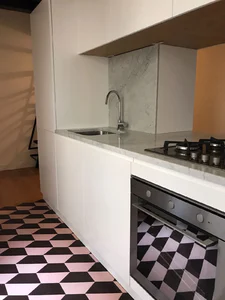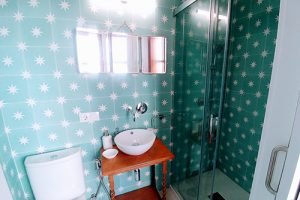
A real cement tile carries its pattern inside the piece: cement, marble powder and mineral pigment pressed cold, never fired. A cement-look floor is a porcelain tile with the pattern printed on the surface, under the glaze, and fired in a kiln. Thickness, edge, back, where the colour stops and the standard that applies to each are what tell them apart.
“Cement tile” now names both a material and a printed effect, and nobody warns you which of the two you are being shown. These are the checks that settle it.
What is the real difference between a cement tile and the porcelain that copies it?
The difference is not the pattern, it is where the pattern sits. In an encaustic cement tile the colour is matter: pigment mixed with cement and marble powder, filling the top millimetres of the piece. In porcelain it is an image printed onto a fired body and protected by a layer of glaze.
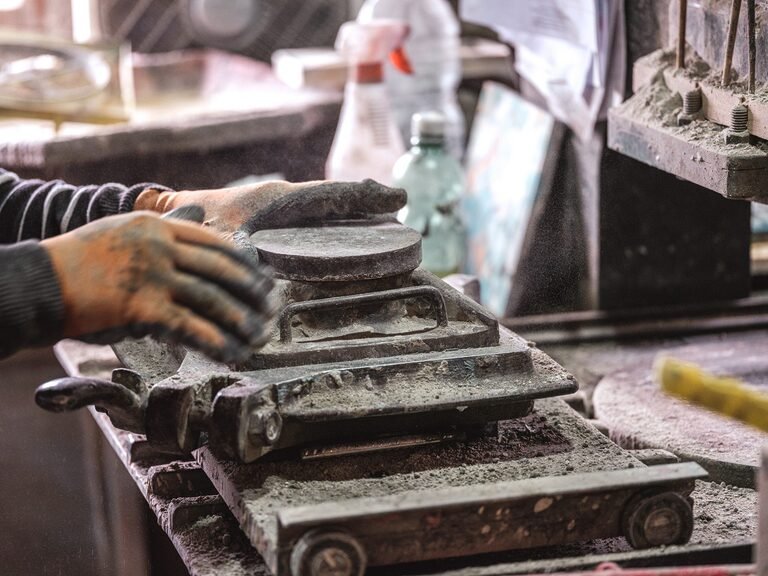
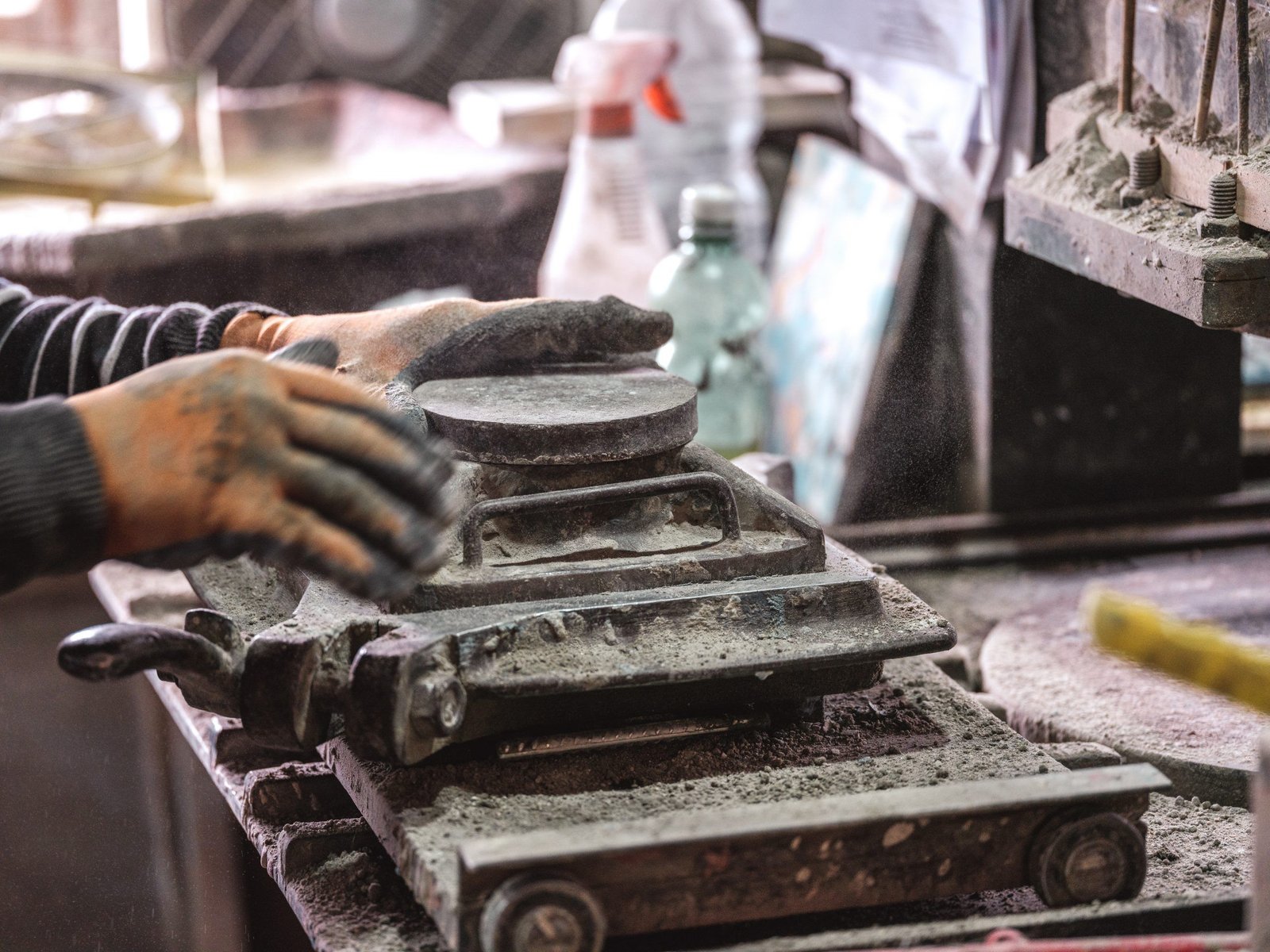
A cement tile is formed cold. The brass mould that keeps the colours apart is filled with the pigmented pastes, the bonding layer and the mortar base go on top, and the whole sandwich goes under the press. That colour layer, the wear layer, is usually between 3 and 5 millimetres thick. The tile then cures with water for weeks: cement is not fired, it sets.
Porcelain works the other way round: spray-dried ceramic powder, pressing, digital printing, glaze and firing above 1,100 °C. The kiln vitrifies the piece and leaves it practically impervious. It is an excellent product; it simply is not the same one.
| Criterion | Real cement tile | Porcelain look-alike |
|---|---|---|
| Where the pattern is | In the body, in a wear layer of some 3 to 5 mm | Printed on the surface, under the glaze |
| Process | Cold pressing and water curing; no kiln | Pressing, digital printing and firing |
| Usual thickness | 15 to 18 mm in our formats | 8 to 11 mm; 20 mm in outdoor series |
| Weight of a 20 × 20 cm piece | 1.30 kg (format H03) | Lower, in proportion to its smaller thickness |
| Water absorption | Porous: it absorbs water and is protected with a sealer | Below 0.5 % in porcelain stoneware |
| Standard that applies | UNE-EN 1339, the Spanish version of EN 1339 (concrete paving flags) | UNE-EN 14411, with UNE-EN ISO 10545 test methods |
| Variation between pieces | Real: the shade changes from one tile to the next | Simulated: a limited number of graphics per series |
| Repair | Piece by piece; the mould can be used again or made again | Depends on the series still being in the catalogue |
| Wear | The pattern runs through the wear layer and does not rub off | Wear attacks the glaze and clouds the pattern |
How do you spot a cement-look porcelain tile with the piece in your hand?
A loose tile, two minutes and no tools at all. These seven checks are listed in order of reliability.
- Measure the edge. A cement floor tile is 15 to 18 mm thick; a porcelain floor tile, 8 to 11 mm, apart from the 20 mm outdoor series. If the piece is thin and light, it is not a cement tile.
- Look at a chip or a cut. This is the decisive test. In a cement tile the colour carries on inwards for several millimetres and then gives way to the grey of the mortar base. In porcelain it stops dead: underneath appears the body, a uniform white or cream.
- Turn it over. The back of a cement tile is bare concrete, rough, with the aggregate in view. The back of a porcelain tile is homogeneous ceramic with the relief of the mould grid and, almost always, the name of the factory.
- Tilt it against the light. A cement tile is mineral matt and feels the same all over its surface, pattern included. Glazed porcelain throws back different reflections depending on the angle, and its micro-texture does not always line up with the printed pattern.
- Count how many different patterns there are. A porcelain series has a closed number of graphics and repeats them identically. In cement tiles the pattern repeats but the shade does not: two tiles of the same model are never quite alike.
- Look at the edge and the joint. Rectified porcelain has a square edge and takes perfectly regular 2 mm joints. A cement tile has a sharp arris, slight variation in size and is laid with a minimal joint.
- Put a drop of water on a loose piece or on an untreated offcut. On an unsealed cement tile the mark darkens the surface and takes a while to go; on porcelain it sits on top.
An eighth clue: weight, from 0.25 kg for the 7 × 7 cm insert to 2.30 kg for the 25 × 25 × 1.8 cm piece. Every reference is listed in our cement tile format table.
Can you see the difference once the floor is laid?
Standing up, two metres away, with a good porcelain series, barely. One metre away, crouching, in raking light, always. Three things give away a cement-look floor once it is down.
- The repetition. A real cement floor has a veil of shade that shifts from one area to another, because every batch of paste comes out slightly different. Porcelain repeats the same graphic every few pieces, with the same grain and the same marks.
- The joint. Cement tiles are laid with a minimal joint; rectified porcelain leaves a grid far too perfect for a material that is supposed to be handmade.
- How it ages. A fifty-year-old cement floor still shows its pattern even after losing its sheen: wear polishes the wear layer but does not take it away. On glazed porcelain, wear clouds the pattern and the arrises begin to show the body underneath.
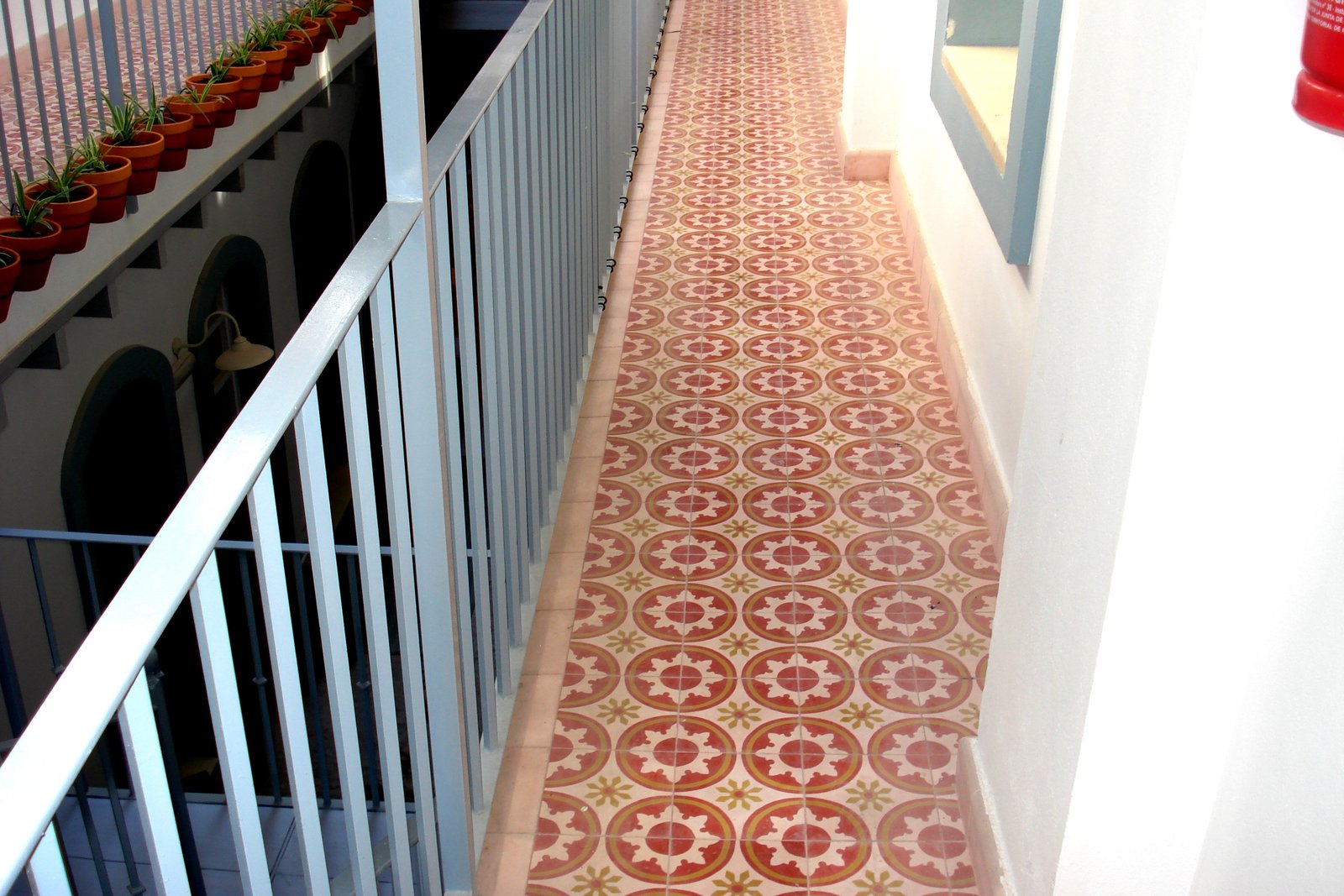
Which standard applies to each, and why it pays to know?
Cement tiles come under UNE-EN 1339, the standard for concrete paving flags; porcelain, under UNE-EN 14411, with the test methods of the UNE-EN ISO 10545 series. UNE-EN is simply the Spanish version of the European standard, so the equivalents are EN 1339 and EN 14411. They are not equivalent to each other, and their figures do not compare.
It is a frequent mistake in specifications: asking a cement tile for a ceramic absorption group, or demanding of a ceramic tile the classification of a concrete flag. We publish the full test reports, with number, sampling date and standardised method; ask us for the ones that concern your project. The cement tile was tested in report no. 9102, on a 200 × 200 × 15 mm piece, under UNE-EN 1339:2004; its absorption coefficient is not among the published values, so you will not see it claimed here.
| Material | Water absorption | Test | Standard applied |
|---|---|---|---|
| Hydraulic terrazzo 20 × 20 cm (Demosaica) | 5.9 – 6.2 % | Report no. 4718 | UNE-EN 13748-1 |
| Glazed zellige 10 × 10 cm (Demosaica) | 15.7 % | Report no. 9103 | UNE-EN ISO 10545-3 |
| Terracotta 15 × 5 cm (Demosaica) | 16.9 % | Report no. 7539 | UNE-EN ISO 10545-3 |
| Porcelain stoneware (industry reference) | Below 0.5 % | — | UNE-EN 14411, group BIa |
Every figure in the table belongs to the material that was tested and does not carry over to the others. The PTV of 59.5 measured with the wet pendulum — class 3, the top of the scale in the Spanish Technical Building Code and the class its Basic Document DB-SUA requires for outdoor areas, swimming pools and showers — belongs to the 20 × 20 cm hydraulic terrazzo, report no. 4718, not to the cement tile. If the specification calls for a particular class in cement tiles, that format has to be tested.
And what about porcelain that imitates terracotta?
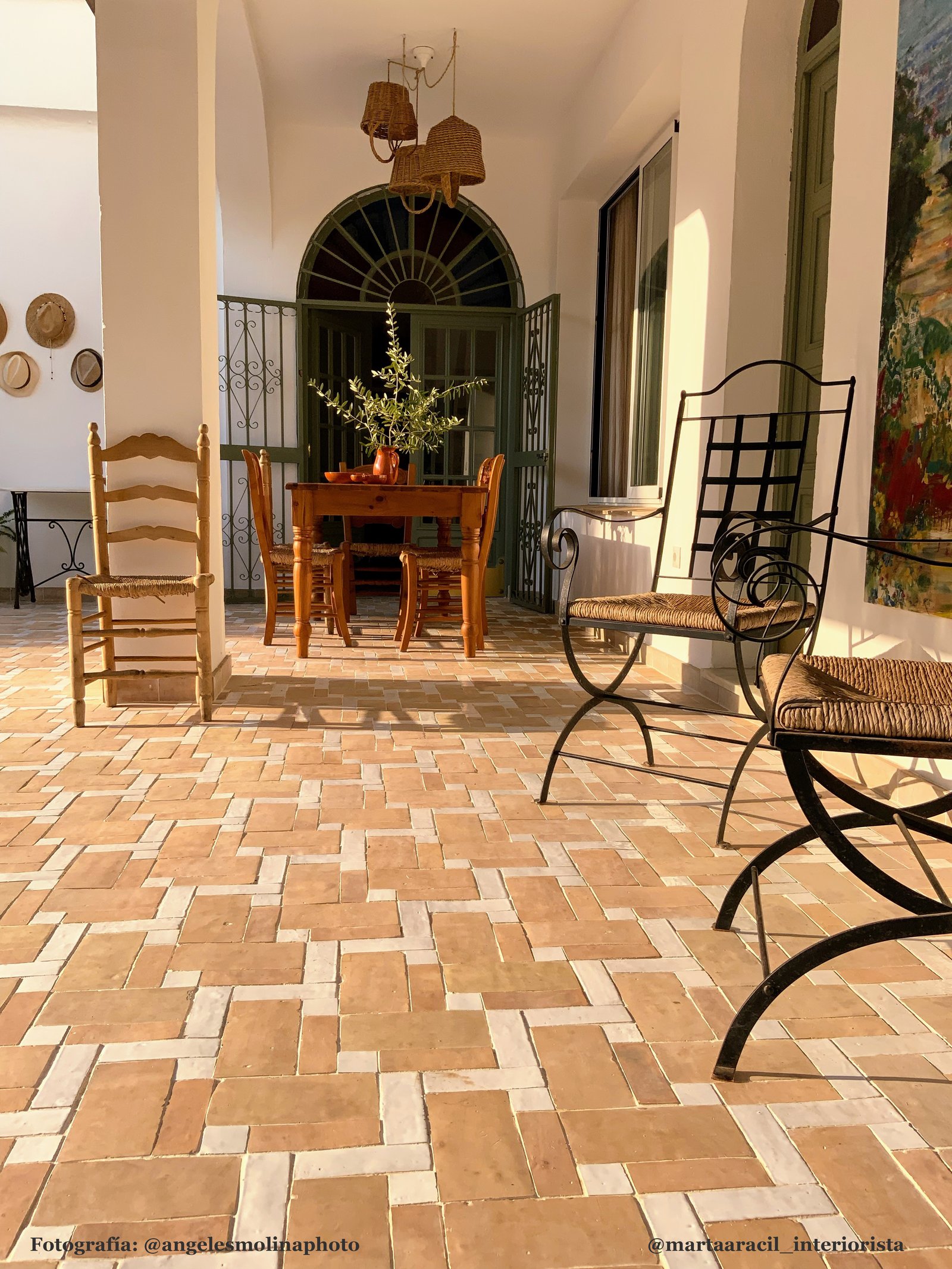
The mechanism is identical and only the copied material changes: terracotta is moulded, fired clay, very porous; terracotta-effect porcelain is impervious stoneware with a photograph of terracotta printed on top.
The figures for terracotta are eloquent: our 15 × 5 cm terracotta returned 16.9 % absorption, a flexural strength of 8.7 to 10.3 N/mm² and stain classification 2, all in report no. 7539. That 16.9 % explains why terracotta is always sealed, and why in areas of repeated frost it has to be laid with judgement.
The same checks tell them apart, with two nuances: the edge of a real terracotta keeps its earthy colour right through the thickness, and its dimensions wander from piece to piece because drying and firing shrink each one in its own way. A terracotta-look floor is calibrated, and the colour stops at the glaze.
When does it make sense to choose porcelain?
Often, and it is worth saying so from a workshop that makes the other thing. It is the reasonable option in these cases:
- Outdoors exposed to repeated frost with nobody to look after the floor: its almost nil absorption is what that scenario needs.
- Large areas on a tight budget. A mass-produced product starts from a lower cost per square metre than a tile pressed one at a time.
- Premises washed daily with aggressive products. Acids and bleach attack cement; glazed stoneware puts up with them far better.
- Large formats. Pieces of 60 × 60 cm or more with a 2 mm joint are porcelain territory.
- Refurbishment where the floor level is tight. From a 9 mm porcelain tile to a 17 mm cement tile there is almost a centimetre of difference: doors that catch and steps that stop complying.
When is a real cement tile worth it?
When the floor has to last decades, be repaired without a building site and look like no other. Five specific situations:
- Refurbishment and heritage. If half a room of an old floor is missing, the model can be reproduced by making the brass mould again. With a discontinued porcelain series there is nothing to be done.
- Your own design. Pattern, colours and format are chosen separately; you do not depend on what a factory released this season.
- Repair piece by piece. The broken tile is lifted and another one from the same mould goes in, even ten years later.
- Formats that ceramics do not cover. Hexagons, octagons, 7 × 7 cm inserts or interlocking pieces such as the Chakar cement tile, plus skirtings and borders in the same material and colour.
- A floor that improves with use. Wear polishes the wear layer and gives it that muted sheen of the floors in the courtyard houses of Seville.
How can you be sure that what you are buying is what you think it is?
By asking for the technical data sheet, the test report and a physical sample. It is the quickest way to settle the doubt before signing an order:
- Ask for the data sheet with the framework standard: if it says UNE-EN 14411 or ISO 10545 it is ceramic; if it says UNE-EN 1339 or UNE-EN 13748, it is concrete.
- Ask for the test report with number, date and laboratory, not a table of values with no origin.
- Ask for a physical sample and run the seven checks on it: no photograph replaces looking at the edge.
- Ask about future replacement: if you need twenty more pieces in five years, can they be made, or does it depend on the catalogue?
Frequently asked questions about real cement tiles and imitations
What exactly is a cement-look floor?
It is a ceramic floor, almost always porcelain stoneware, that reproduces the patterns of the traditional cement tile by digital printing. The pattern sits on the surface, under the glaze, and the piece has been fired in a kiln. Aesthetically it can come very close; technically it is another material, with another standard and another thickness.
How do I know whether the old floor in my house is a real cement tile?
Look for a broken piece, a chip or the cut around a floor grille. If the colour carries on several millimetres inwards and grey mortar then appears, it is a cement tile. Check the thickness too where the floor meets a door: under 12 mm points to ceramic. Irregular shades point to authentic material.
Are cement tiles suitable outdoors, or only porcelain?
They work in sheltered, well-detailed Mediterranean outdoor settings, with a sealer and good drainage. Where it is not worth the risk is in areas of repeated frost: water lodged in the pore expands as it freezes and breaks the piece from the inside. The only slip test we have published is the one for hydraulic terrazzo (class 3, report no. 4718); for cement tiles, ask for the test on the format you are going to lay.
Can a broken cement tile be repaired without lifting the floor?
Yes. The damaged piece is chipped out carefully, the bed is cleaned and another tile of the same model and format goes in, grouted in the same shade. That is why it is worth keeping a small surplus from the job; if none is left, it can be made again from the mould.
Does terracotta-look porcelain need a sealer?
No. Porcelain stoneware absorbs less than 0.5 % water and neither takes nor needs a water-repellent treatment. Real terracotta does: our 15 × 5 cm terracotta returned 16.9 % absorption in report no. 7539, and its stain classification 2 explains why.
Which works out cheaper, the cement tile or the imitation?
Per square metre of material, the industrial imitation starts from lower prices than a tile pressed one at a time. An honest comparison also takes in service life and the possibility of repairing and replacing years later. Ask the workshop for a quotation with the format, the model and the real square metres.
If you are still in doubt, the fastest route is to have the piece in your hand: ask for a sample, look at its edge and its back, and compare it with our cement tile catalogue. At our Seville showroom you can see and touch them by prior appointment.